Driving Conversation

629284F7-3B1B-406D-AEE4-EE2F489A2FCE
Snow comes early to the Tatra Mountains that separate Slovakia and Poland.

When traveling east or west across the European continent, trains are the ticket.  But should you wish to travel north or south, rail travel is often challenged by natural barriers between countries…..a series of mountain ranges; so alternatives can make travel in these directions more efficient.

As a result, three times during our extended European holiday we employed a driver for transport from one country to the next.  Three handsome young men who are well-educated, interested in people and travel, optimistic and articulate, even in English.  We traveled comfortably and learned as we listened.

For example…..which is a phrase each driver used frequently as he searched for the English words to communicate his thoughts…..each young man expressed opposition to the entry of immigrants and refugees into his country.  One driver lives in Hungary, the second in Slovakia, the third in Poland; but all three had the same reservations: fear for what they said was a violent minority within these groups, and frustration for what each young man perceived was a reluctance of newcomers to learn the language and to assimilate into the customs of their new country.

The community where I live in the USA has fewer fears and frustrations.  This is understandable because our town is many thousands of miles more removed from most of the source countries for displaced populations, but more importantly it’s because my community knows it NEEDS immigrants and refugees to fill jobs, housing and schools.

Helping to fill the public school classrooms of my home community are students from more than 60 nations.  More than 50 different languages are spoken.  Our Refugee Development Center is contacted almost daily by employers looking for newcomers to fill job openings, and the RDC’s English classes are filled to capacity by refugees hungry to learn.  They show up for class even when schools are closed for holidays and storms!

I won’t pass judgement on the attitudes of people in other countries.  I didn’t criticize the drivers.  Rather, I said several times to each driver…..so that it might make an impression…..that a country as blessed as the USA has the capacity and thus moral obligation to do more than it is doing now to respond to the current world-wide humanitarian crisis.  I wanted these young men to consider that the USA is not a great nation when it reduces entrance of legal, fully-vetted refugees to the lowest number for any of the 28 years of the US State Department’s modern tracking of refugee resettlement (now down to one-tenth of the number admitted in 1980), but when America’s actions to help correspond more closely to its capacity to help.

”Greatness” does not describe a nation which resorts to doing its least ever when the world-wide need calls for that nation to do the most ever.

JER
Krakow

9562F4CF-1591-4C55-82E7-7788B37A78A3
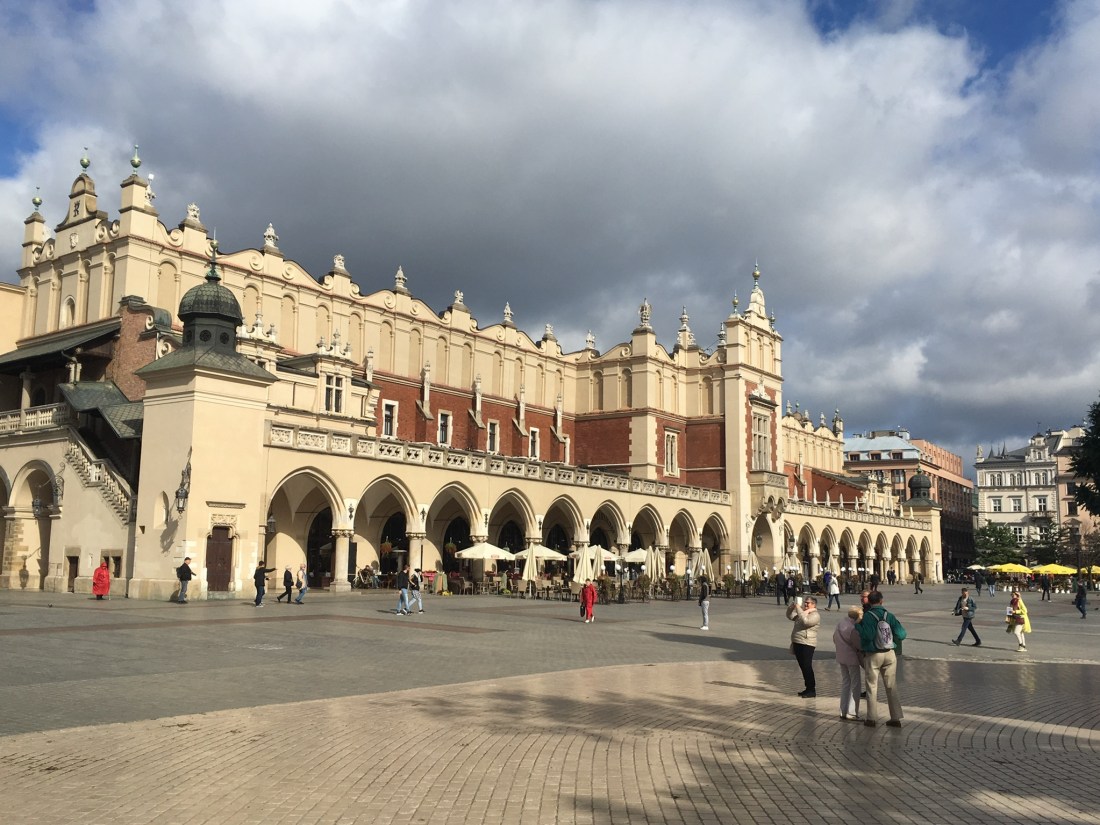
Cloth Hall is the centerpiece of old town Krakow’s massive main square.

The cafe culture of Krakow, in southwest Poland, is second to none.  Not even Vienna exceeds it in terms of cafe density, ambiance and heritage.  We enjoyed cappuccinos in an establishment opened in 1364…..that’s not a misprint……Wierzynek Cafe.  Now in its eighth century of operation, the cafe has evolved into four opulent floors of luxury dining…..and expensive coffee.

Krakow’s “old town” is also unmatched, in my experience, because of two features.  It is surrounded by a refreshing green ring…..a 200-yard wide wooded park that circles the walled city.  And in the center is Europes’s largest old town main square, called Rynek Glowny.  A dozen football fields could fit within the perimeter of cafes and cathedrals…..the University of Michigan’s 107,000-seat capacity “Big House” could be dropped inside with room to spare. What actually IS situated within this massive market square is Cloth Hall.  Erected in the Gothic style in the 13th Century and “remodeled” in the Renaissance fashion of the 16th Century, Cloth Hall is touted as the world’s oldest shopping center, although I’m betting there are dozens more ancient commercial centers on other continents that are less traveled and promoted.

Many people also visit Krakow for two near-by “attractions.”  One is Wieliczka Salt Mine south of Krakow which opened in the 13th Century and ended its salt mining operations only 11 years ago.  Generations of miners have created more than 150 miles of tunnels and shafts…..most by hand, some with the help of horses and mules, and only during the last century with motorized machinery.  I was shocked to learn that dwarfs were once “employed” in these mines, but I imagine their experiences were not as idyllic as portrayed in the Grimm fairy tale and Disney production of ”Snow White and the Seven Dwarfs.”  Probably wasn’t much “whistle while you work.”

As is the case in many central and eastern European cities, Krakow has a Jewish Quarter which, like many others, was once a comfortable neighborhood, then forced to become a compacted slum, and now has rebounded to attract artists, entrepreneurs and tourists.  But drawing more attention by visitors to Krakow are the remains of the Auschwitz concentration camp west of Krakow.  It was operated by Nazi Germany when it occupied Poland during World War II.  Auschwitz is actually just one of nearly four dozen forced labor, concentration and/or extermination facilities in this region that terrorized Jews as well as ethnic Poles and even Soviet prisoners of war.  Well in excess of one million people perished in this network of camps during less than five years.

So,  like many other central and eastern European cities, Krakow is pleasing to the eye but disturbing to the conscience.

JER


Polish Roots

0B0D4A02-B8F9-4628-8F49-AC75F85EE653
The traditional Polish paczki.

Across the street where I lived for the first years of the childhood I remember was a statute of Casimir Pulaski.  He fought unsuccessfully against Russian occupation of Poland and then, with the assistance of Benjamin Franklin, joined the War of Independence in America.  Pulaski is credited with saving the life of then General George Washington during the Battle of Brandywine in 1777.  Pulaski reformed the American cavalry and demonstrated its superiority over infantry.  Although he died at the age of 34 during a battle in Savannah, Pulaski is one of only eight persons ever to be conferred honorary citizenship by the US Congress…..President Obama signed that action into law in 2009.

The population of the town where I was born and raised was, while I lived there, more than fifty percent of Polish descent.  If their grandparents hadn’t shortened their names to a single syllable, many of my classmates and teammates had last names with long, complicated spellings……the kind that most people mispronounce but I find easy to state correctly.

So when we arrived in southern Poland this summer, my wife thought I might be able to communicate with the locals.  But I could not, except by pointing and smiling.  When I consulted with a guidebook to brush up on Polish words for everyday transactions, I was stumped.  The spellings looked like random collections of letters.

One Polish word I did know was the word for “thank you.”  But when I checked with the guidebook, the letters did not look at all like the sounds I knew I was supposed to make.

Many people where I now live in the USA know one Polish word…..”paczki,” pronounced “ponch-key”…..the almost softball-shaped, fried and filled pastry popular on “Fat Tuesday” prior to Lent.  That’s the only time each year when these treats are available for purchase where I live.  But in southern Poland this summer we found these caloric catastrophes for sale everyday, everywhere, in both large towns and small…..even at a hut in a meadow near the end of our four-hour hike in the Tatra Mountains…..a blueberry paczki for “sugar replacement therapy,” we rationalized.

JER

Repeating History

629BEBAB-EA13-4C2B-888F-A163AC1D7EF0
The Singing Fountain in Kosice, Slovakia.

The last century has not been an easy one for the Czech Republic and Slovakia, and 2018 is an important year of remembrance.  It’s the 100th anniversary of the birth of the Czechoslovak state which existed prior to German occupation in 1938.  It’s also the 50th anniversary of the “Prague Spring,” a brief period of political liberalization during the dark decades of Soviet domination which ended with the fall of the Berlin Wall in 1989.

Shortly after Communism’s collapse, Kosice — pronounced (roughly) “Ko-sheet-seh” and located in southeastern Slovakia not far from the Hungarian border — began a resurgence that has turned the city’s core into a walker-friendly history lesson.  There is now a pedestrian-only passage stretching from Kosice’s modern inter-city train station, through an adjacent park to a pedestrian-only zone of shops, restaurants, a grand opera house, a lighted-choreographed fountain, and numerous restored 13th and 14th century churches, inside of what was once a medieval city with a wall to protect it from invasion by Mongol tribes.

Yes, that’s right.  Mongol tribes!  History is long here.  Portions of fortifications dating from the 13th Century have been preserved.

Kosice is home to the oldest annual marathon in Europe, conducted since 1924.  Discounting Athens’ connection to the original Olympic marathon, Kosice has the world’s second greatest marathon tradition, behind Boston’s celebrated race.

It’s a point of significant national pride that Kosice will co-host the World Ice Hockey Championships with Slovakia’s capital, Bratislava, in 2019.  And while this is an indication of how much has changed since Iron Curtain days, the recent Russian aggression in near-by countries suggests that, perhaps, the more things change the more they stay the same.

JER

Budapest

69BC1FB5-A338-464D-A8B2-4747117AFFB0
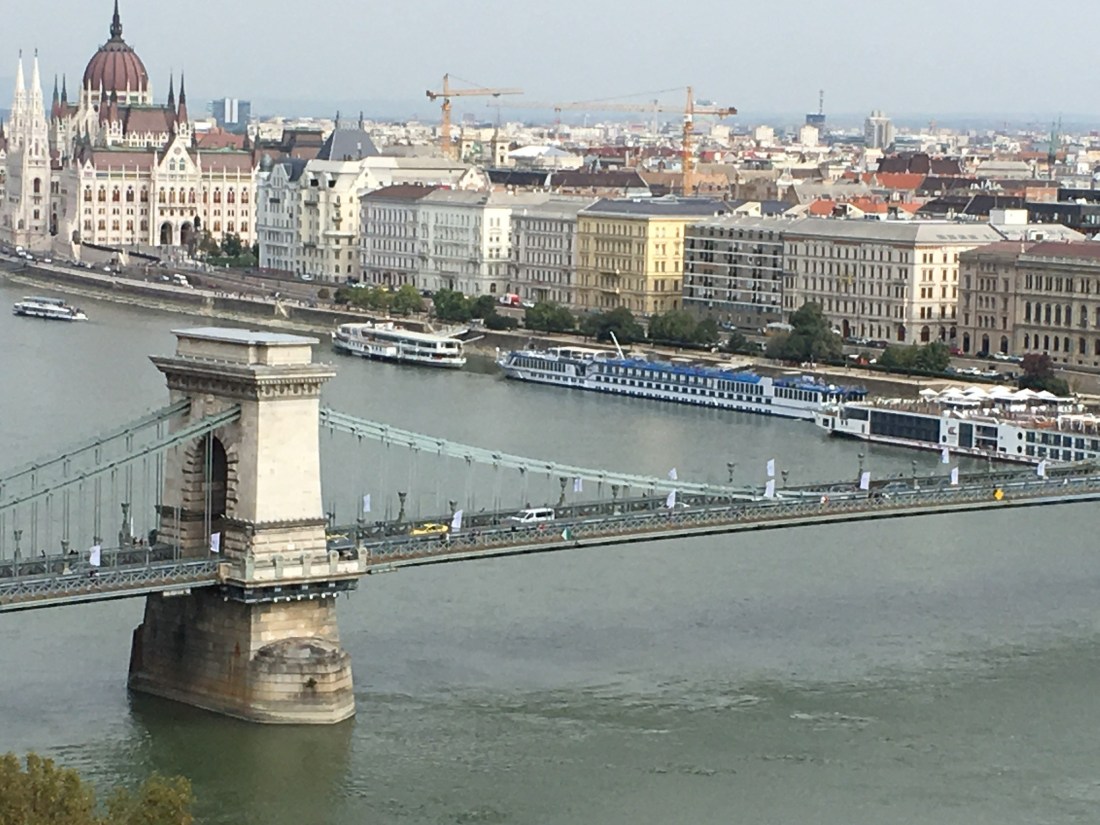
From Buda….the Chain Bridge spanning the Danube to Pest.

Hilly Buda and flat Pest are divided by the River Danube.  Maps make the cities seem stitched together by the ferry routes which crisscross the river.  Near the famous “Chain” Bridge — second oldest permanent span on the entire 1770 mile length of the Danube — the banks are lined by the stretch limousines of cruising vessels….long, low luxury river craft.

Budapest appears to have one foot in this century and one midway in the last.  Its Metro Line 1, which has a stop just outside the door of the apartment we rented, is the European continent’s oldest underground transportation system and has UNESCO designation and protection now.  Its trains are short….just two cars; its stops are frequent….just a few blocks between each; and its platforms are small.

Budapest’s antique but still operating central station for inter-city rail service may not have had a coat of paint in a hundred years.  It looks like a prop from one of Hollywood’s old western movie sets.

You can find on Budapest’s swankiest shopping boulevard a more than life-size poster of Steve McQueen.  He’s promoting watches for the near-by TAG Heuer boutique.  McQueen’s acting career peaked in the 1960’s; he’s been dead since 1980!

One can transact business either in the currency of the past, the Hungarian Forint, or with the Euro, the currency of the European Union which, like a lot of Europeans, Hungarians do not fully embrace.

Budapest has more litter and noise than Vienna.  It’s less pretty, polite and polished.  But its heart may beat with more palpable energy.  At least it did on the late summer weekend we arrived and found the streets closed and the plazas clogged with food trucks and picnic tables, street concerts, and hoards of strolling tourists and locals.

JER

Vienna

7337C785-307B-4BE6-B024-6825CA999B02
Vienna’s parks are more for the mind than the body..

Billy Joel’s 1977 single “Vienna” tells us Vienna is a patient city.  It waits for us.  And this summer, I finally got there.

Vienna’s core is upper crust.  Massive buildings shine like new, although many are centuries old.  Government buildings with steeples and bells are indistinguishable from churches; but unlike Prague, buildings and sculptures have not been allowed to turn black and stay that way.  Keeping things bright and almost white appears to be an occupation with job security in Vienna.

More than compensating for the massive stone and concrete structures are gardens of even grander dimensions throughout and surrounding Vienna’s central city.  Parks are intricately designed and carefully manicured.  There are more park benches than walkers in many of these green spaces, and people stroll and read more than they run and play.  Unlike Berlin, we saw no nudity in Vienna’s parks…..I suspect that would be too crude for this more buttoned up city.

Where Prague would have bars and pubs, Vienna has cafes.  The cheap-trinket tourist traps, so common in Prague, are absent from Vienna’s core.  Graffiti — ubiquitous in Hamburg, Berlin and Prague — is non-existent in Vienna’s core and rare in outlying areas. Same is true of litter.  Parks are pristine.

Vienna has wide, uncrowded pedestrian-only streets that provide more carefree passage than in Copenhagen and Prague.  However, venture off these streets and one is likely to have close encounters with bicycles whose riders seem to make a sport of scaring walkers.

Vienna’s cultural heritage is second to none, and I think its locals know that.  Vienna is the home or principal workplace for many famous composers, including Beethoven, Brahms, Hayden and Mozart, as well as philosopher Martin Buber, psychoanalyst  Sigmund Freud, and the art world’s leading non-conformist Gustav Klimt.

The Spanish Riding School of Vienna is located in a central city palace that the royalty of other nations might wish to have as a personal not merely equine residence.  The fancy Lipizzaner stallion is the featured breed here.

In addition to this rich equestrian history for the well-to-do, Vienna has provided the commoner a public transportation system that exceeds all others we experienced during our exploration of ten large cities in eight European countries.  Faster, cleaner, and with better coordination between subways, and surface trains, trams and busses.  While my age allowed me to travel public transportation free of charge in Prague, the system in Vienna is far superior…..approaching the super systems we’ve used in China, South Korea and Japan.

Finally, from the Piano Man……..”But you know that when the truth is told…..That you can get what you want or you can just get old…..You’re gonna kick off before you even…..Get halfway through…..When will you realize, Vienna waits for you…..”

JER


Prague

94ECD062-791A-4D6E-A1A0-3AAC0E2EBADC
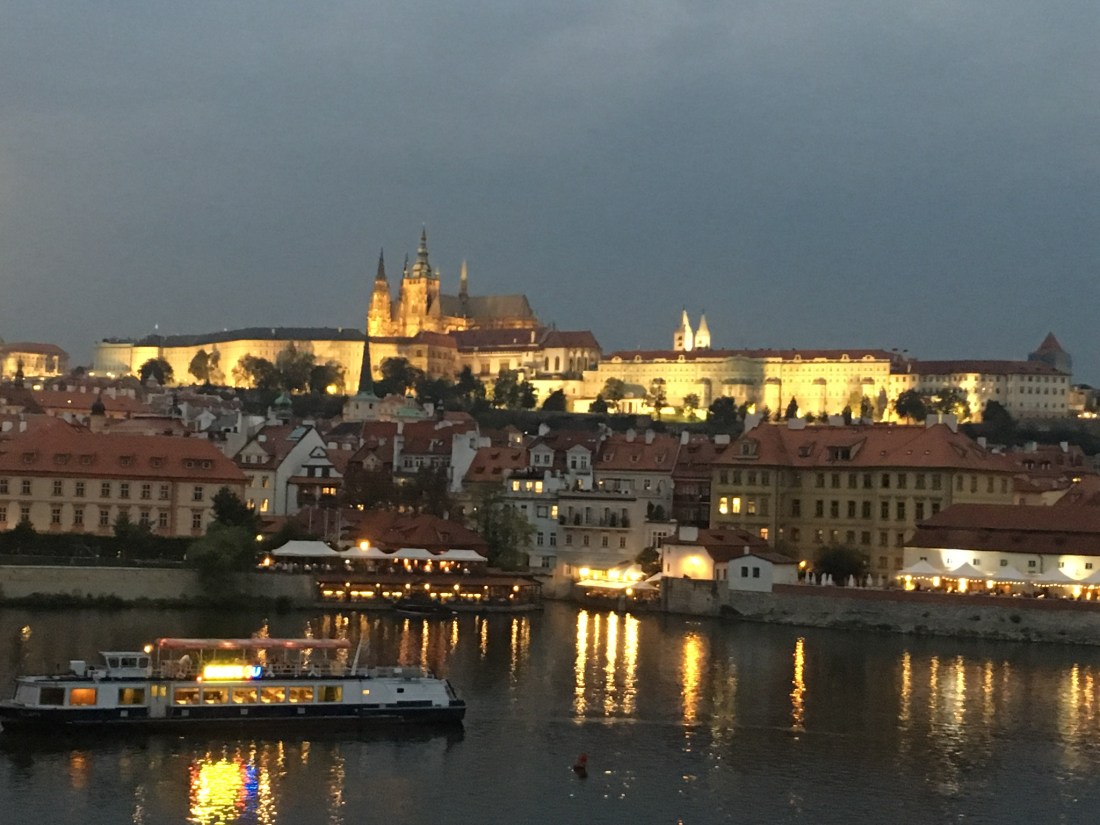
Prague Castle above the Vltava River.

We lost our breath; literally, we gasped and held our breath when we first entered Prague’s Old Town Square. Gorgeous religious, civic and residential buildings framing it.  Thousands of people filling it.  We both stood silently for many minutes, just trying to take it all in. We returned repeatedly to the square.  Grand during the day; surreal at night.

Prague provides sensory overload.  While its inner city has few bikers, and fewer traffic lights than currency exchanges, almost everything else about Prague exaggerates what we saw during the weeks before in Gothenburg, Stockholm, Copenhagen, Hamburg or Berlin.

If you look up as you walk in Prague you see beautiful buildings, block after block,  many adorned with paintings or statues of mythical, political or religious importance.  If you look further up you see steeples in every direction so none can serve as a point of reference to help you find your way ”home.”  Look down and you see almost every sidewalk is a stone mosaic masterpiece, far exceeding in scope what we saw and raved about in Lisbon two decades ago.

Tourists, street “artists” and beggars combine to pack the iconic Charles Bridge and the narrow cobblestone streets leading to it.  Tourists peddle little boats or ride in larger craft in the wide but gently flowing water of the Vltava River below the bridge.  Restaurants along the river banks provide dining with iconic scenery, including Prague Castle, which is as much a treat up close during a day trip as it is lit up atop the distant hill at night.

Night after night, churches and synagogues across Prague host accomplished but un-acclaimed musicians performing programs that appeal to the pocketbooks and tastes of tourists; while season after season, grand venues are the settings for performing works of some of the greatest composers in history, many of whom were Czech-born or residents, like Dvorak.  Mozart lived here only briefly but visited several more times and later composed the “Prague Symphony.”

Prague proudly promotes its links, however brief, to some of the greatest thinkers and writers since the invention of the printing press, like Kafka and Einstein.  And in their tradition, Prague continues to have gritty groups of locals drinking and debating long into the night, appearing to just be warming up as we were retiring for the evening.

And the story told in the Jewish Quarter here evokes nearly as much emotion as in Berlin.

All considered, Prague dominates the memories of our summer sabbatical like no other city.

JER

Berlin

1AB340E7-A93B-4809-8A93-B182DD15F500
A sign along the Spree River in Berlin that Germany struggles to bring new attitudes to an old issue.

I was told that Berlin is unique among major European cities in that it does not have a single central core.  It has an eastern city and a more upscale western city, although that distinction is diminishing every year.  Between the two is an area about four blocks wide and twelve blocks long that was “No Man’s Land” before the Berlin Wall fell in 1989 and has since become a modern business district.

The unifying feature of Berlin today — its existential core — is not a place, but a pall.  It’s the city’s horrifying twentieth century history….the persecution and then extermination of Jews by Nazis, followed by the arbitrary and then brutal division of the city by Soviets.  Berlin has rebuilt, but reminders of a terrible past — a recent past, really — are all around.

We talked in hushed tones during much of the days we toured Berlin.  It was reverence.  It was sadness.  It was worry it could happen again.

JER

Hamburg

1C39186E-F54C-4D9E-A0CB-D0F6A5262C79
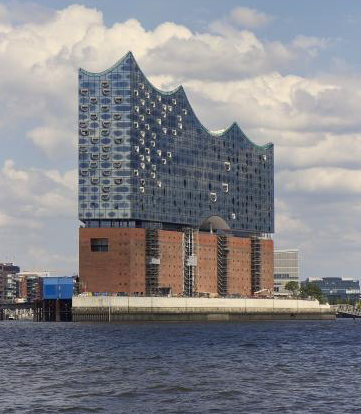
The Westin Hotel is the sail atop the Elbphilharmonie, Hamburg’s concert hall on the Elbe River, where the city has begun its third act.

Hamburg, Germany has more bridges than Amsterdam and Venice combined.  I read this; I didn’t actually count them myself.

It should be humbling to any traveler from the infant USA to learn that Hamburg’s old town was established in the 8th century, and that its so-called “new town” was established in the 12th century. The difference between the old and new is not now easy to discern.  More obvious is a kind of third city being created now in harbors which are at the heart of Northern European commerce today and were ports from which much of Hitler’s hell was exported in the 1930’s and 1940’s.

We stayed in a small hotel in the St. Pauli neighborhood of Hamburg.  Liberal, artsy, filled with plain dark bars and cafes which spill out to loud, overflowing street parties on warm summer evenings.

St. Pauli is home of Hamburg’s favorite football (soccer) club where the list of applicants for season tickets is even longer than the wait for Green Bay Packer tickets.  Approximately half of spectators at home games are female, and the club has adopted several social causes which add to its “Everyman” (or woman) appeal.  As does the 10 euro per game ticket price (less than $12 US) for season ticket holders.

To my disappointment, however, I  learned that Hamburg’s St. Pauli neighborhood is not where St. Pauli Girl beer is brewed.  That’s in Bremen, Germany.

JER

Copenhagen

Copenhagen advertises that it has the longest pedestrian-only street in Europe.  It’s actually several streets that stretch from world famous Tivoli Gardens — which provided inspiration for Disneyland and still provides a sparkling night-time walk decades after my wife first visited — to the festive Nyhavn from which most canal tours launch.  There is fun dining at both ends of this passage, and all along the way. Lots of tourists and street performers.

A8A7F4A5-C3CF-4F26-8B75-0ABE62D84019
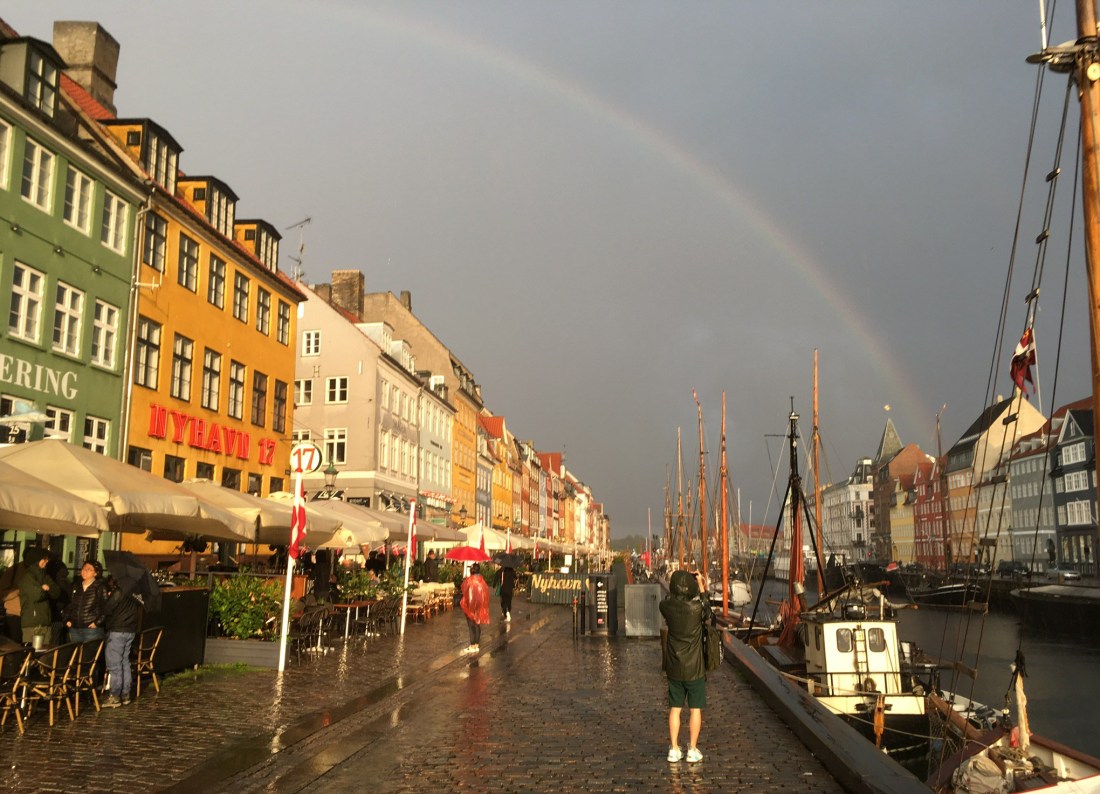
Sun and a sudden rain produce a pleasant scene at Copenhagen’s Nyhavn.

As much a fantasy world as Tivoli Gardens, but with a totally opposite look is the bohemian “freetown” neighborhood called Christiania.  It was settled by squatters in 1971 and subsequently tried repeatedly to secede from the rest of the world.  The community likes to consider itself a sovereign entity.  Indeed, the strictures of society do not seem to fully apply when it comes to public health standards or controlled substances.

Our time in Copenhagen coincided with a state visit by French President Emmanuel Macron, which added pomp and circumstance to a city that has routine ceremony on behalf of Denmark’s monarch, Queen Margaret II, who we learned is quite well liked by most Danes….although perhaps not so much by most residents of Christiania.

JER

Trains over Planes

D5B14A83-27C6-4957-B9FD-2704F7696D5B
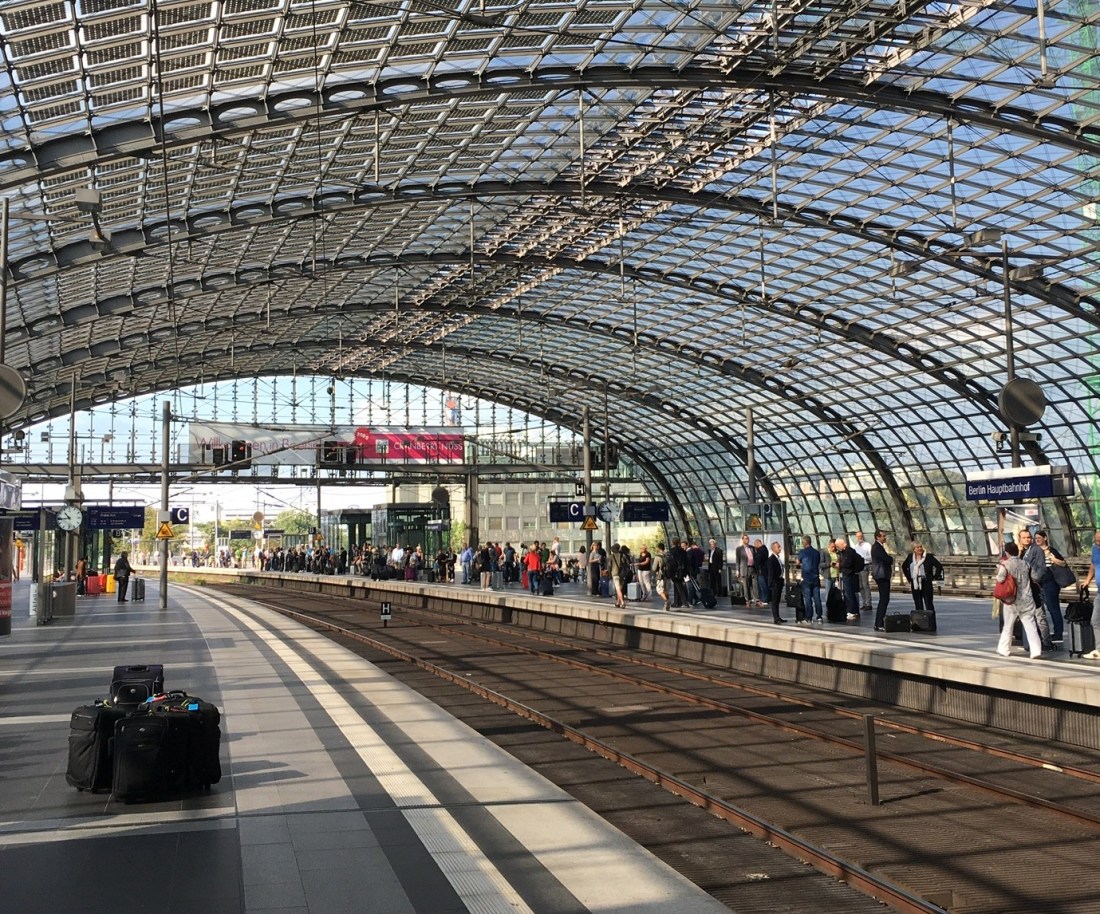
Departing from Berlin’s central train station.

Our European odyssey has included inter-city trains from Gothenburg, Sweden to Copenhagen, Denmark; from Copenhagen to Hamburg, Germany and then to Berlin; from Berlin to Prague in the Czech Republic; from Prague to Vienna, Austria; and from Vienna to Budapest, Hungary.

While European trains, tracks and depots may not be the world’s best, we had a good experience overall.  We experienced one cancellation…..a connection from Malmo, Sweden to Copenhagen which resulted in a mere 20 minute delay.  There was one complete breakdown……necessitating the train be towed from an island back to the mainland of Denmark; we were then bused and ferried to a German port and finally rescheduled on another train, arriving in Hamburg four hours late…..but imagine if it had been an aircraft rather than a train that failed mid-journey.

Even with these two problems, I find rail travel is more comfortable and convenient than air travel.  Many hours are saved.  Trains depart from and arrive in the central business districts of cities, not many miles out of town.  When traveling by train it is not necessary to arrive at the station two hours prior to departure and then unpack and undress to clear security. Passengers enjoy more elbow and leg room on trains than in almost any seat on planes.

Rail travel is more democratic than air travel. Everyone boards at the same time, through multiple doors, unlike air travel which classifies passengers by a half dozen or so categories or groups.  Making one feel less and less like a full person as you wait for your group to be called forward.

JER

Posing a Problem

9CBAC4E7-2279-4B45-BB68-B6153E04A067
A favorite place for silly posing is the Charles Bridge in Prague. Here, unobstructed, is the view toward Prague Castle.

This is a high class problem, I know; but I have to say it……I’m often irritated by the picture-taking habits of tourists.

I’m annoyed by those who must pose for photographs with silly gestures, and even more so when the scene they are upstaging is sacred, somber or spectacularly beautiful.  In front of a gorgeous mountain peak or canyon?  The altar of an 800-year old and still operating cathedral or synagogue?  The site of Nazi crimes against humanity?

Is it narcissism or is it cultural or is it generational? I don’t know, for I see enough exceptions to undermine any stereotype I begin to formulate.

All I know is that it’s embarrassing, maddening, or both.

There seems to be more of this since the development of small cameras and the proliferation of selfie sticks which do away with the need for these embarrassments to require an accomplice.  Now tourists can pose inappropriately without any help from their friends.

JER


Beetles

26810201-28E8-4C5F-B1F9-94833FFDBA1B
A yellow “Bug” showed us Europe the first time around.

Years ago, when young people who could not afford to go to Europe did so anyway, I sold my 1969 Mustang, my wife and I purchased a German-made Volkswagen Beetle for pickup in Europe, and we drove it around the continent for a summer. The car was yellow, and it looked a lot like it performed after it was shipped to the USA….like a lemon. Our marriage held up better than that car.

Nevertheless, and perhaps overcome more by nostalgia than good sense, we bought a used VW bug two years ago.  It’s robin egg blue….the cutest darn thing you’ve ever seen….and so far it’s performing just fine.

While traveling in Germany this summer we saw few VW Beetles.  Fewer in a week than we see in a single day in our community in the USA.  We’ve seen many times more Beetles in Central and South America than in Germany itself. We’ve been wondering why there are so few Beetles in Germany compared to many other countries, and we have a theory.

The proprietor of the little hotel where we stayed in the heart of what was the western sector when Berlin was a divided city told us that German people don’t fit their stereotype.  They drink more wine than beer, he said, “And German people stopped eating German food 35 years ago.  It’s good for tourists, not Germans.”

Perhaps it’s the same for the VW Beetle….a car for the rest of the world, not Germans.  Commissioned as “The People’s Car” by Adolf Hitler in 1933, but gaining popularity first in a modified form as a military vehicle during World War II, this model may conjure difficult memories and emotions among German people.

Since the late 1940’s when car manufacturing capability began slowly to return to war-torn Germany, it appears Germans have preferred not to own but to export “the people’s car.”

JER

Walls

B5A53920-6431-4C4B-9335-4993D9502C64
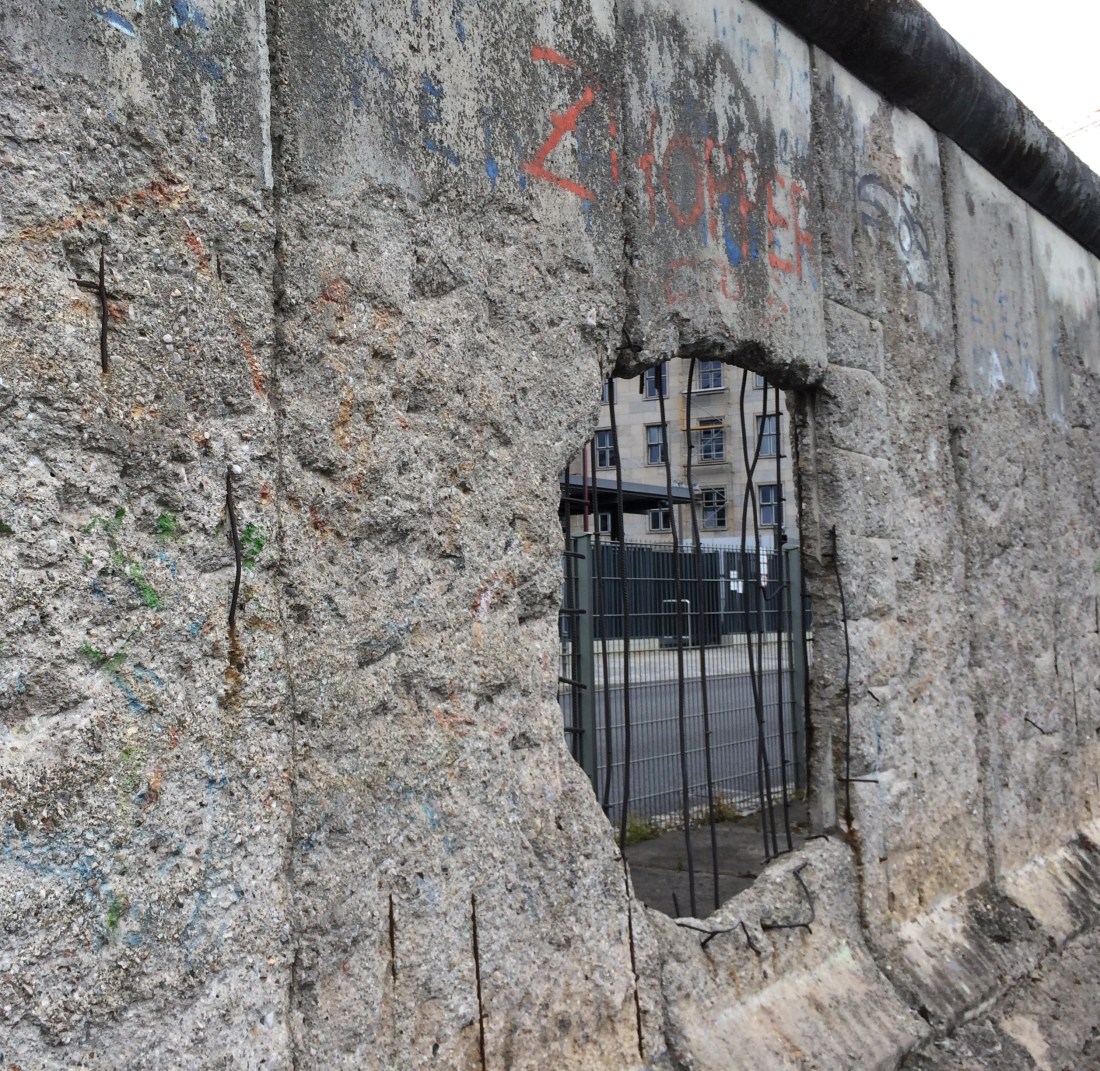
A remaining portion of the Berlin Wall — a hole in history.

Anyone who thinks a wall along the southern border of the USA is the answer to anything needs to visit Berlin.  Needs to see remnants of the Berlin Wall.  Needs to consider if history would judge America any differently in the future than we judge the Soviet Union today for building a wall in the early 1960’s that failed to survive a single generation yet continues to be the most vivid symbol most of that and future generations have of repression by a superpower.

Of course, the Berlin Wall was designed to keep people in, not out.  But, in both cases, the people we are talking about were and are people seeking freedom…..people who were and are seeking opportunity…..and most poignantly, people who were and are seeking asylum from tyranny and terror.

The history of America is to stand on the side of those people.  The hope of the world is for America to stay on the side of those people.

JER

Revisiting History

17B1A3AA-B2B1-46BB-BA75-4328A0387252
“Checkpoint Charlie” evokes memories of a divided Berlin.

When my wife visited Berlin as a college student, the city was divided by a wall. She took advantage of an opportunity to cross the border at “Checkpoint Charlie” and spent a few hours in East Berlin. Her memory is that everything on the Soviet side of the dividing line was gray.

Checkpoint Charlie is now a chintzy tourist magnet while the broad streets that stretch east on what was once the colorless Soviet side of the wall have become a glitzy, high-priced commercial zone.

Several hundred yards into the western side of the divide there is a not-to-be-missed mix of historical remembrance.  Here a large portion of the  Berlin Wall remains scarred but still standing.  Running parallel, but below ground level, are exposed portions of what were prisons during Hitler’s reign of terror thirty years earlier, presented with photographs, dairy entries, newspaper articles and other documents — and a detailed timeline which demonstrates how relatively quickly a republic can be retired and a dictatorship installed.

The Berlin Wall and the Third Reich are not directly related to each other; the authorities responsible for each were actually bitter adversaries.  But to see these ruins occupying the same ground is to help understand how first one and then another authoritarian regime controlled this space, and to appreciate how fragile republics — even our young republic in the USA — can be.

JER


The Beat Goes On

”The music is all ours.”

That’s what my wife said after listening to the car radio as we drove through Central Sweden last month.

And again after watching an hour of mixed gender and generation line dancing on a Wednesday evening in Stockholm’s massive Medborgartenplatsen…..everything from Dean Martin to The Eagles, and every song in English.

And again at a national triathlon event in a small harbor town along the North Sea where a loudspeaker featured, for example, Elvis Presley singing “Burning Love” and Donna Summer singing “Hot Stuff.”

And Norah Jones has almost become “Muzak” in Sweden, apparently the favorite choice for background music in restaurants and lobbies.

Certainly there are local artists promoted on posters plastered all over European  cities, and rhythms from all over the world pulsate from clubs in the night scene across the continent; and obviously, centuries of European  composers  remain among the greatest of all time.  But music from the USA first recorded during the last half of the 20th Century is all-around, all the time.

JER

F8E2DD6A-55F9-4005-B483-57EAC97EA43C
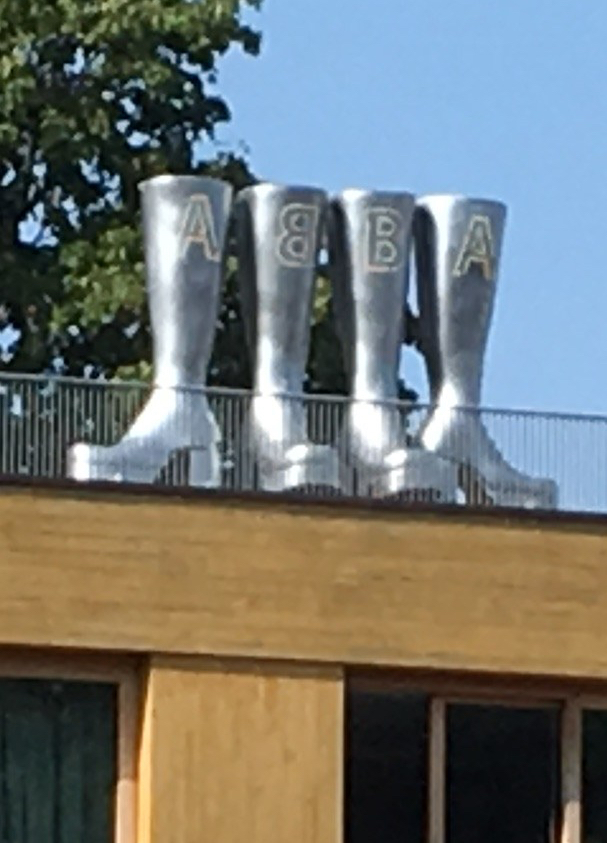
Sweden celebrates Abba with a museum in Stockholm.


Potholes

There are more potholes in the street where I live in the USA than in all 1200 miles of highways, byways and backroads we drove during two weeks in Sweden during August.

It is not that Sweden is a car-centric nation. That’s the USA, a car culture where decades of government and corporate investment was in interstate highways, while mass transportation was ignored outside of a few large cities.  Sweden has both….excellent mass transportation AND roads. There are neither potholes nor patches in what seemed like 99 percent of its roads we traveled.

It is not that Sweden’s climate is kinder and gentler to roads than the weather in the USA. Sweden is a more northern country where winters are harsher and longer than in 49 of 50 states in the USA.

Rather, what I noticed is that Sweden uses asphalt as the primary ingredient for its roads, rather than the concrete slabs that pave most major highways in the USA and eventually cause a teeth-chattering ride when the sections lift, buckle and crumble.  Sweden’s roads are more seamless, and much smoother.

It could also be that the nation of Sweden makes the greater users of its roads pay a greater share of the expense for the construction and care of those roads.  It cost well over $100 to fill up my mid-size SUV in Sweden, which is two to three times  the cost for a fill-up in the USA.

What is needed more in the USA than cheap gasoline relative to most other nations in the world is a greater national commitment to improving our nation’s infrastructure, including roads, bridges and, most importantly, clean-energy powered mass transportation. Those who build and maintain this infrastructure and those who use it will both benefit.

More jobs and fewer bone-jarring, teeth-rattling roads.

JER


Newcomers

9310c8d8-4905-4ee0-b2a0-89f9756649af-e1535955555766

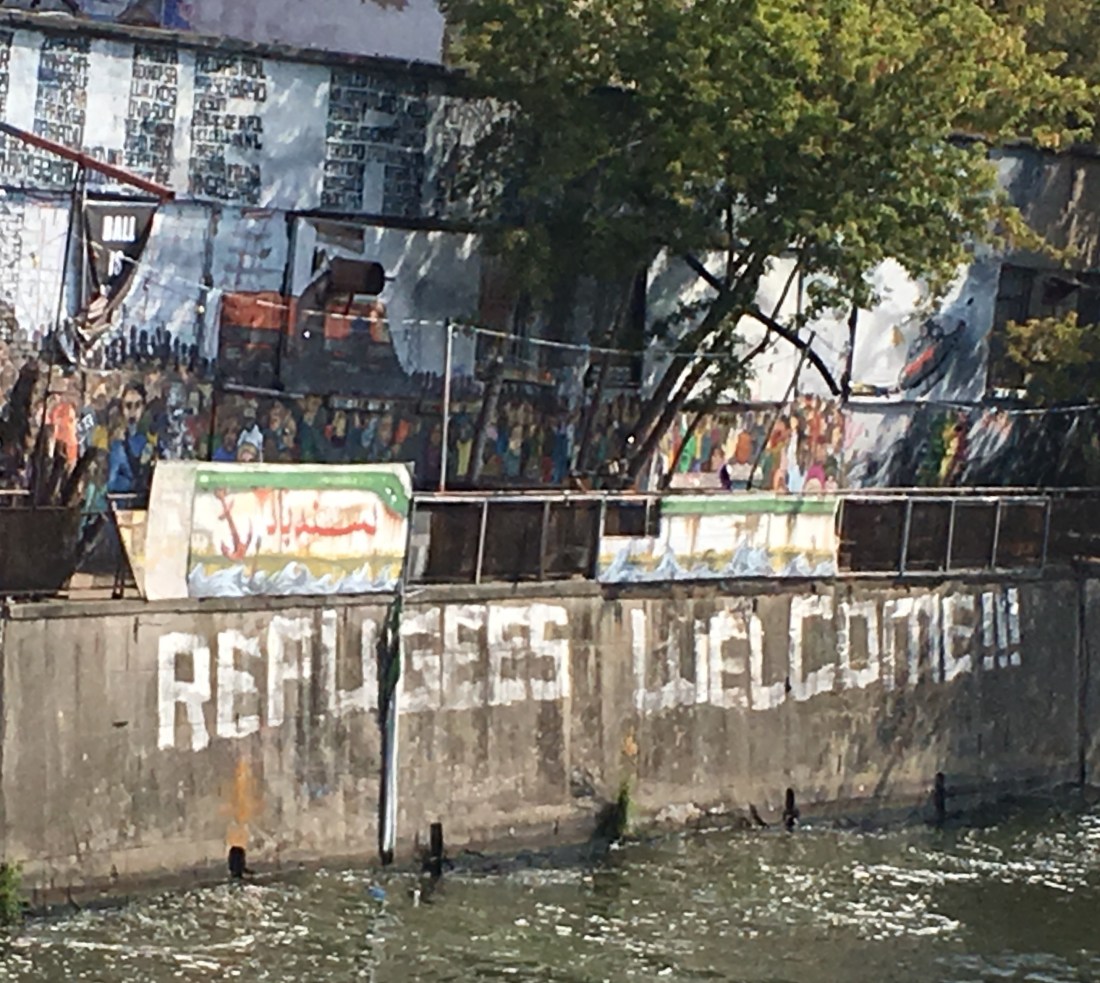
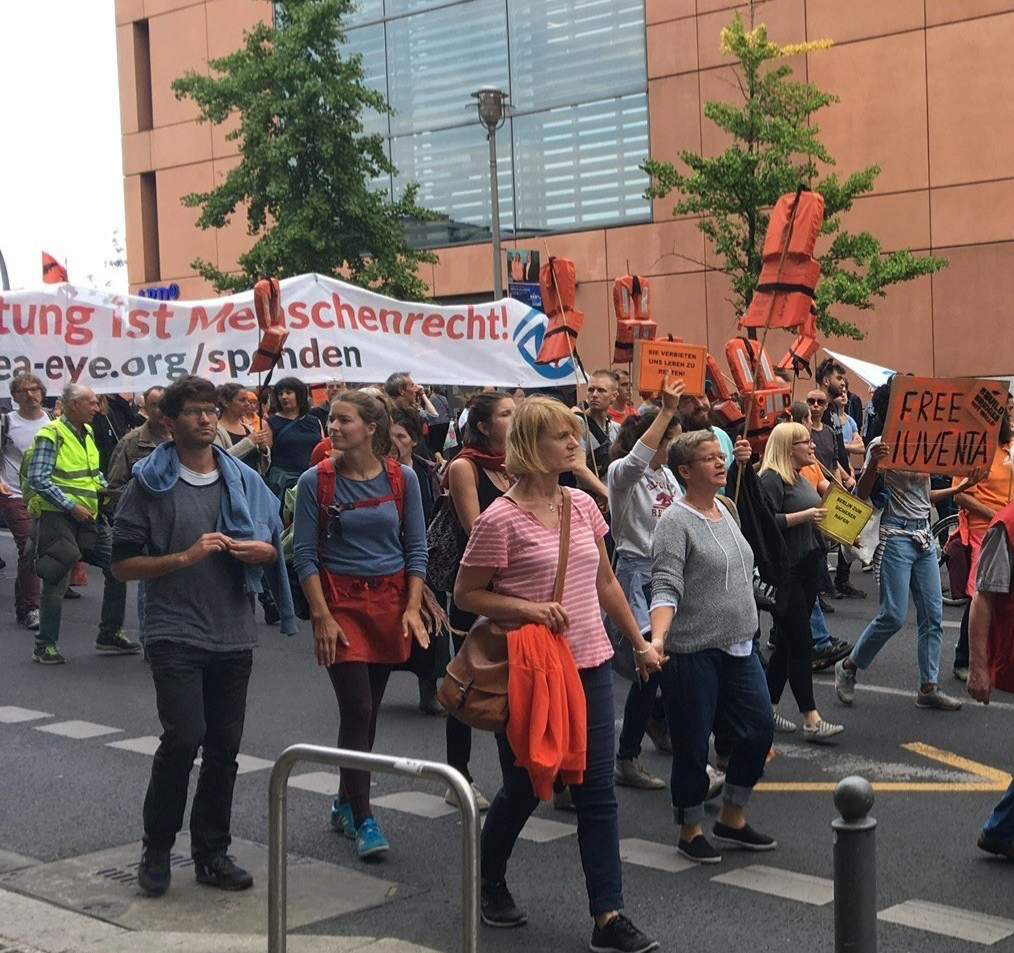
       As in Sweden, Germany is debating immigrant and refugee policies.  Here in the    streets of what was once walled-in East Berlin, demonstrations on behalf of Sea-Eye whose mission is to make ocean rescues of refugees…..as a humanitarian imperative, not a political statement.


It took us longer than a full week in Sweden before we had eaten what one might call a typical Swedish meal. Indian, Middle Eastern, Asian twice, “international,” but never a dinner with a classic Swedish theme and menu, whatever that means today, Never saw a meatball, for example.

Some on Sweden’s political right wing might say this is but one of many signs that Sweden is losing its national identity under the weight of hundreds of thousands more immigrants and refugees than the country can assimilate and an attitude predominant among the country’s liberal wing that a receiving country which restricts the numbers of newcomers, or requests their assimilation, is bigoted and intolerant.

If it ever was, Sweden is no longer a place where one sees only tall, blue-eyed blonds. It is, if not a melting pot, a full box of crayons. It is this way in both large cities and small towns.

All across Europe debate escalates regarding each country’s role and responsibility to provide a safe place and basic services to immigrants and refugees. Even those countries with the most accepting reputations and most generous support of the world’s displaced and persecuted people — countries like Sweden — are soul searching…..

……As we are in the USA, or should be, and with much more nuance of feeling and intellect than our current Administration demonstrates.

JER

The Pace of Play

Years ago when we honeymooned in Europe for three months, we had so much time and so little money that there was neither need nor possibility to make every moment a masterpiece.

Since then, each vacation has been squeezed between the responsibilities of what is called “daily life,” so we traveled with a sense that no moment should be wasted…..every accommodation special, every meal sumptuous, every view spectacular.

This first trip of retirement, more than twice the duration of any vacation since our honeymoon but still half the length of that journey, is being conducted at a median pace.  We cannot make every day a homerun….neither our pocketbooks nor our waist lines allow that.  We are renting apartments, using public transportation, shopping for groceries, eating some simple meals in and acting abit more like locals than we did decades ago.

The fact that we traveled then at a total cost per day that is less than one good glass of wine now also has a lot to do with the pace of this journey.

JER


Accidental Tourism

32AC231A-21D1-4089-8387-C2A03064D09C
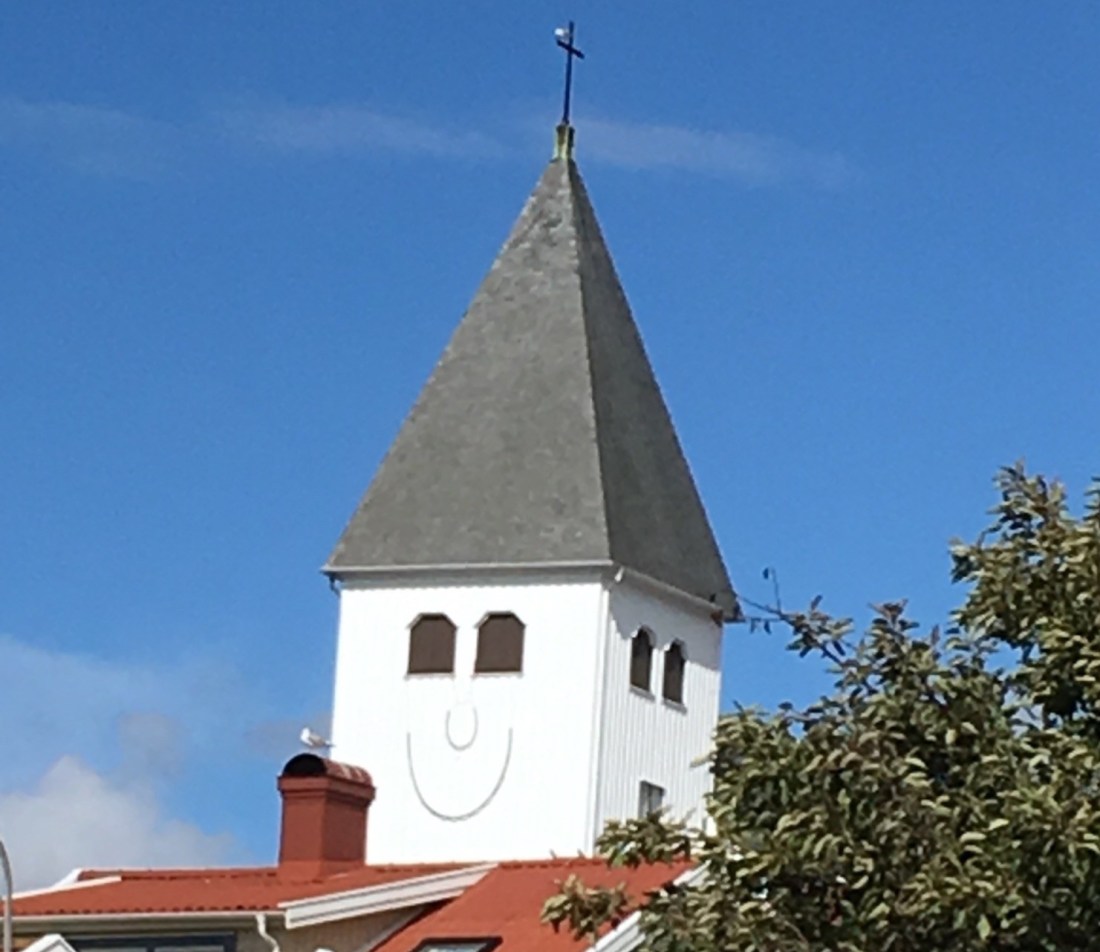
Unexpected…a church with a happy face on Sweden’s west coast.

Our favorite way to see the countryside is to drive ourselves around; and our preferred way to view a city is to walk. These are the modes of transportation that cause us often to lose our way but sometimes find what we would miss if we sped by in faster modes of transportation planned by experts.

On the way from Lake Vattern in Central Sweden to Stockholm on the east coast, for example, we spent nearly five hours wandering Swedish backroads along the Gota Canal, a distance a tour bus might cover in about fifty minutes.  The construction and continuing operation of this canal is a fascinating and humbling story.

Once in Stockholm, and consciously grateful that we are able to do so,  we walked many miles multiple times each day for three days, encountering sights and smells that no guide book describes.  And wearing off enough calories to eat and drink to our  hearts content.  Almost.

Our accidental tourism caused us to encounter a motorcycle rally in the environs of Sweden’s central lakes, boat shows in three different harbor towns along Sweden’s west coast and a national triathlon competition in a fourth idyllic seacoast village.  None of this was on our agenda, but all of it made memories.

Purposeful travel can improve the human condition, and we admire such efforts and respect the learning experiences they provide. And there’s no doubt we take some wrong turns and waste some time as we wander around.  But sometimes getting lost is the point of travel.

JER