
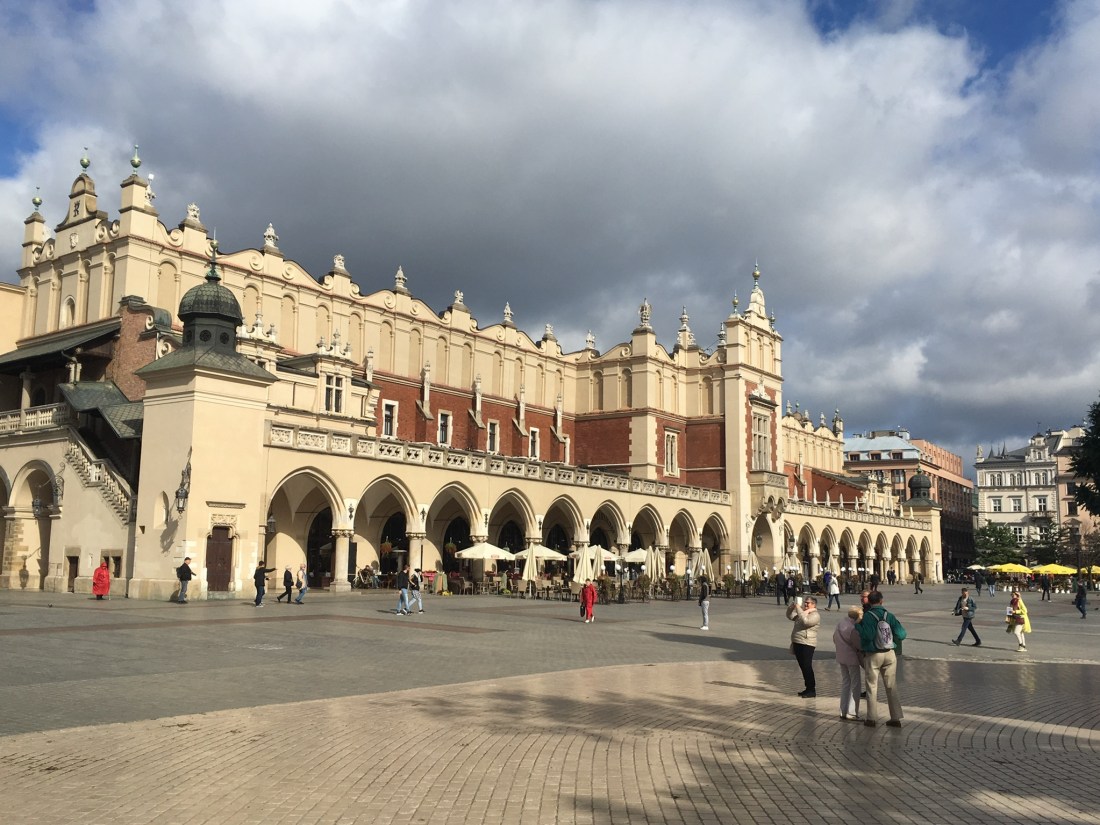
The cafe culture of Krakow, in southwest Poland, is second to none. Not even Vienna exceeds it in terms of cafe density, ambiance and heritage. We enjoyed cappuccinos in an establishment opened in 1364…..that’s not a misprint……Wierzynek Cafe. Now in its eighth century of operation, the cafe has evolved into four opulent floors of luxury dining…..and expensive coffee.
Krakow’s “old town” is also unmatched, in my experience, because of two features. It is surrounded by a refreshing green ring…..a 200-yard wide wooded park that circles the walled city. And in the center is Europes’s largest old town main square, called Rynek Glowny. A dozen football fields could fit within the perimeter of cafes and cathedrals…..the University of Michigan’s 107,000-seat capacity “Big House” could be dropped inside with room to spare. What actually IS situated within this massive market square is Cloth Hall. Erected in the Gothic style in the 13th Century and “remodeled” in the Renaissance fashion of the 16th Century, Cloth Hall is touted as the world’s oldest shopping center, although I’m betting there are dozens more ancient commercial centers on other continents that are less traveled and promoted.
Many people also visit Krakow for two near-by “attractions.” One is Wieliczka Salt Mine south of Krakow which opened in the 13th Century and ended its salt mining operations only 11 years ago. Generations of miners have created more than 150 miles of tunnels and shafts…..most by hand, some with the help of horses and mules, and only during the last century with motorized machinery. I was shocked to learn that dwarfs were once “employed” in these mines, but I imagine their experiences were not as idyllic as portrayed in the Grimm fairy tale and Disney production of ”Snow White and the Seven Dwarfs.” Probably wasn’t much “whistle while you work.”
As is the case in many central and eastern European cities, Krakow has a Jewish Quarter which, like many others, was once a comfortable neighborhood, then forced to become a compacted slum, and now has rebounded to attract artists, entrepreneurs and tourists. But drawing more attention by visitors to Krakow are the remains of the Auschwitz concentration camp west of Krakow. It was operated by Nazi Germany when it occupied Poland during World War II. Auschwitz is actually just one of nearly four dozen forced labor, concentration and/or extermination facilities in this region that terrorized Jews as well as ethnic Poles and even Soviet prisoners of war. Well in excess of one million people perished in this network of camps during less than five years.
So, like many other central and eastern European cities, Krakow is pleasing to the eye but disturbing to the conscience.
JER

