To some people, wind turbines such as these on the southwestern slope of the extinct Pu’u Kukui volcano on the Hawaiian Island of Maui, are magestic, graceful and peaceful. For other people, they spoil nature.
Through the window of a train car late last summer, as I watched the farmland south of Berlin pass by, before we reached the gorgeous Elbe River valley nearer the border with the Czech Republic, my eyes were drawn to the hundreds — probably thousands — of wind turbines which dominate an otherwise bucolic Bavarian landscape. And my mind traveled toward the thought that one person’s solution might be another person’s problem….. that one’s treasure might actually be another’s trash.
The thinking that wind power is less polluting than most other forms of energy is commonly accepted, but not entirely convincing to me. This is because I do not find a view of the horizon much more damaged by a strip mine than I do by seeing mile after mile of towering turbines across the landscape. When I see sprawling windmills standing in lakes and oceans, I want to scream!
To me, a seascape is as victimized by a spread of windmills as by a single derrick pumping oil or gas. Burning the fossil fuel at another time and place is another matter, of course; but in terms of upsetting natural beauty at the point of resource extraction, widespread windmills do as much visual damage as the derrick.
I don’t believe I’m alone in this thinking. Property owners along the Lake Michigan shoreline are strong advocates for a clean environment, and just as adamant that wind turbines are not positioned within their view and usage of that magnificent and massive fresh water ocean. Vacation destinations we visit around the world lobby powerfully for a clean environment, and they fight even harder to assure that any solutions are not within their line of sight.
Right now in Michigan’s Upper Peninsula local citizens are fighting to overturn a zoning board decision that would allow four dozen wind turbines spread over thousands of acres of an elevated slope in the northwest UP near Lake Superior — perfect for generating wind power, of course, but it’s also some of the UP’s most pristine property. Making matters worse…… the wind farm would be built on managed timberlands which our planet needs much more of to filter its air……and even worse, these lands are hunting and fishing grounds for the Keweenaw Bay Indian Community, which also opposes the project.
When advocates for wind power say this wind farm project will “change the landscape,” they are not just speaking metaphorically about what it may do for UP energy costs. Unintentionally, they also speak a literal truth.
The one and only operational wind farm in the UP, located in the south central portion of the peninsula near Lake Michigan, has become a target of law suits which claim a variety of negative effects upon humans, animals and the natural environment. These lawsuits are advancing in spite of company publicity heralding the jobs it has created and the donations it is making to local non-profits.
Our natural environment cries out for protection. This requires powerful push-back against polluters as well as some so-called progressives…..against both rampant pollution and reactionary solution. Erecting monstrous structures across miles of green spaces and waterways is not an adequate answer.
Good intentions can have bad results — in fact, they often have negative effects. This should not paralyze us; but it ought to humble us, and both inform and balance our responses to all kinds of serious issues which confront us.
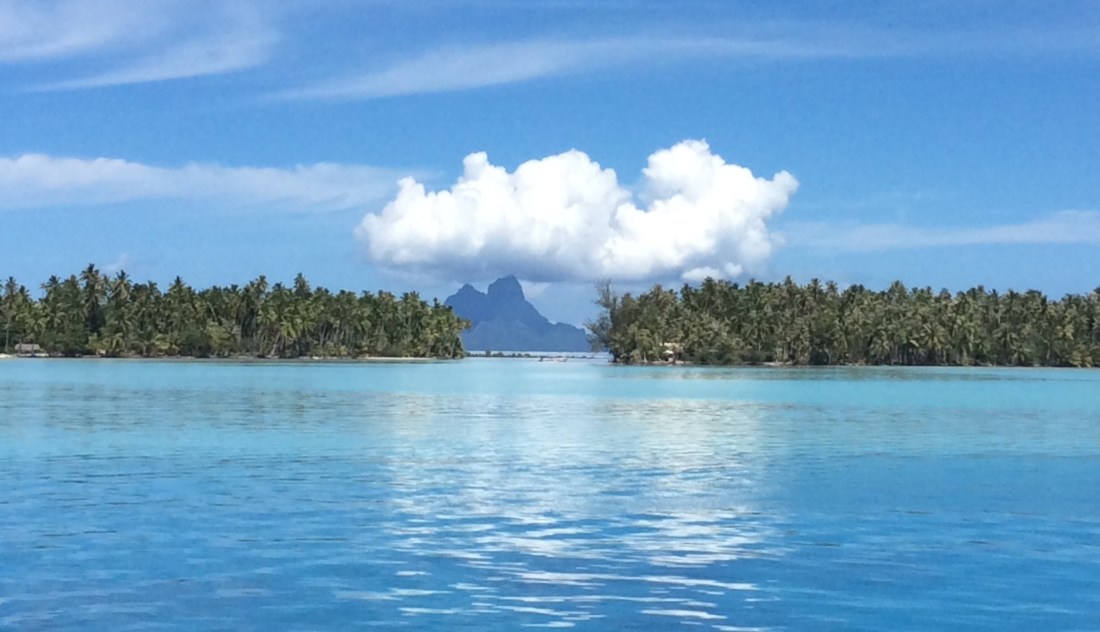
Bora Bora in the background of the snorkeling paradise of French Polynesia.
For my wife’s birthday during our first year of marriage, I gave her a set of golf clubs and accessories. It was what I wanted for her, not what she wanted; and it is not among her favorites of all the gifts I’ve given to her over the years. In fact, that might be the gift she’s least valued…..and least used.
So it was with some hesitation that, for this year’s Christmas gift, I equipped my wife with a complete suite of snorkeling equipment…..mask, snorkel, boots and fins…..hoping they would be put to use in Hawaii now and in the Maldives early in the new year.
Over the years I’ve learned more about my wife and about gift giving, and I was more optimistic about the snorkeling gear than the golf clubs. While my wife had never played golf, she has snorkeled many times…..for example, in Belize, the Galápagos Islands and especially French Polynesia where she had her best-ever experience at this time of year in 2015.
But it turns out the roiling swells of the Pacific Ocean surrounding the Hawaiian Islands in December are too nippy to make snorkeling a pleasure for my pint-sized and poorly insulated wife. She loved December snorkeling in the flat waters of French Polynesia, but that part of the Pacific lies 2700 miles south of the Hawaiian chain, and the water is much calmer and warmer…..actually, much like bath water.
So, once again, giving my wife a gift I wanted her to have more than she wanted to have it, hasn’t worked out well. I really should have known better.
At this stage of life, when we are trying to discard, donate or recycle two items for every one item we acquire, we do not get very excited about material gifts. Photographs of precious people or places never disappoint, and bottles of New Zealand Sauvignon Blanc wine are always welcomed; but otherwise, the gifts we are more apt to give each other, and appreciate from one another, are moments.
And memories take up little very space in the basement, attic and garage.
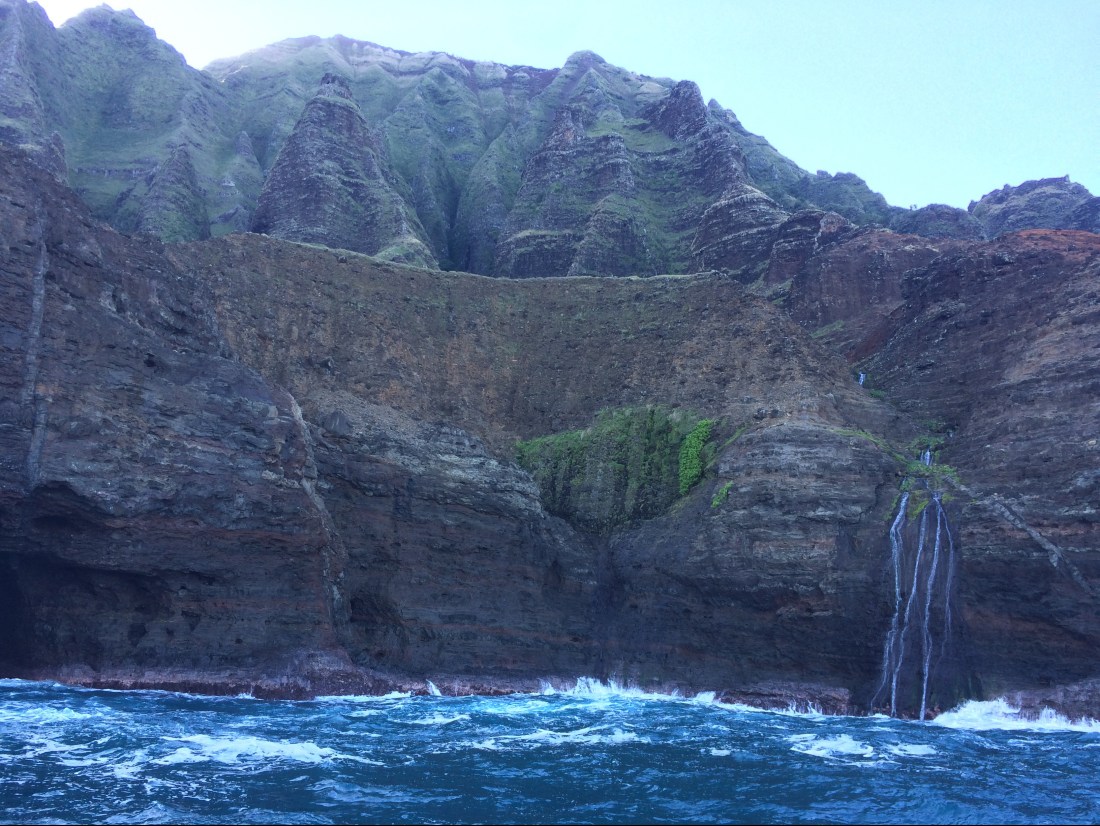
The Na Pali Coast on the Hawaiian Island of Kauai is now protected against humans but is still being battered by nature.
Hawaii is said to be the most remote land on the planet…..that is, farthest from any continent. It is, indeed, a real “get-away.”
The last to the union of 50 states in 1959, Hawaii also has the latest date of US states for the introduction of human inhabitants, commencing in the early fifth century A.D.
It is believed the first visitors to this paradise traveled from the Marquesas Islands, located 2500 miles south, at the remote northeast tip of what is now French Polynesia. Why these intrepid souls were compelled to wander so far north is unknown. Theories include war, drought and overpopulation….some of the same forces which are driving millions of people from their homelands across the globe today.
It was the Big Island of Hawaii — the youngest island and, we know from continuing volcanic activity, a still forming island — which received the first settlers. Being largest and southernmost of the island chain, odds were on its side that the double-hulled canoes which ventured from far south would be more likely to bump into this island than another island of the chain we now call Hawaii, some of which are 1500 miles farther north and so tiny they are not shown on most maps of the USA. Some of these islands still have no year-round inhabitants.
Hawaii has both the fastest growing and the most rapidly eroding shorelines in the world…..increasing as a result of lava flows on the southeast shore of the Big Island of Hawaii, the newest island…..diminishing as the result of wind, waves and rain along the northwest coast of Kauai, the oldest island…..one island dramatically ascending from the earth’s molten core as another island subtly descends into the sea.
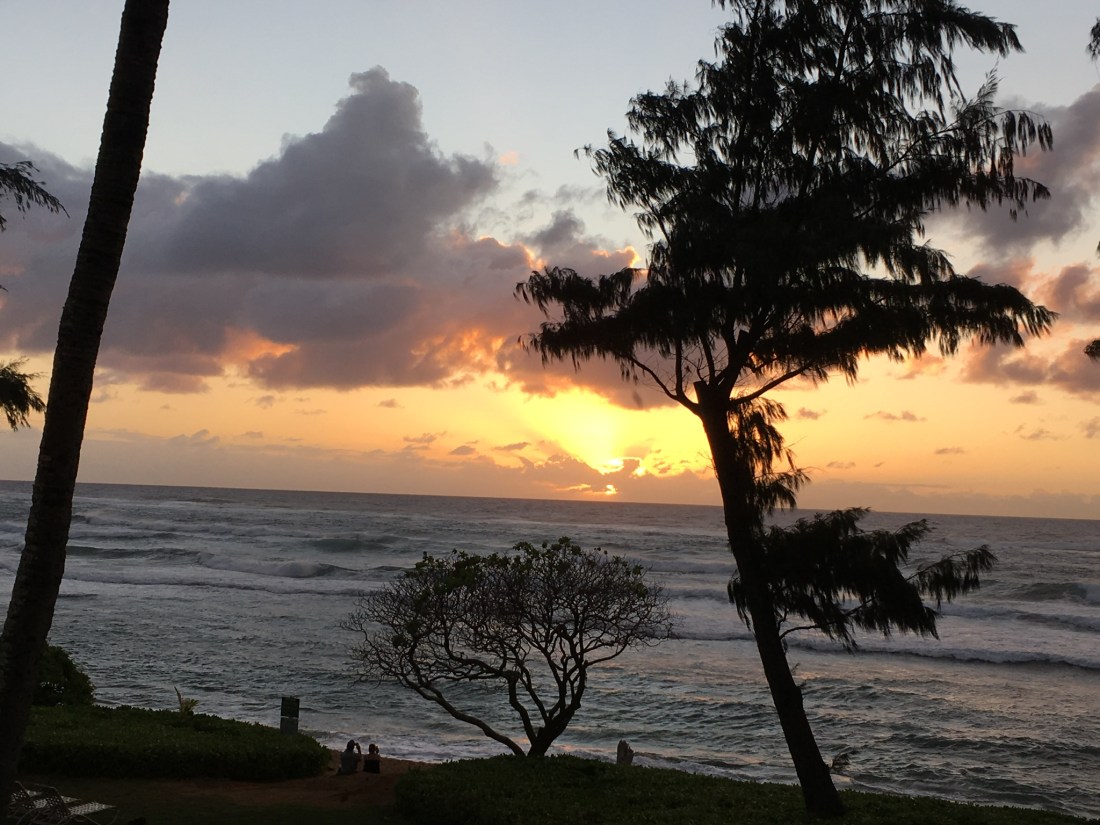
Along the eastern shore of Kauai, people arrive in one’s and two’s and more. Some sweaty and in running gear, some shivering and wrapped in blankets, some in the largest and loudest shirts you’ve ever seen. Some carry cameras, and many carry caffeine. It’s the church of the ocean sunrise.
People approach as if hypnotized. They maintain a worshipful hush. They sit or stand near the water’s edge as if in a spiritual trance. The white noise of the unceasing waves, colliding with rocks and crashing on the shore, drowns out distractions. It’s daybreak, for those on a winter break, on Hawaii’s oldest island.
The sun is vain, announcing itself an hour before it actually appears, sending up yellow, orange and pink flares that reflect off an entourage of clouds.
As the sun rises, the horizon separating sea from sky sharpens. Then a unique ribbon of light streams across the water’s surface directly toward each and every witness, as if the sun has a special message for each individual.
Perhaps it does.
The indigenous people of this paradise worshipped the holy in many aspects of their existence, and especially in the sky and the sea. Observing their pull on contemporary visitors to this island, I can see why.
There are a half dozen ocean locations around our planet where plastic has gathered into giant tumors which are growing to astounding dimensions. I just flew over one of these tragedies…..called the “Great Pacific Garbage Patch” between California and Hawaii. It has grown to a size that would more than cover the state of Texas, twice; and it’s getting larger every year. It is now estimated to weigh more than 175,000 pounds…..the equivalent of more than 40,000 automobiles.
In the ocean! Between two US states! A colossal cesspool of plastic.
Why are we not outraged? Why is our government not addressing this “clear and present danger?”
I didn’t actually see this gigantic garbage flotsam from the window of the Boeing 757. In fact, only specially equipped satellites can detect it because, well, it’s mostly plastic, and not a solid mass, but a massive area of ocean water where plastic particles are unusually dense…..so dense that most marine life is extinguished.
It intrigues me to know there currently is what might be a quixotic effort to reduce this toxic tangle off our shores; but even if this is just jousting with windmills, I’m cheering for Cervantes’ hapless hero to land a blow. This enterprise — “The Ocean Cleanup” — is designed to spread its mechanical arms the length of six football fields and drag a net ten feet below the sea’s surface. Its designers hope to collect many larger plastic objects before they break down to microscopic and environmentally more threatening particles.
This device, which is just now undergoing its beta testing, is being criticized by some for the potential harm it might unintentionally do to marine life. And it would make more sense, if it were not politically so impossible, to place such devices at the mouths of the most polluting rivers around the world to catch some of the eight million tons of trash that enters the oceans each year, eighty percent of which comes from Asia.
But regardless of outcome, monitoring this imaginative non-governmental effort to mitigate the problem should motivate the rest of us to address the problem at an earlier stage and on a more personal level…..eg., when we refuse plastic utensils, replace plastic straws with wooden alternatives, reuse the same plastic item time and time again, and recycle rather than discard the plastic we cannot avoid and can no longer reuse.
In this mission, let’s be as Sancho, the peasant laborer who became squire to Don Quixote — greedy at times and cowardly, but ultimately determined and faithful.
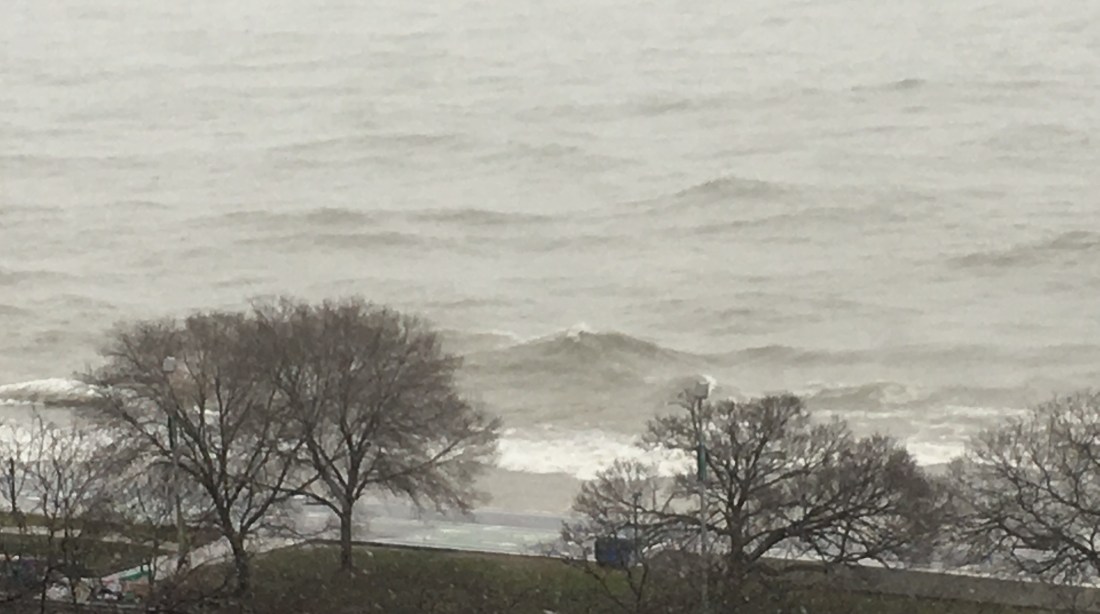
A color photo above Chicago’s Lake Michigan shore looks black and white on a snowy December morning.
When I was a high school freshman, an English teacher talked me into entering a poetry reading contest sponsored by the state forensics league. That teacher provided me Carl Sandburg’s “Chicago” to prepare and present. At the conclusion of my reading at the first round of the state series, and gifting me with a poor but passing grade, the judge who observed my performance said, “That poem should be recited by a man, not a mere boy.”
That tells you something about me, but even more about the city of Chicago. It IS “Stormy, huskey, brawling, City of the Big Shoulders,” And it DOES demand a more masculine voice than I was capable of then, and perhaps even now.
Chicago is by far my favorite Midwest metropolis, and perhaps the choicest city in the entire USA. There is much to recommend it…..for example, its music, art, neighborhoods, restaurants, bars and pro sports teams which can both steal and break your heart…..but it’s the lakeshore which grabs me most. No city has made its waterfront more available to greater masses of people than Chicago, stringing for 20 miles along its lakefront, from its southern border to its northern, a variety of parks, paths, sports fields, fountains, beaches, harbors, museums and performance venues. Adjacent Lake Michigan is a sweet water sea, on the scale of an ocean, which provides fresh breezes in summer and frigid blasts in winter.
Brian Doyle — who actually lived in a gorgeous area of the USA’s Pacific Northwest — wrote a novel, “Chicago,” which is like a love letter to the city. Doyle employed magnificent meandering run-on sentences which never lose the reader, and with paragraphs which can start you laughing when they begin and have you crying when they end, much like a day in the life of a resident of Chicago. Here is one of Doyle’s cadent, heart-gripping passages about my favorite city:
”A city of burning energies on the shore of a huge northern sea. An American city, with all the violence and humor and grace and greed of this particular powerful adolescent country. Perhaps the American city — no other city in the nation is as big and central and grown up from the very soil. Chicago was never ruled by Spain or England or France or Russia or Texas, it shares no ocean with other countries, it is no mere regional captain, like Cincinnati or Nashville; it is itself, all brawn and greed and song, brilliant and venal, almost a small nation, sprawling and vulgar and foul and beautiful, cold and cruel and wonderful. Its music is the blues, of course. Sad and uplifting at once, elevating and haunting at the same time. You sing so that you do not weep. You have no choice but to sing. So you raise up your voice and sing of love and woe, and soon another voice joins in, and you sing together…..”
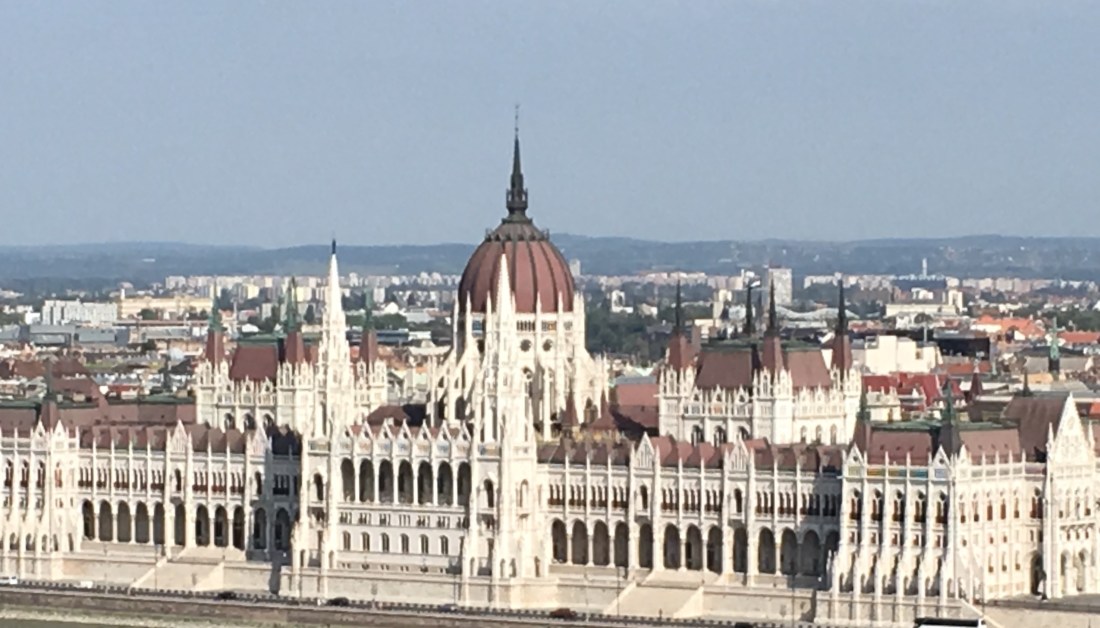
The Hungarian Parliament Building in Budapest, seat of the National Assembly of Hungary.
Years ago I enjoyed a broad-minded colleague who could complicate any topic and was fond of starting most discussions by saying, “I’m like a mosquito in a nudist colony…..I hardly know where to begin.”
That’s the dilemma a thoughtful traveler faces when attempting to describe in brief almost any aspect of any foreign country visited. Where to start? What to emphasize? What can be generalized? What is merely an isolated occurrence; what is really an insightful anecdote?
While American travelers abroad may be having an identity crisis and worry about what citizens of other nations may be thinking of us, that’s more a symptom of American self-centeredness and arrogance — our thinking that the world revolves around the USA — when, in fact, most Europeans we engaged this summer and fall were more concerned with and apt to talk about the dis-functions within their own countries…..stagnant economies, polarizing political parties, alienated youth, crooked judiciaries and a discernible tilt in the electorate from left to right and from global to national.
In my limited experience, it is rare to talk with a resident of any European nation who does not criticize his or her own government, who does not think that nation’s lawmakers are corrupt and more concerned with lining their own pockets than performing a public service, and who does not distrust the media. While no person with whom we conversed was complimentary of the current US president, they all seemed to admire the American people and conveyed the clear impression that they still think the USA is a special place, perhaps THE special place on the planet. But the problems of their own countries, not of America, were the preferred topics of discussion.
All across Europe, including the Czech Republic, France, Germany, Hungary, Poland, Slovakia, and even in Denmark, Norway and Sweden — the news is often about extreme nationalism within those nations, and the rhetoric of both common folk and public figures is routinely as inflammatory as anything we hear or read in the USA. And their legislators and leaders are adopting laws as reactionary as anything happening in America.
It is the WORLD that is changing, not just the USA. Acknowledging this makes us no safer, but may briefly allow us to feel less guilty. In any event, turning inward — advancing an “America First” agenda — is not the place to begin to repair the roads of reconciliation within America and build bridges of bi-partisanship around the world. The possible solutions to the current mess here and abroad may be so many and complex and interconnected as to create a kind of paralysis that comes with having too many options for action, but advancing protectionism and extreme nationalism is not the place to begin.
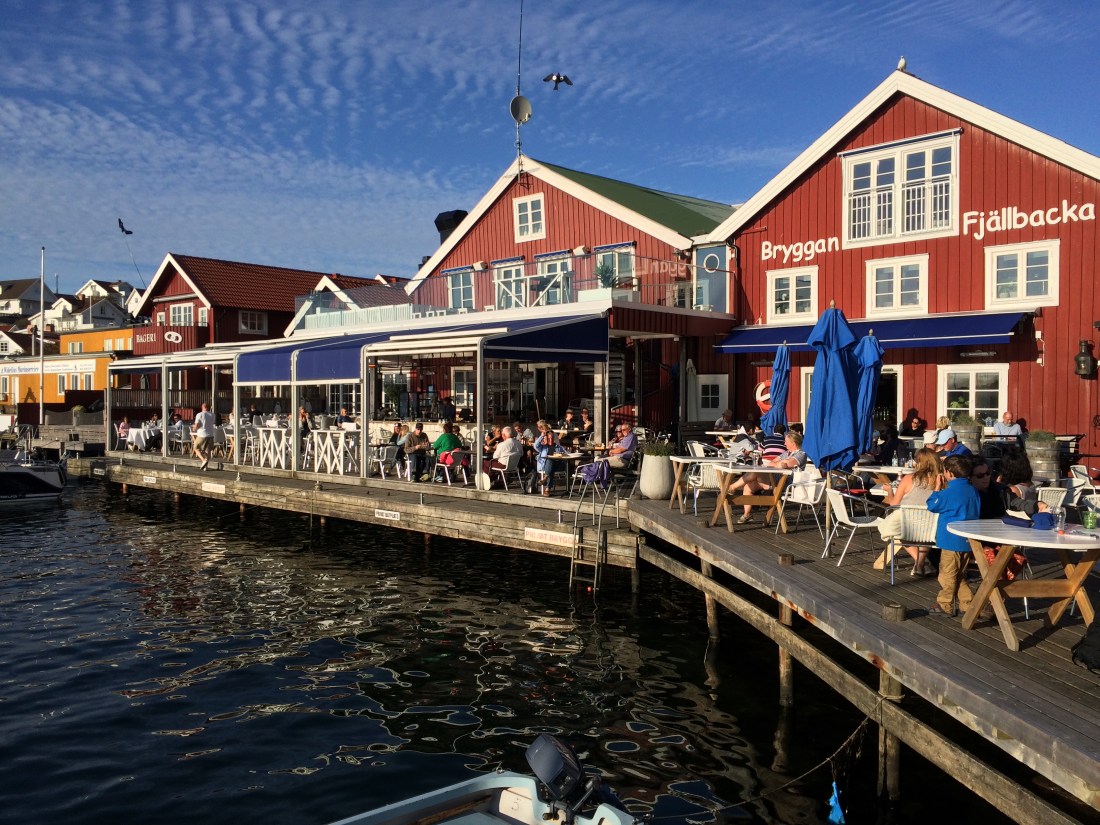
Some Scandinavian dining offers both fresh fish and fresh air.
My sister and her husband recently traveled to Rome with their daughter’s family, which includes two bright elementary school-aged children; and I followed their family blog. The first posting about this terrific adventure reported that the kids enjoyed everything, but complained about all the smoking they encountered in public spaces.
That is precisely my singular criticism of the eight European nations my wife and I visited a few months earlier. Lovely countries, too often spoiled by smoking.
Smoking is not allowed indoors at most eating establishments in Europe. But neither codes of conduct nor common courtesy seems to apply on the sidewalks of Europe or to customers dining al fresco, at the best tables, really, for what would otherwise provide the most pleasant ambience. It was not unusual for us to find a story-book sidewalk or riverside cafe for drinks or dinner, but before long be surrounded by smokers who fouled the air.
Smoking among adults in the USA declined from about 21% in 2005 to as low as 15%, depending on the statistical source, a decade later, and is now well below the worldwide average of approximately 20%. The smoking rate in Scandinavian countries we have visited tends to be lower than average. Baltic nations and other countries behind or near the old “Iron Curtain” are disproportionately represented on various lists identifying where the adult smoking rate is highest. You’re welcome to jump to any conclusion you’d like to explain the reason why this might be so.
In Italy where my young relatives were bothered by so much smoking in public, the adult smoking rate is 21 to 24%, depending on the survey…..not too far above the worldwide average, but still nasty to the noses of two American kids.
The oldest National Football League franchise in continuous operation under the same name and in the same location is the Green Bay Packers, founded in 1919 and joining the American Professional Football Association, forerunner to the NFL, in 1921.
Green Bay, Wisconsin is the smallest city to host an NFL team, but Packer fans are among the league’s most loyal. The waiting list for Packer season tickets is the NFL’s longest…..more than 100,000 applicants…..about a 30 year wait. The Packers are the only publicly owned franchise in the NFL, with over 360,000 stockholders, more than three times the population of Green Bay.
So it was an extraordinary occasion when I met this fall, during travels in Wisconsin, a Green Bay Packer backer who has stopped watching NFL games because some of the league’s players refuse to stand during the pre-game playing of the National Anthem. I wondered why it didn’t bother this fan more that many NFL players act like idiots once the game starts.
Their sack dances are childish; their end zone prances are ridiculous. As is strutting and pointing after catching a pass or making a tackle. It is not a compliment to the owners, coaches, athletes or officials that NFL players behave repeatedly in ways that would earn a high school player an unsportsmanlike conduct penalty if it occurred just once.
It’s as if the older the player or the more money he is paid, the less mature he may act.
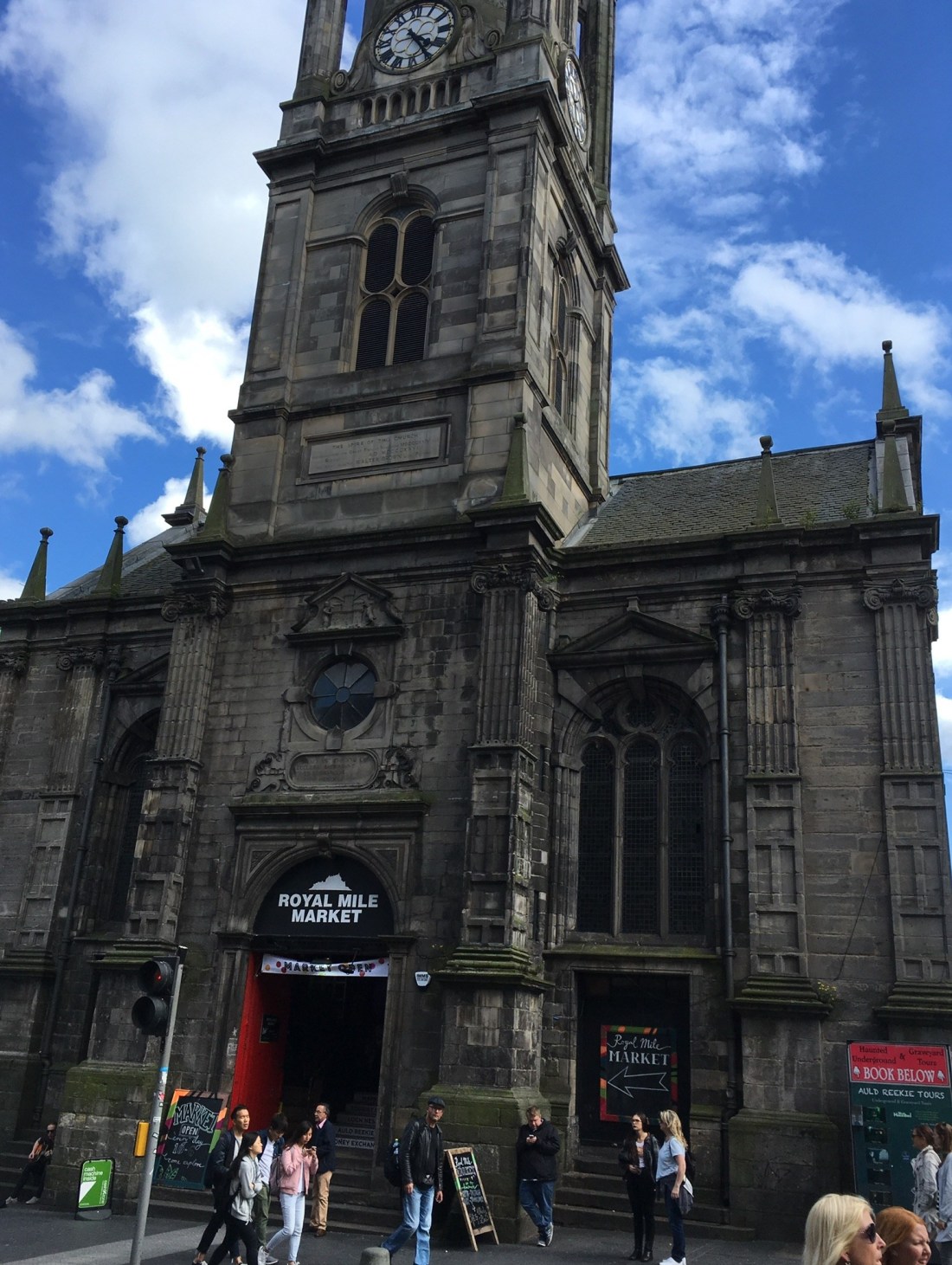
New businesses in an old church in Milton, Wisconsin USA.A repurposed church on the Royal Mile in Edinburgh, Scotland.
Two weeks of driving on the left side of city and country roads of Scotland could lead a person to prayer or to drink. And because so many churches have been repurposed as pubs in the land of bag pipes and plaid, drinking might be the better bet.
Scotland is lovely; but the more gorgeous it gets, the more twisting and narrow the roads which transport the traveler. And throughout this nation, in village after town after city, churches no longer are places for conversion of souls. Many are closed; many others have themselves been converted….. into shops, restaurants, information or community centers, and taverns.
There are websites devoted almost exclusively to listing properties once occupied by the Church of Scotland. For sale are hundreds of buildings without sufficient congregants to be sustained. Approximately 60 percent of Scots now identify themselves as non-religious…..a 50 percent increase in less than 20 years. More weddings are performed outside any church than in.
Scotland may be among the leaders but is by no means alone in these trends. We have observed much the same in many Western European countries, and we see it often in the USA.
Recently, just off the main road in the small town of Milton, Wisconsin, I spotted a 130-year old church building which once housed a Methodist congregation but has recently been converted into several specialty shops. You can get breakfast, lunch and Charming B’s coffee, facials by Laura, and “body work” at the Cat Walk Salon.
After 138 years of operation, nearby Milton College closed due to financial pressures in 1982, and those buildings have been incorporated into a historical district, which Milton has reason to celebrate. A hexagonal stage coach inn built in 1884 is said to be the oldest concrete building still standing in the USA. It’s also one of the 14 recognized stations of the Underground Railroad which facilitated passage of freed or escaped slaves.
Milton, Wisconsin is named after “Paradise Lost” poet John Milton which, noting the demise of the town’s college and central church, is either ironic or prophetic, depending on your orientation.
Voters have just made Michigan the first Midwest state in the USA to permit recreational use of marijuana.
Michigan’s political character is a bit hard to define. It’s one of those purple states…..neither blue nor red. Its state legislature and highest court remain more red than blue, but those the voters send to Washington are more often blue than red.
This middle-of-America and middle-of-the-road state has allowed the use of marijuana for medical purposes for a decade. And on the 6th of November, 56 percent of voters took the big step to approve a proposal to legalize “recreational” use of pot by adults.
This caused me to reflect upon the times I’ve spent in the Northern European city of Amsterdam and the time I’ve spent with Russell Shorto’s book “Amsterdam — A History of the World’s Most Liberal City.” It really isn’t.
Last January in Amsterdam I was experiencing a sinus headache and had need for a nasal decongestant like Sudafed, which tends to provide me prompt relief. I searched at several convenience stores and pharmacies without success before finally inquiring where I might find the medicine I knew I needed. I was told that, in Holland, the key ingredient in the most effective products — phenylephrine — is a controlled substance that could not be purchased without a doctor’s order and could only be sold in specific and regulated locations.
This was a surprising, label-bending discovery. Here I was in Amsterdam, where a person could buy, sell and smoke on the street what was illegal in most of America…..where I would walk through a haze of marijuana smoke on many streets…..but I could not purchase what in most states of the USA is a common over-the-counter remedy for a head cold.
So it appears to me that “liberal” is a squishy label. As are moderate and conservative. As are middle-America, middle-of-the-road, middle-class and all the other boxes we get placed in. Labels don’t help, any more than laws regarding cannabis, to define or understand a culture, a city, a candidate or a soccer mom.
On the day of national elections in the USA, and during the weeks leading up to and the days following, television viewers are bombarded with maps, most often dominated by the colors of bright blue and red. Maps are used to help provide us quick pictures of campaign trends, exit polls and actual vote counts, and to slice and dice the electorate.
CNN’s John King seems to have by far the fanciest maps and the most fun with all this, putting a “Magic Wall” in motion and taking us instantly to any electoral district in any state, with only a slight tap of his index finger. Perhaps he also clicks his heels together…..if so, CNN doesn’t show us that.
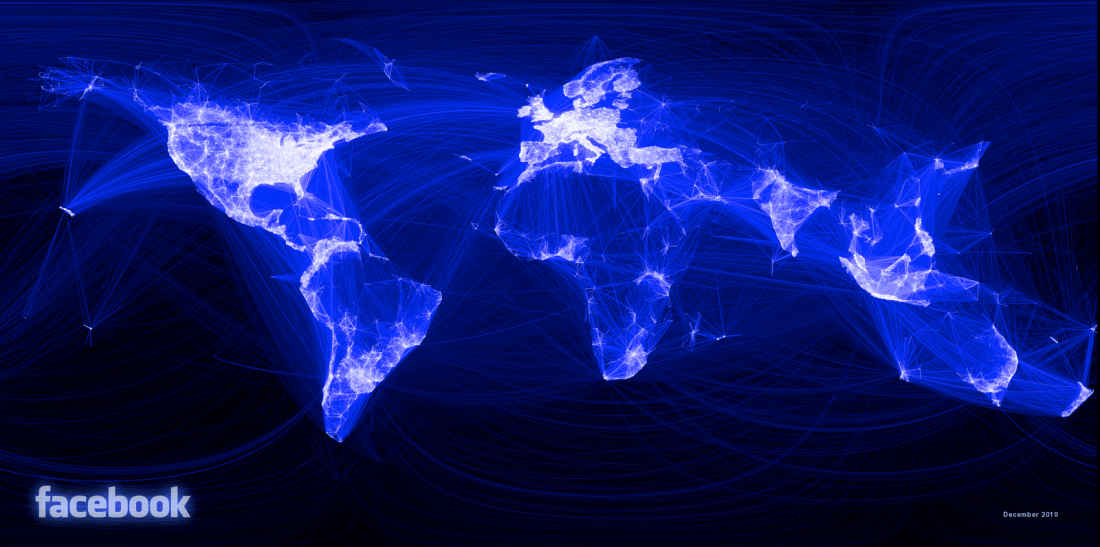
As I write this I am slogging through Simon Garfield’s book “On the Map — A Mind-Expanding Exploration of the Way the World Looks.” Most fascinating so far is a report on the 2010 initiative of a Facebook intern to map the connections of some 500 million users all at once. The result is blue lines and white patterns on a dark background. The white patches are brighter where Facebook users are more concentrated, creating on the basis of the connections alone, eerily accurate outlines of the earth’s land masses as we know them.
North America, Central America, India, Europe, Australia, New Zealand, Japan, most of Southeast Asia and Indonesia and portions of South America and Africa are among the land masses most clearly defined by this process.
But missing entirely…..completely dark spaces on the “map”…..is where we would expect to locate Russia and China and North Korea.
The picture that results provides more than a hint of the places around our planet where communications flow more freely and, either as cause or effect (I’m not sure which), freedom shines more brightly.
JER………..Note — Due to a misconnection between WordPress and LinkedIn, this posting of November 11th was not widely published and therefore is being repeated today. Please accept my apology if you are receiving this more than once.
On the days of national elections in the USA, and during the weeks leading up to and the days following, television viewers are bombarded with maps, most often dominated by the colors of bright blue and red. Maps are used to help provide us quick pictures of campaign trends, report exit polls and actual vote counts, and slice and dice the electorate.
CNN’s John King seems to have by far the fanciest maps and the most fun with all this, putting a “Magic Wall” in motion to take us instantly to a map of data from any electoral district in any state, with only a slight tap of his finger. Perhaps he also clicks his heels together…..if so, CNN doesn’t show that.
As I write this I am slogging through Simon Garfield’s book “On the Map — A Mind-Expanding Exploration of the Way the World Looks.” Most fascinating so far is a report on the 2010 initiative of a Facebook intern to map connections of some 500 million users all at once. The result is blue lines and white patterns on a dark background. The white patches are brighter where Facebook users are more concentrated, creating on the basis of the connections alone, eerily accurate outlines of the earth’s land masses as we know them.
North America, Central America, India, Europe, Australia, New Zealand, Japan, most of Southeast Asia and Indonesia and portions of South America and Africa are among the land masses most clearly defined by this process.
But missing entirely….completely dark spaces on this “map”…..is where we would expect to locate Russia and China and North Korea.
The picture that results provides more than a hint of the places around our planet where communications flow more freely and, either as cause or effect (I’m not sure which), freedom shines more brightly.
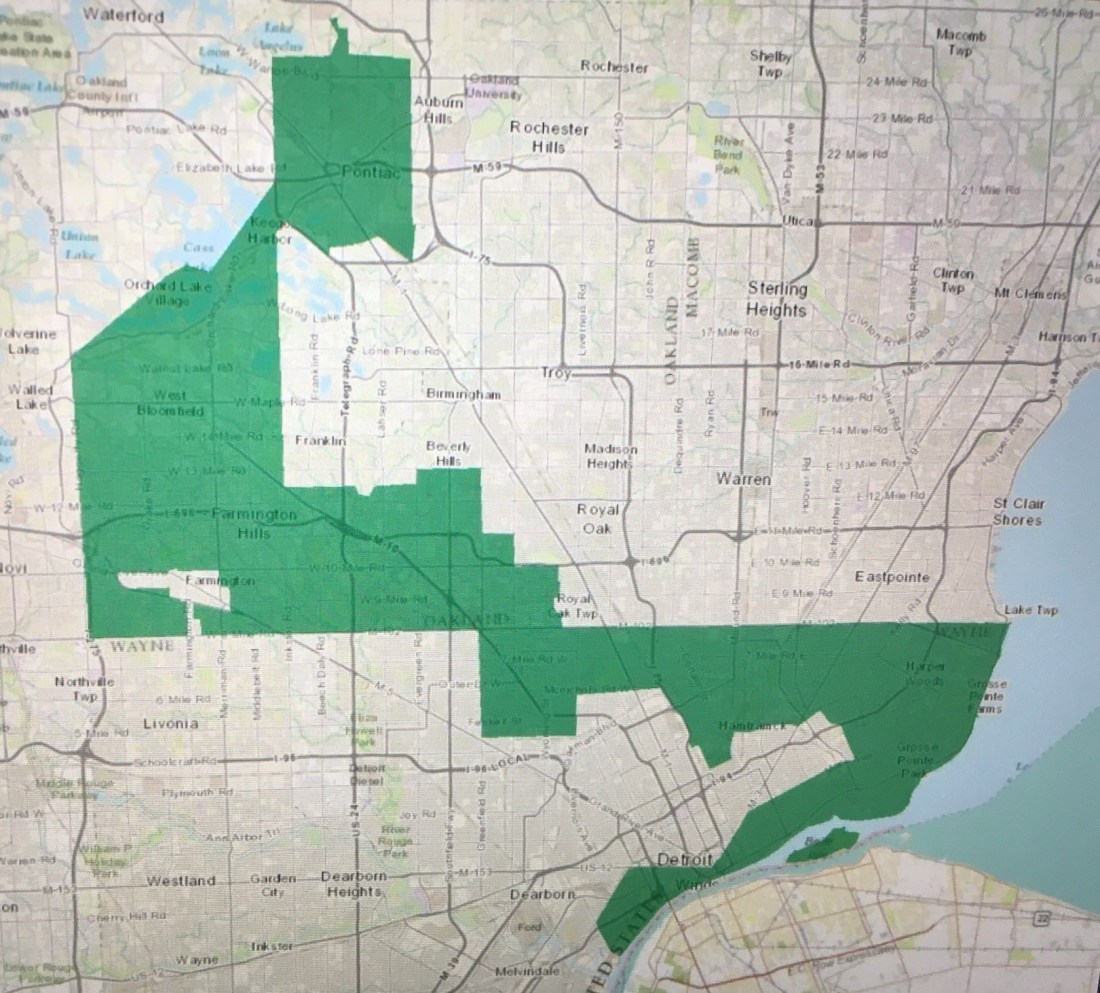
The rambling design of this voting district in Michigan may become a thing of the past.
On November 6th, about 60% of voters in Michigan approved changes in the state’s constitution which intend to frustrate partisan control for designing legislative boundaries in a state which has become notorious for its weirdly shaped electoral districts. “Gerrymandering” by the party in power has led to voting districts in many states which have little to do with geography. They are, literally, “all over the map.”
Gerrymandering has created electoral districts which tend to assure that one party’s candidates win some seats while the party in power wins even more seats without much of a challenge. This causes the candidates for the nomination by each party to make little effort to address the concerns of independent or middle-of-the-road voters. To achieve the nomination candidates must appeal to the more rigid or extreme thinkers in the dominating base of their party. And this has resulted in polarized politicians and legislatures which can agree on nothing and cannot resolve anything.
The term “gerrymander” derives from an early 19th Century governor of Massachusetts who decided it might benefit him to reconfigure electoral boundaries near Boston, saturating a few senate seats with opposition voters but packing more districts with his own party’s faithful. That governor was Elbridge Gerry.
Gerry (pronounced with a hard “g”) was no novice. He had signed the Declaration of Independence. He had helped establish the Library of Congress. Eventually he became the fifth Vice President of the United States, serving just 20 months before his death, but casting nine tie-breaking votes in the US Senate during that brief tumultuous tenure.
One Gerry-influenced reconfigured electoral district around Boston was so disconnected to geography that when it was seen on the map it looked very much like a salamander. Soon political cartoonists depicted the district as a fire-breathing, claw-bearing creature that resembled a dragon. It didn’t take long for Governor Gerry’s critics to capitalize and label his scheme “Gerrymandering.”
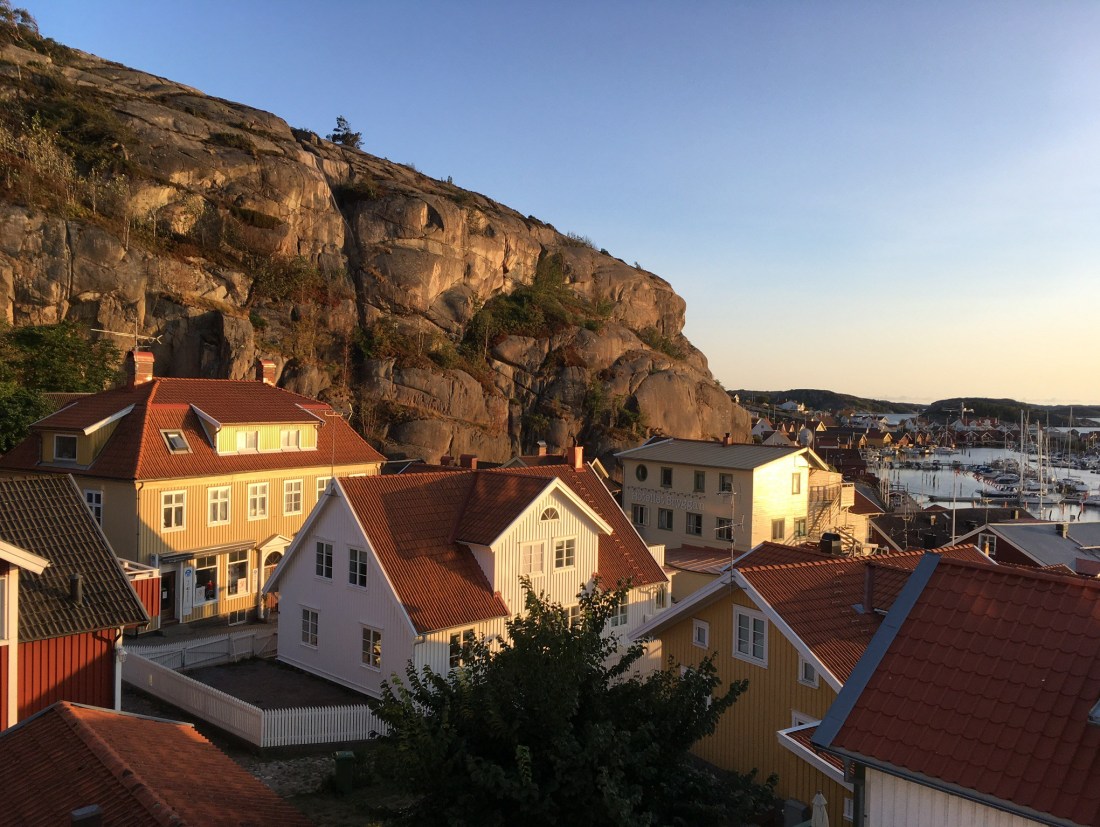
Reflecting on the sunset over the North Sea harbor town of Fjallbacka, Sweden.
Throughout my four dozen years of employment in an office setting, I became accustomed to people making appointments and keeping them. Appointments were on time or the opportunity for the meeting was lost.
The biggest adjustment I’ve had to make in my first four months of retirement is to realize that is NOT how the so-called service world works.
Plumbers, painters, electricians, landscapers, appliance repair persons — whatever the expertise needed — do not operate their working world as I operated mine. They do not establish a specific agreed upon time for their arrival; they provide a two to four-hour window of time when they MIGHT arrive. And half the time they miss the window by hours or miss the appointment altogether.
I have been critical of some doctors who routinely keep their patients waiting for 30 to 60 minutes, but physicians are prompt in comparison to the random scheduling of repair professionals.
I guess, now, the shoe is on the other foot. I have more need for the time and talents of the service industry than they have for my projects and payments.
In my postings on this site I often write about the benefits of travel…..that’s a principal purpose of this site. Well, I’ve discovered another benefit: that planning and executing travel is the best antidote I know for forgetting the frustrations of home maintenance.
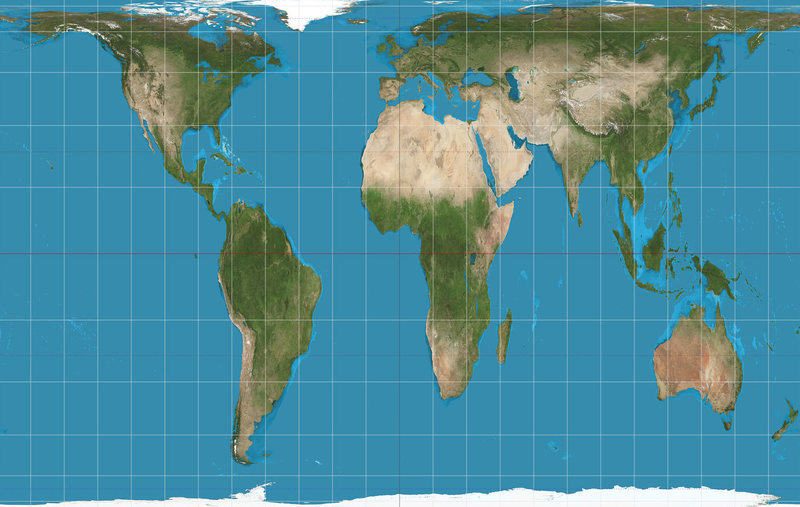
The “elongated” appearance of Africa and South America on this “Gall-Peters” projection world map may not look like what we learned in school, but it’s a more accurate view of the world’s various land masses.
The flat map of the world to which most of us were introduced in school and at home is inaccurate. The globe on our teacher’s desk probably was correct, but the flat map in textbooks or affixed to the wall or pulled down like a movie screen in the front of the classroom likely was not. It significantly oversized some countries and undersized others.
Compare Africa, Australia and Greenland. They appear quite similar in size on the typical flat map; but, in fact, Australia is thee times larger than Greenland, and Africa is more than twelve times larger.
Some people posit that this is the result of a cultural bias toward the ethnic groups of the Northern Hemisphere, and it is certainly true that most of the earliest mass-produced world maps are the results of efforts by persons who have lived north of the equator. Others suggest that this is a bias against civilizations of the Southern Hemisphere; and certainly there were magnificently accomplished cultures which have vanished…..some vanquished by violence and/or viruses brought by invaders from the Northern Hemisphere.
The map we grew up with and still use most often is called the “Mercator” world map. It places a sphere on a flat page, the result of which are distortions which we assume are accurate depictions. They are not.
This map gets its name from the Flemish geographer and cartographer Gerardus Mercator who lived in the 1500’s and first projected a cylindrical map onto a flat surface. It had the advantage of presenting the planet’s latitude and longitude in straight lines and right angles, but it distorts the actual size of objects…..they become larger the farther they are from the equator. At more than 70 degrees north or south of the equator the distortions render the map almost unusable, which partially explains why parts of the Article Circle, Antarctica and Greenland are often omitted from the flat map presentation.
While the Mercator map was a major breakthrough for nautical navigators of the 16th Century, we should be able to do better for the rest of us world wanderers in the 21st Century.
For every country my wife and I have visited together for the first time during our marriage, we have placed a yellow dot on a large wall map in our home. We added six dots following our recent summer sabbatical to eight European countries. However, more significant than the dots we added are the dots already on the map where the countries no longer exist…..at least as they were named and we saw them years ago. Yugoslavia, for example.
To summarize a few recent of very many complicated changes in this region, Yugoslavia became a nation more completely titled the “Kingdom of Serbs, Croats and Slovenes” at the end of World War I, was renamed the Kingdom of Yugoslavia in 1929, and was reconfigured at the end of World War II as the People’s Republic of Yugoslavia.
Since we visited in the early 1970’s and brought home fond feelings for the rural people we stopped to “talk” with as we drove through the countryside, the former Yugoslavia has undergone an orderly and somewhat peaceful period of autocratic leadership followed by tragic episodes of civil war and ethnic cleansing after the dictator’s death.
A current map of the region no longer shows a single nation consolidating the republics of Slovenia, Croatia, Bosnia and Herzegovina, Montenegro, Serbia, and The Former Yogoslav Republic of Macedonia. In the place where this one nation was held together by Josip Broz Tito’s socialist rule from 1946 until his death in 1990, we now find six separate countries, and Kosovo as an autonomous area within Serbia.
I’m not sure now which of those countries we actually set foot in four decades ago. And after all they have been through, I’m not sure any of those countries we did visit would look and feel now at all like they were before the physical destruction and human atrocities of the 1990’s.
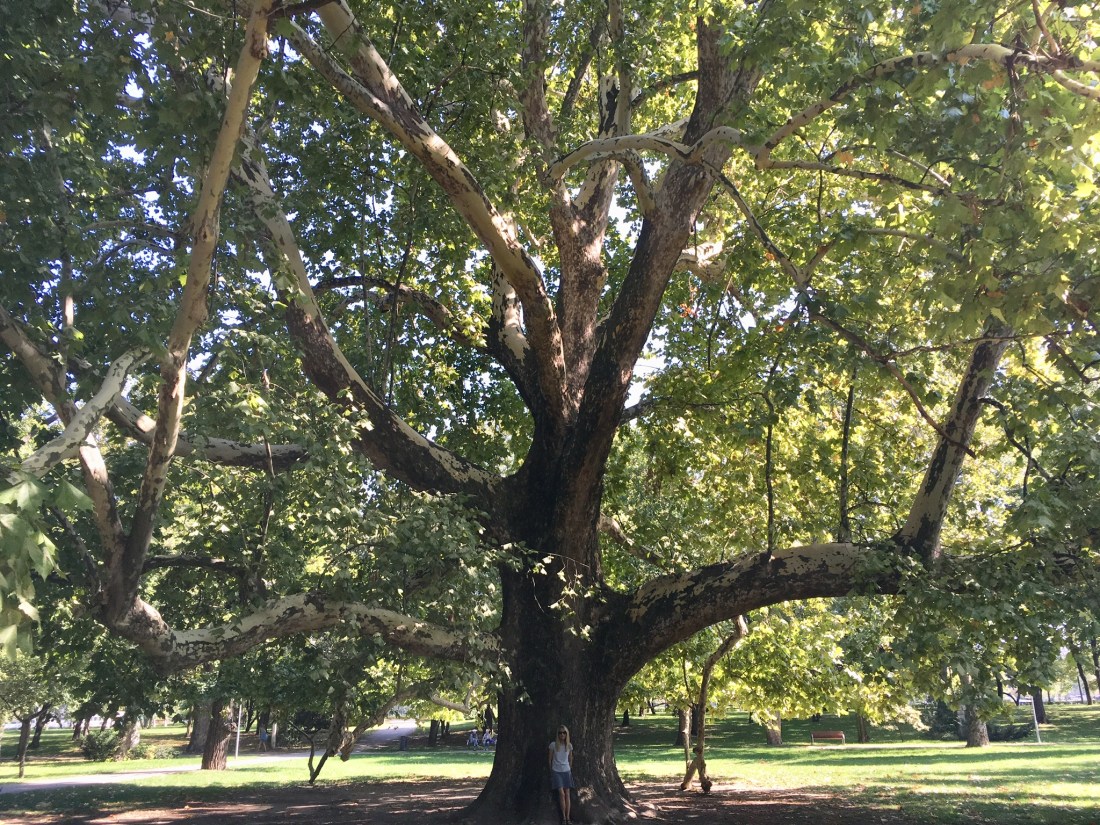
A London Plane Tree planted on Budapest’s Margaret Island in 1823 — aptly called an “Ancient Sycamore.”
In Europe this summer I saw trees which were nearly 200 years old…..trees which have survived the devastation of two world wars……like the huge sycamores which line many boulevards and grace the parks of what once was bombed-to-bits Budapest where, at a point in 1945, eighty percent of buildings were severely damaged and all seven bridges spanning the Danube were destroyed…..and I wonder why my peaceful home in the USA had to sacrifice a perfectly healthy 175-year old white oak with a 5-foot diameter base to the local board of water and light’s assault on trees in our community.
The utility company was attempting to pre-empt storm damage. It apparently believes that removing or savagely trimming trees is a better course of action than re-routing or burying its precious power lines.
The utility company might have considered pollarding trees, an “old country” procedure that produced ideal-size firewood needed to heat many European homes centuries ago. It’s a tree-trimming technique that is still practiced in many European cities today to maintain trees at prescribed heights. Pollarding wouldn’t have been my first choice, but our utility company went with the worst choice…..if, in fact, it gave any thought at all to any course of action other than search and destroy.
It is not a compliment to our community that a wire the diameter of a breadstick is considered to be of greater value to society than a massive oak tree which predates that line by 100 years.
Allowing this gigantic glory of nature to be removed from my home’s backyard is the worst decision I’ve made this year. The effects will be seen and felt by those who occupy this space for at least the next 100 years.
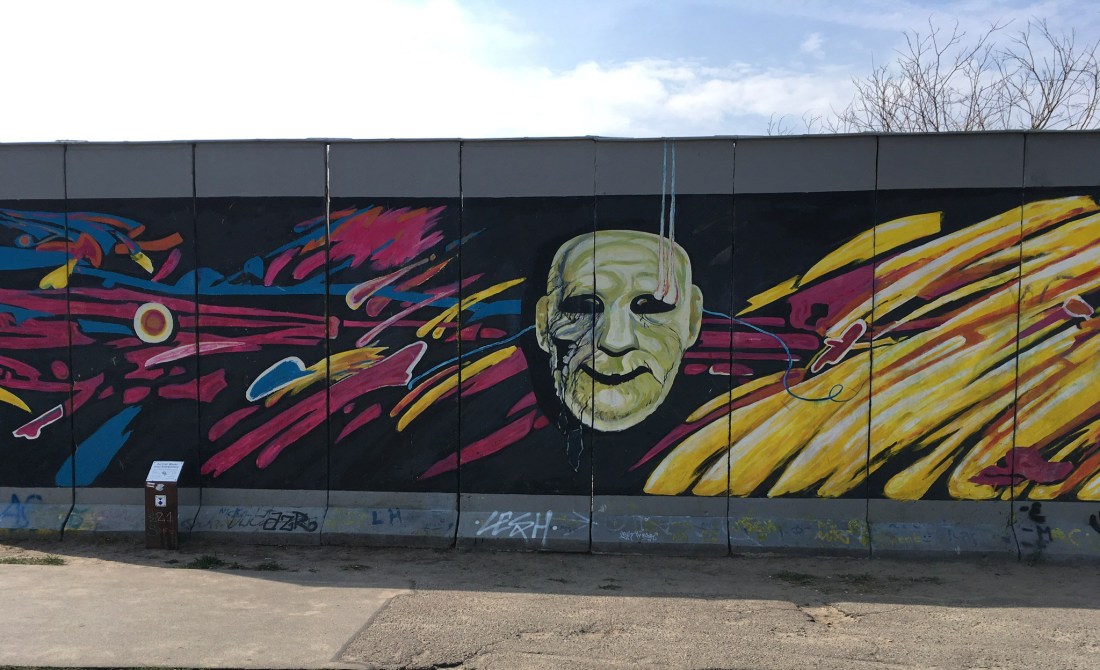
A glimpse of the mile-long “East Side Gallery,” an open-air mural with more than 100 paintings by artists from 20 countries. The “canvas” is preserved portions of the Berlin Wall.
Compared to Scandinavia, it appears that central and eastern Europe have much more litter and graffiti. Which caused me to wonder…..When does graffiti stop being a kind of litter and start becoming art?
It’s likely that a person who has studied art history and architecture not only could help answer that question, but also would understand at a much deeper level than I, more of what surrounds a traveler in Europe. Preserved art and architecture provide a visual record of the comings and goings of deities, despots and dynasties on this diverse continent.
A similar deeper understanding would benefit a traveler who has studied the diaspora of religions across the European continent and its neighbors…..appreciating more fully than I how, for more than 3000 years, nations and cultures have been created, removed or erased in the name of religion, often in complicity with hunger for power and/or wealth.
Those who have studied geography will understand how the shape of the land has affected European history…..how the presence of natural barriers like mountains and oceans has insulated and protected some nations, while the absence of such has made other lands perpetual battlegrounds…..and how the proximity of rivers and oceans has allowed some nations to enjoy commercial development, while the lack of such resources has set back and even impoverished other nations.
The more a traveler knows of these subjects, which might have seemed of no practical use when presented to us in our youth, the deeper one’s appreciation is of the long and complex history that still influences relationships and events on the old continent. In contrast, the more I see of Europe, the less I feel I really know about Europe.
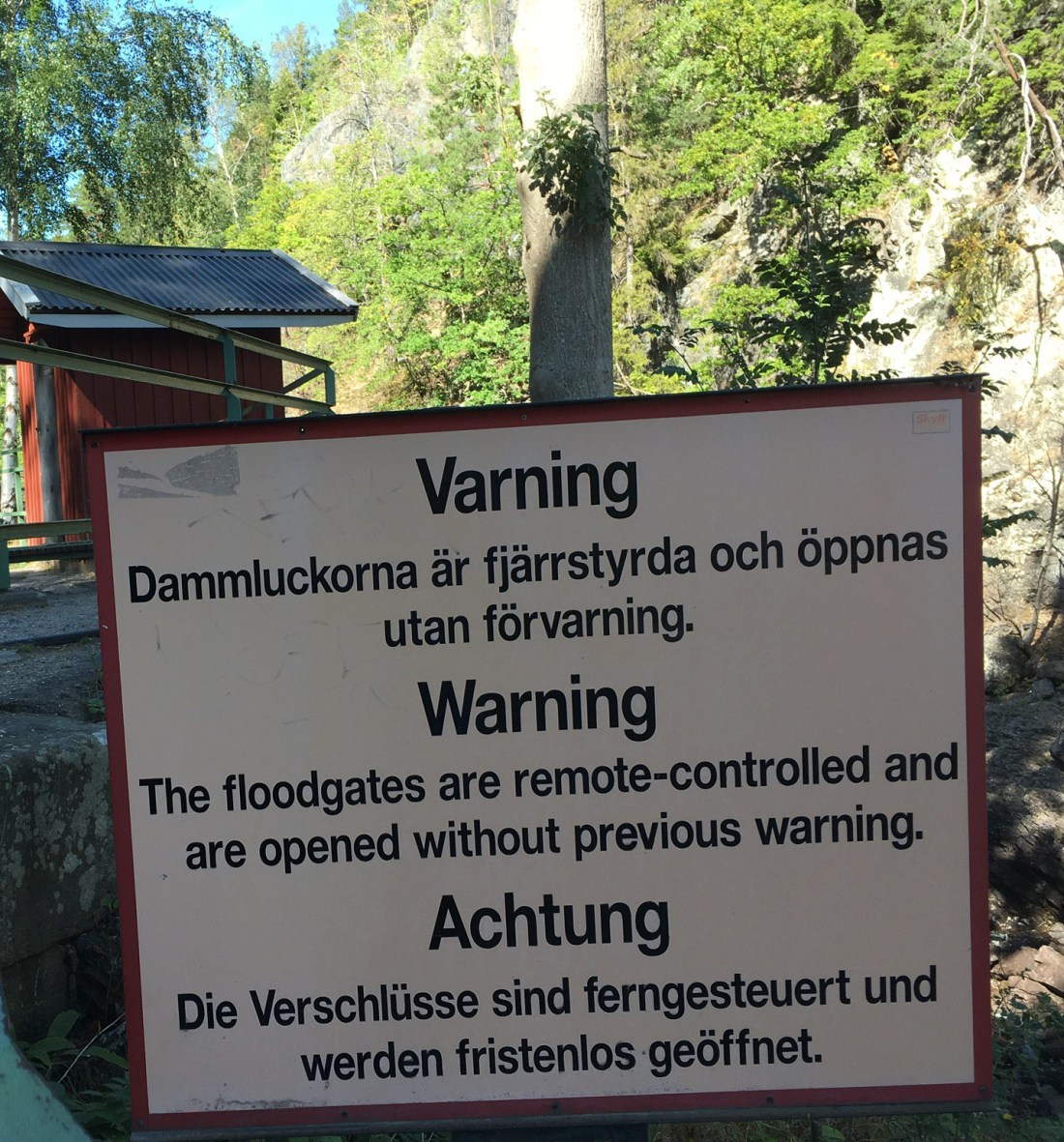
A sign posted in three languages at the Haverud Aqueduct, the key engineering feat of the 150-year old, 160-mile long Dalslands Canal in western Sweden.
My wife once said that when Germans speak it often sounds like they are angry. Which caused me to wonder…..when the French and Italians speak their native tongue, do they want to make love?
My favorite travel destinations are places where I can’t drink the water, don’t know what’s in the food and can’t speak the language. It’s then that I know we’ve really gotten away.
There were times this summer, in southern Poland for example, when my wife and I did not hear another native English speaker during an entire day. Those were precious days.
But, not withstanding this pleasure in the unknown, every trip I take to a country where English is not the native language renews my frustration for having my early elementary school education occur in a place and at at time when it was not considered necessary that American children learn a second language early in their lives. Instead, for my generation, if there were any foreign language requirements at all, they were at high school and college levels when it is much more difficult to learn a second language.
In contrast, children of my generation in other countries became fluent in at least one additional language, and children all around the world today are being introduced to, if not immersed in, second and third languages when they are very young. They are not only learning other languages in the classroom, they also are using these languages on the playground. It’s becoming a part of who they are and what they have to offer colleges and employers.
And later, when they travel the world, they enjoy a level of interaction and education that I cannot attain.


 Along the eastern shore of Kauai, people arrive in one’s and two’s and more. Some sweaty and in running gear, some shivering and wrapped in blankets, some in the largest and loudest shirts you’ve ever seen. Some carry cameras, and many carry caffeine. It’s the church of the ocean sunrise.




 ALL OVER THE MAP