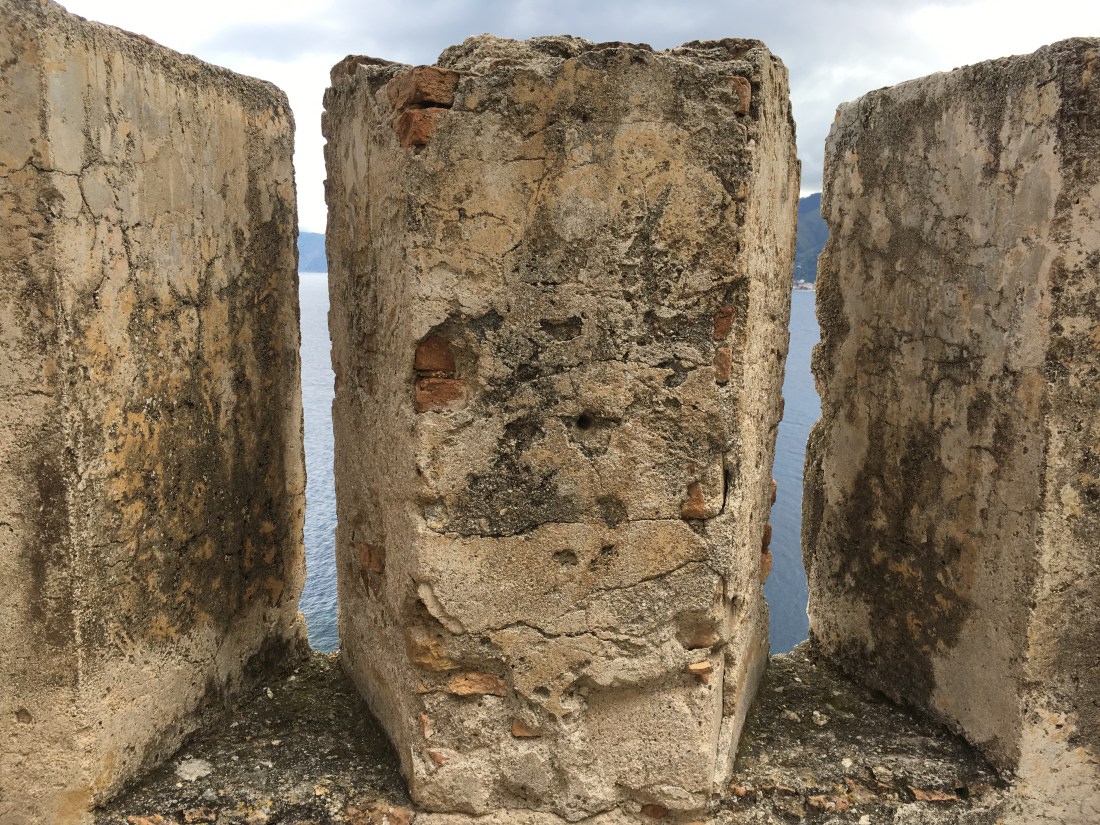
The “loopholes” of this ancient fortress above Scilla, Italy invite modern metaphorical allusion.
One of the failings of non-fiction writers is to see one thing and assume it applies to all things. We are prone to generalize what is just an isolated occurrence.
Writers of fiction do this too, but they are better at compensating for this frailty through the creation of their characters and the pull of their plots.
The “too-quick-to generalize” weakness is especially apparent in those who attempt the briefest forms of non-fiction, including blogs, because there is not the time or space to thoroughly describe, define and defend.
So, what is a blogger to do? Does the writer avoid conclusions, abandoning an orphan observation or idea without venturing support and opinion? Is the blogger’s task to stick to a specific situation or scene and just let it speak for itself?
Perhaps, at best, it is the blogger’s role to reveal metaphors, to help readers see how one thing is like another and, therefore, possibly more universally true or applicable than might otherwise be apparent.
Perhaps the task is to do this with precision. Plainly, without showy vocabulary. And quickly, before the reader is diverted to some other posting, and then another.
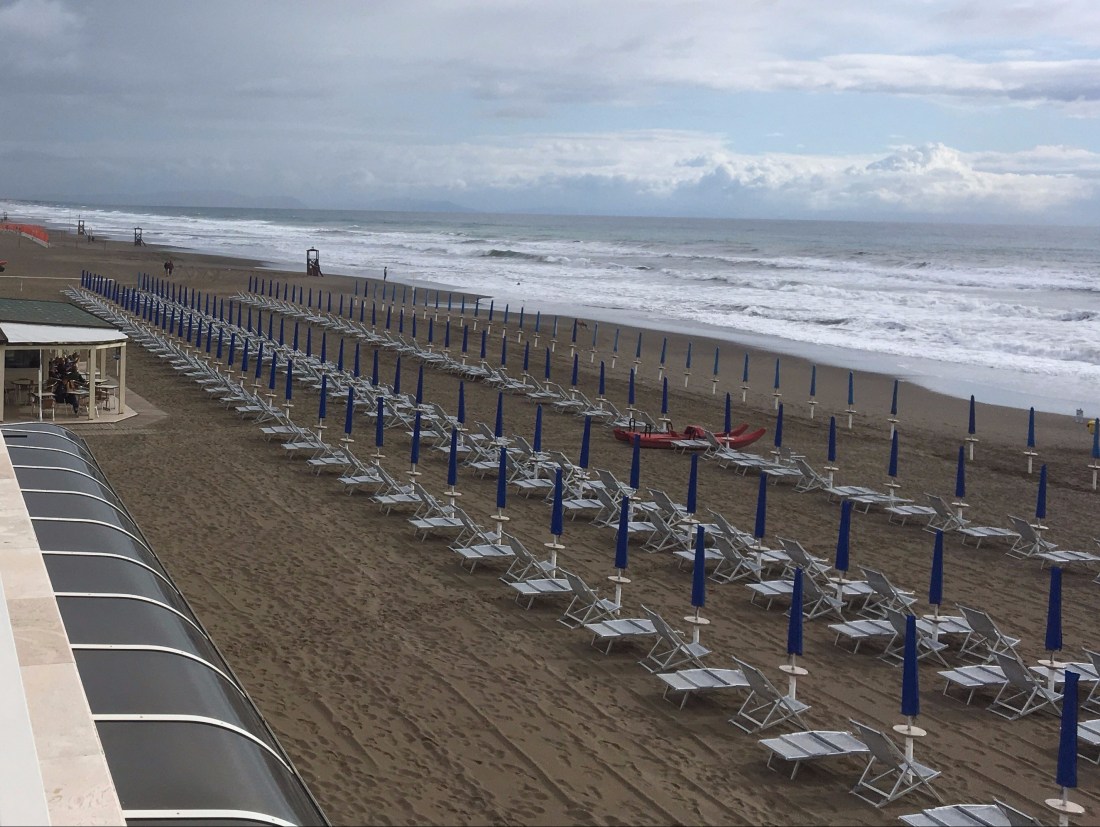
On a sunny day in late May, every beach chair is set out, and all stay empty along the Ligurian Sea of Northern Italy.
It has been said — millions of times, I suppose — “All roads lead to Rome.”
This proverb dates to at least the Middle Ages. Something close to it was put in writing by a French theologian in the 12th Century AD. I suppose it had some factual validity during the height of the Roman Empire a thousand years earlier.
The meaning – and it’s as true for elementary school children as university post-graduate students, and in the work place for blue and white color workers alike, and for both local or world travelers – is that there are many different ways to get to the same answer, solution or destination.
All of this is fine and good, but we spent most of a recent three-week road trip headed away from Rome. Our intent was to focus on what we had not visited before…..the less-traveled countryside and small towns nearer the toe of Italy and on the islands of Sicily and Sardinia. Until the final day of our travels, if we saw a sign that pointed toward Rome, we headed the other way.
Sea-side Seating
Every day in May, rain or shine and no matter how chilly, all along the Italian Mediterranean shoreline, those who control Italian beach properties set out in perfectly aligned rows, every lounge chair and umbrella in their arsenal. Some places it’s three or four dozen chairs; other places it’s more than two hundred.
But most days in May, at every one of the beaches, every one of the chairs goes unused, all day.
I understand that, during Europe-wide holidays in August, a capacity crowd might be expected. But why set up all the chairs at the start of every day, and remove them every evening, day after day, in May? What’s the purpose?
Is this make-work job security that we’ve seen so much of in countries outside the USA?
Does the local chamber of commerce or tourism bureau require this to demonstrate capacity?
Or, might this be just a male thing, like a marking of one’s territory?
The Cork Screw
Because my favorite wines are sauvignon blanc from the Marlborough region of New Zealand, where screw-off tops rather than cork stoppers are considered the state of art, I have not been thinking much about the corkscrew. But while recently in rural and small town Italy — where New Zealand wines are impossible to find, cork trees provide a cash crop and cork is still king when it comes to sealing wine bottles — I purchased a bottle of white wine at a market…..and later struggled mightily, and unsuccessfully, to open the bottle.
Try to remove the cork from a wine bottle without one and you come to appreciate what a marvelous invention the cork screw is. Seems like a simple enough device, and marketers have added bells and whistles. But the essential ingredient of the device – the screw – has never been bettered.
Whoever it was who invented the corkscrew is unknown. It is believed that what became useful to open wine bottles was a modification of a device widely used to dislodge bullets stuck in rifles. The earliest known patent for a corkscrew as a bottle opener was attained by an Englishman in the 1700’s. He should have become a rich man.
JER
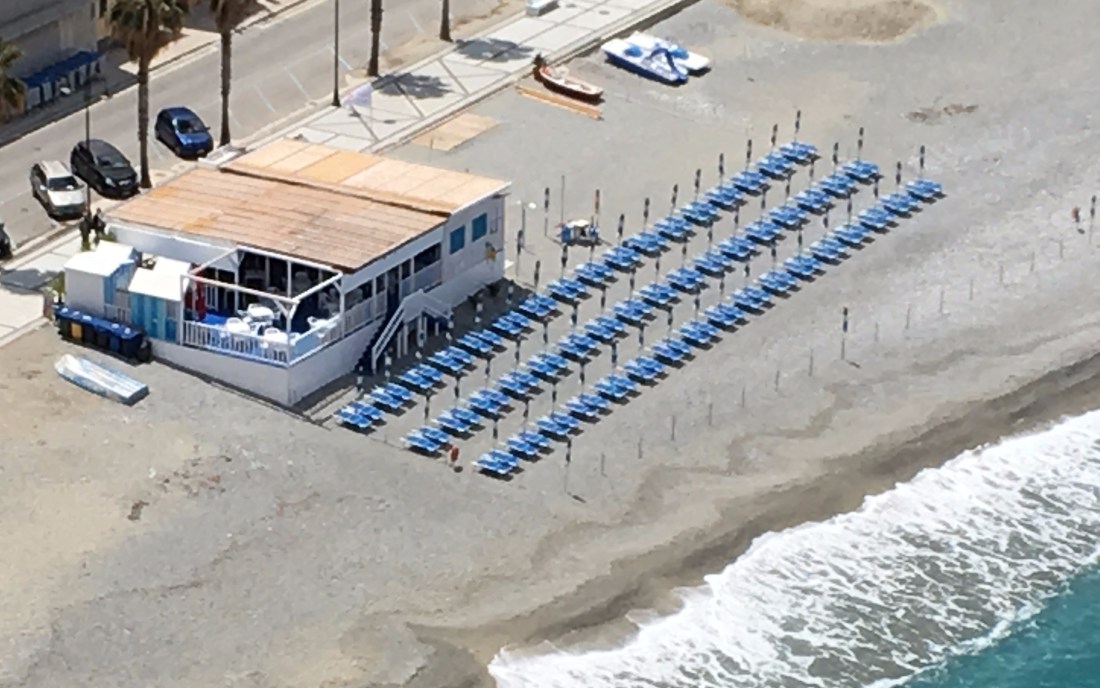
Every beach chair is available in May at a Beatles tribute bar along the Tyrrhenian Sea at Scilla in Southern Italy.
It is difficult to find anything but Italian trattorias and ristorantes in some parts of Italy. During our recent 2,000 mile road trip through small towns and countrysides the length of the mainland’s Mediterranean coastline, and on the islands of Sicily and Sardinia, we never saw restaurants featuring Mexican or Indian or Japanese or French or German motifs and menus, and we passed just one Chinese restaurant. While we love Italian fare, we also enjoy variety, which Italy appears to lack, at least outside its largest cities.
On a more positive note, we encountered in this thin slice of mostly rural Italy, very few outlets for the fast-food chains common in the USA and many other countries…..only a few McDonalds, only one KFC and one Burger King, and none of the pizza and sub-sandwich chains which have sprouted in sprawling strip malls across the USA and around many other parts of the world.
We speculate that the lack of menu diversity and Western fast food chains results from the dining traditions which still dominate Italian culture……the large mid-day meal…..the late evening meal….and in both cases, the communal commotion of those events. Eating is a group activity — a long, noisy, often festive process that works its way through antipasto choices, then the pasta course, followed by the meat or fish course, and then dessert and coffee and more.
Another positive spin on the lack of culinary diversity is that the small towns and country sides of Italy near the sea are intentional about being different than other countries and are maintaining a unique Italian identity. Globalization has led to finding the same foods everywhere, which takes something significant out of the adventure of travel. But in those parts of Italy where we recently traveled, the fare is Italian or it’s nothing at all.
Visitors to these less-traveled parts of Italy won’t find the same food they eat at home. There’s no room at the table for wiener schnitzel or a Big Mac. It’s as if the official policy of Italy’s small-town Mediterranean coastline dictates: “If you want French food, go to France.”
Why is it that “quaint” has such a strong pull…..so much more attractive to me than ancient, more magnetic than either modern or massive? Why does cobblestone calm me the way the smoothest asphalt does not? Why does scaling and discolored stucco draw my attention, and affection, more than shiny steel and gleaming glass? Why will I drive past 2,000 year old antiquities in favor of more time with “Old World” charm? What is it about imperfections and small dimensions that attracts me when I travel to small towns and countrysides?
Quaint is not quirky, and neither weird nor whacky; it’s too substantial for that. Old, but not necessarily old fashioned. In style, but without a hint of being trendy. Without trying.
Parts of the Almalfi Coast south of Naples — in its smaller villages which cruise ships and tour buses mostly ignore — and some areas further south to the “shin” of Italy — still disregarded by popular guide books — qualify as quaint.
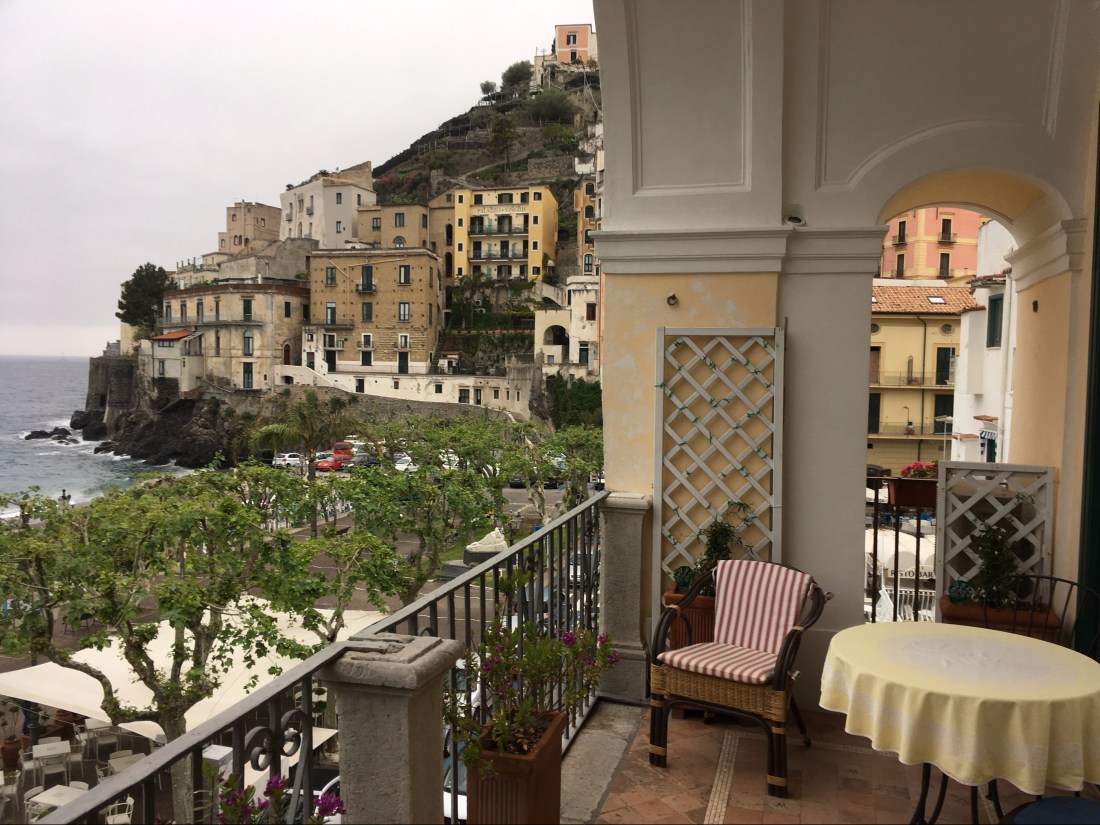
For example, it required three separate keys to open three different doors to enter our apartment up three flights of worn stone steps of the oldest building in unheralded Minori. Busy Amalfi coastal road traffic passed directly below the balcony which faced south across a promenade to the Tyrrhenian Sea. Windows without glass or screens, but no bugs. And at night, with solid floor-to-ceiling doors hiding the windows, no sounds of traffic, yet the soft roll of the ocean somehow seeped in. This is quaint.
From a distance the roads carved in the rock along the Amalfi Coast appear to be among the thousands of terraced gardens and vineyards which have been clinging to the mountain sides for centuries. Up close the roads are an engineer’s marvel and a driver’s nightmare. Quaint…..and yet thrilling…..proof that quaint need not be boring.
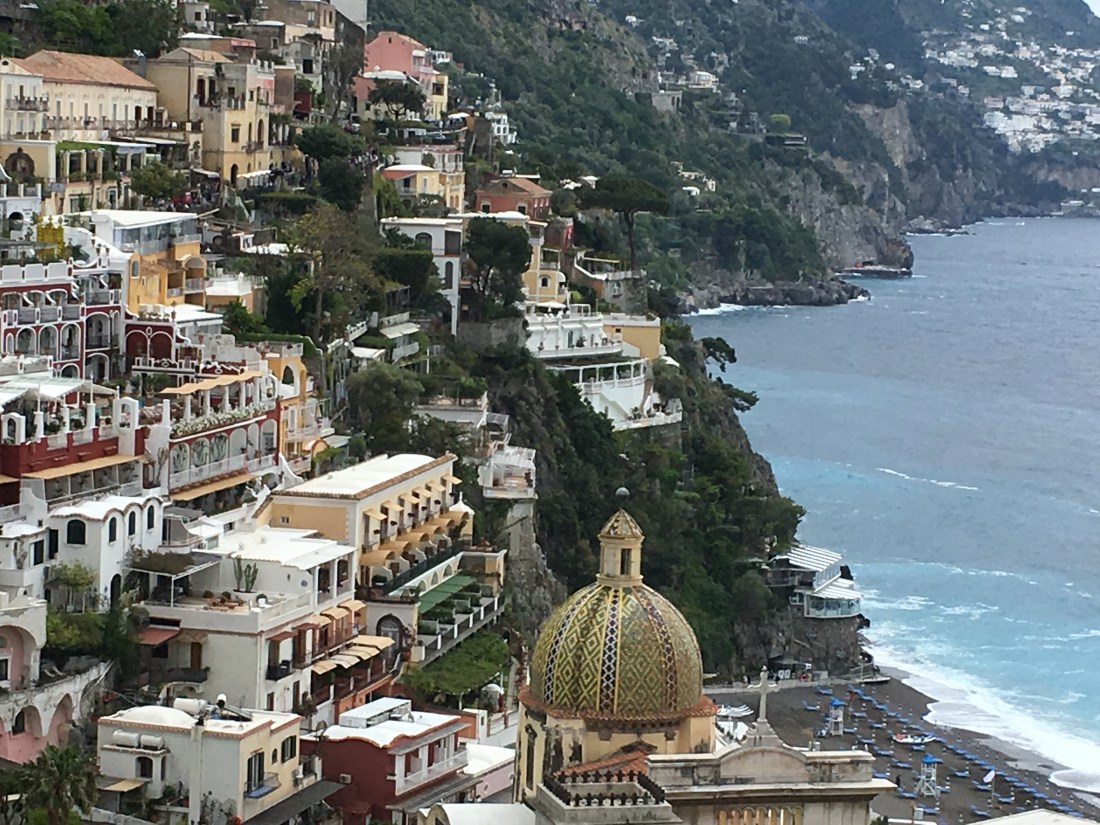
We wound our way through village after village of the Amalfi Coast, with stops down a deep-cut harbor near the old fishing village of Praiana and at popular, photogenic and pricey Positano. We ascended the cliff-clinging road to refined Ravello, the hill-top village which has been made famous, but less quaint, by its annual music festival and international celebrity visitors.
Later, along the shin of Italy, we drove a coastal road through villages missed by the expressway, where quaint was more likely to be found. In fact, we discovered that the twisting roads and tiny villages of the Maratea region were understatedly as wonderful as the Almalfi Coast, but far less crowded.
On the island of Sardinia we found another Amalfi Coast-like drive — in fact, more beautiful and less crowded — along the southern shore’s “Golfo di Teulada;” and we found that quaint feeling we relish at a rural home on the much smaller island of Sant’ Antioco — a small rustic villa, which is now booked through Airbnb.
Back on Italy’s mainland, along the Gulf of Genoa, we traveled the small coastal road along the Italian Riviera where too-magnificent-to-be-quaint homes distract drivers during dangerous turns. Then we visited the five celebrated villages of Cinque Terre which are spectacular in their setting but, like towns on the Amalfi Coast, may be losing some of their charm to the tsunami of tourists and trekkers.
Quaintness is a hard characteristic to have, and perhaps even harder to hold on to.
JER
After three locked doors and three different keys, a room with a view in Minori.
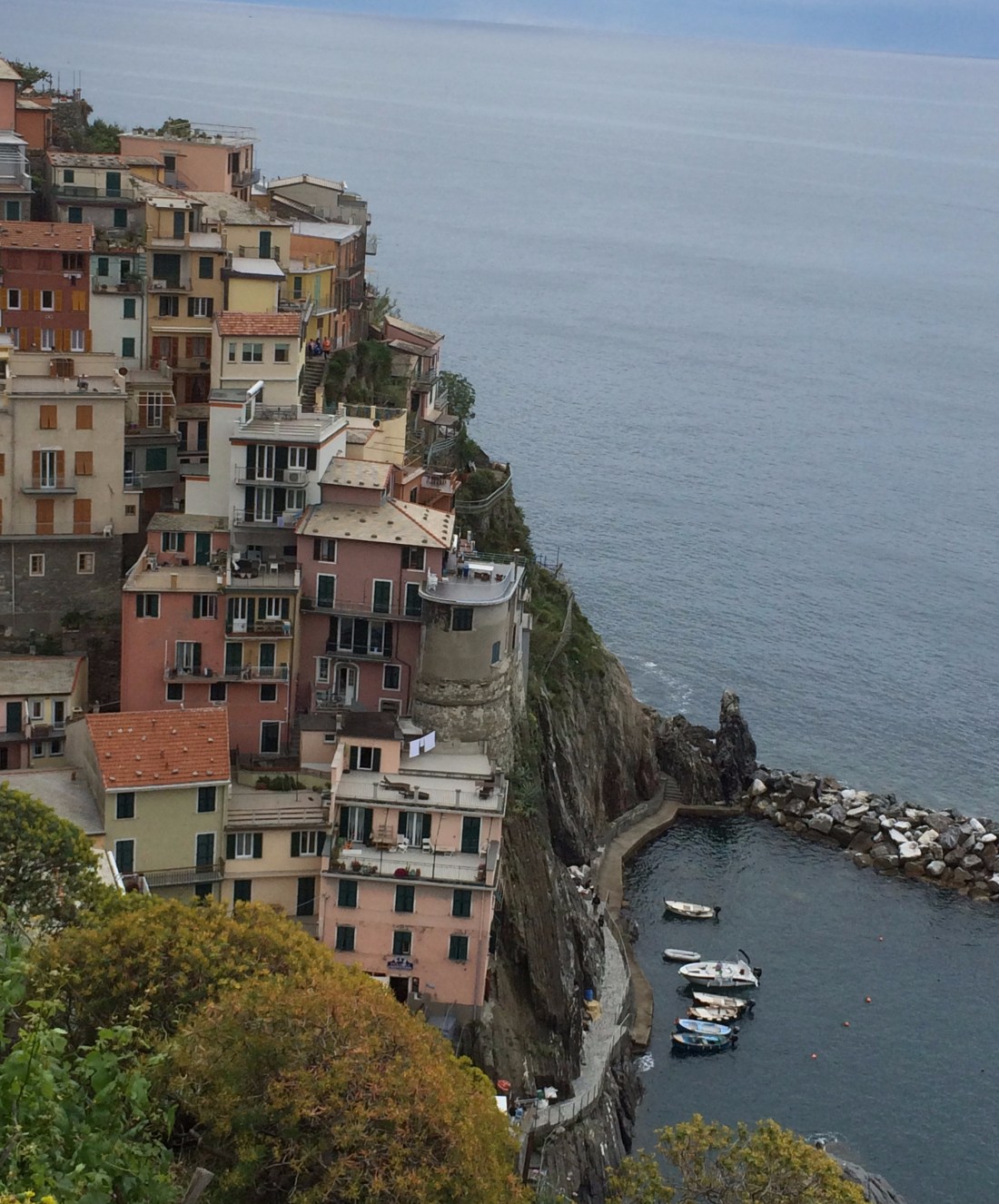
Manarola, Italy — one of the featured five villages of Cinque Terre.
From high above the shores of Cinque Terre (“five earths, or lands”), the five famous villages look lovely and as spectacularly situated on the Gulf of Genoa as they are reputed to be. All can be reached by coastal train or on foot via a honeycomb of trekking trails; four are accessible by water; and while they all can be approached by car or motorcycle, none can actually be entered with a private vehicle.
Our first visit was to Vernazza, the most disappointing of the five villages. It’s a tired town…..run down, and over-run by tourists. The approach on foot along a road accompanied by a cascading stream is pleasant enough, as is the approach by boat into a small harbor rimmed by wavy black rocks, streaked with what appears to be white marble, which still have the liquid look of the time millenia earlier when the cliffs were formed. But the buildings which front the harbor at venerable Vernazza have falling-down facades and closed-up shutters, more fitting for a deserted warehouse district than a world-renowned destination for trekkers and travelers.
With its cliffs covered in cascading steps of crops and flowers, and its deep river gorge, Manarola would have been our favorite of the five villages. It’s the most vertical and the buildings are the most colorful. It absorbs and disperses the train-loads of tourists better than Vernazza. But Manarola has made one terrible mistake. It has covered more than a mile of its gorgeous river and water falls with a pedestrian road, parking lot, church plaza, shops and eateries. One can hear the river rushing under the pavement, but the river and water falls can’t be seen. There had to have been a better way.
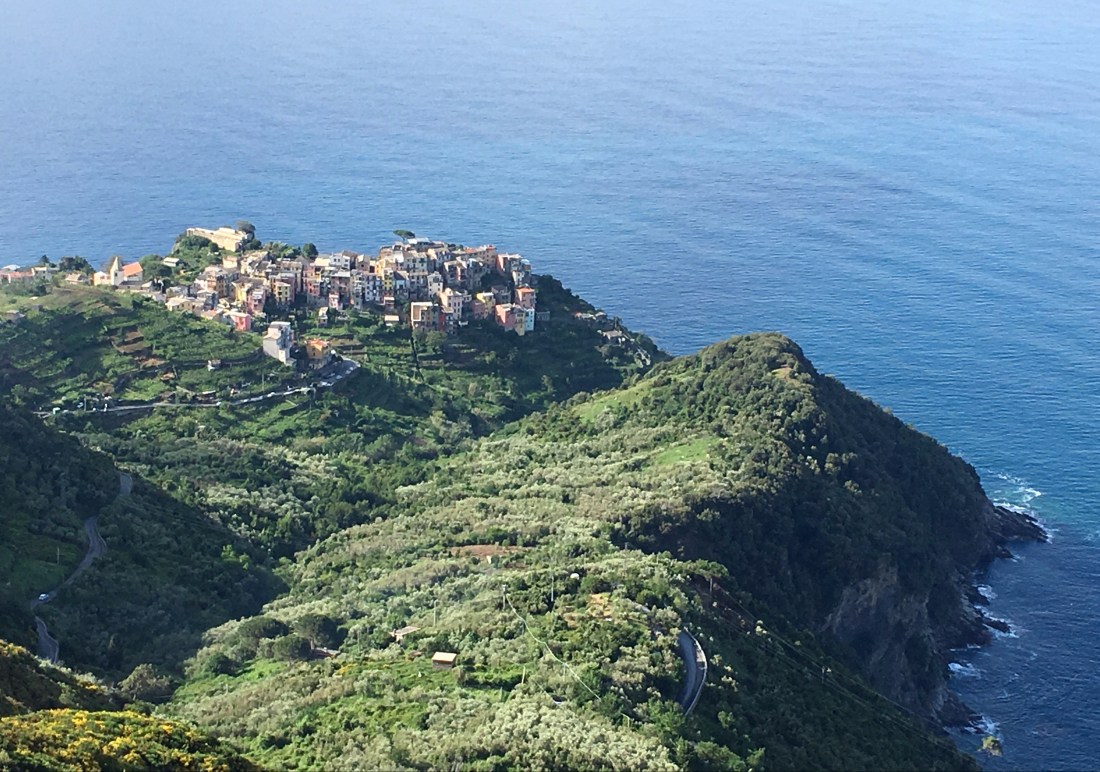
Corniglia doesn’t have water problems. It is set high on a cliff without river or ocean access. The city provides outstanding venues for ocean viewing, and it has the smallest tourist onslaught. It conducts itself at a pleasant pace. A lovely spot.
Furthest northwest is Monterosso, which has the broadest exposure to the ocean….. actually two gravel beaches separated by a rock outcropping with (what else) a fortress on top. Night-time lighting at the ocean’s edge, which was visible to us from our high hillside accommodations twenty miles away, beautifies the setting. The area around the smaller southern beach is more charming; the train station is adjacent to the larger northern beach. Monterosso is the most accessible and thus the most visited of the five villages.
Furthest southeast is the village of Riomaggiore which features a small beach surrounded by tall, colorful buildings. It is reputed to have inspired more paintings than any of the other four villages; but it was a windy, wet day that we were to tour it; so while we can attest that it’s a city of towering buildings over narrow passage ways, we cannot truly attest to the beauty that has inspired generations of artists.
Cinque Terre is Italy’s smallest national park, but it can provide a traveler more spectacular vistas and physical exercise in a single day than most places offer in a week.
JER
Above landlocked and lovely Corniglia in Cinque Terre.
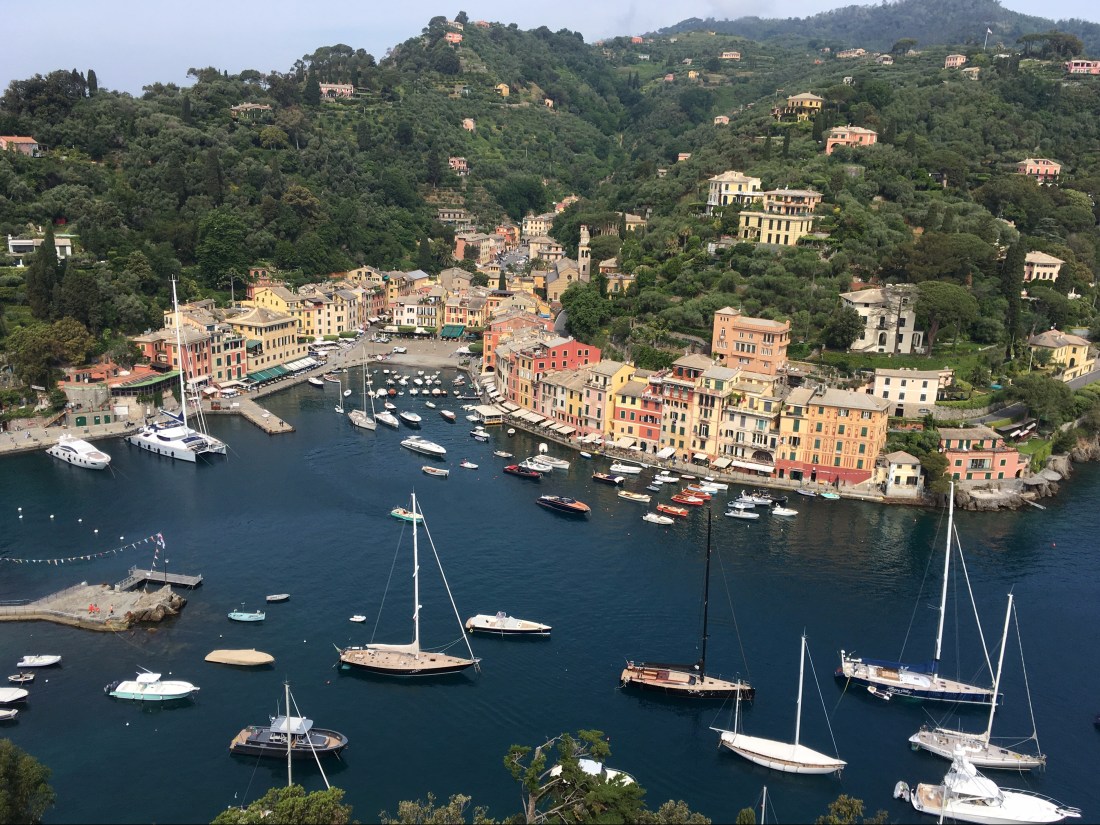
Don’t get me wrong…..we loved Portofino. The views of the long, curving harbor — and from that harbor — are wonderful. Story book. Historical. The walk above the town to Chiesa di San Giorgio and then to Castello Brown and on to Faro di Portofino is invigorating and interesting, and it provides spectacular 360-degree photo ops.
The bells of Chiesa di San Martino add charm. From eight in the morning until ten at night, at the top of every hour, they sound out the hour (eg., eight times at 8:00 am); but they do this twice each hour, three minutes apart. The only explanation I received for this duplicate service was that the priest must think the parishioners are hard-of-hearing. To me this ministerial meddling makes sense because, between the two soundings of eight bells at 8:00 on Sunday morning, the bells rang another 30 times…..very loudly at first and then gradually softer…..as if to wake Saturday night’s revelers and rally folks for Sunday worship.
From eight-thirty in the morning until nine-thirty at night, the bells also ring one time at each half hour…..except at 19:30 (7:30 pm) when they toll any number of times…..45 times one evening and 29 the next. No local I asked could tell me why this happens, and – amazing to me — none of them had actually noticed!
Portofino has been the setting for many literary works, including one of my favorite fun novels, “Beautiful Ruins,” which depicts the shallowness of 20th Century celebrities, especially motion picture stars. And ironically (or perhaps not), Portofino suffers from a similar superficiality today.
On closer inspection, not everything in Portofino is as it seems. The masonry work on almost every building is phony….3-D painting of beveled stone blocks, corners and cornices…..well-done to be sure, but fake. And the village continues to toast its celluloid celebrities long after they have stopped visiting. Today, lesser personalities blight the harbor with larger yachts.
Even before a wedding reception unfolded beneath our hotel window, we saw more men in sport coats and women in high heels during just two days in Portofino than we had seen during the previous two weeks of travel in Italy; and you had to wonder about the vanity of 4-inch spike heels on the pedestrian-only, ankle-twisting cobblestone lanes of Portofino.
The food is no better than at eateries in hundreds of other small Italian towns, but it’s served in Portofino at almost double the price of restaurants in lesser locations because many hundreds of tourists delivered by ferry boats to the harbor docks each day of pleasant weather are a captive clientele.
Even so, as we sat in our room overlooking the harbor after some of the oversized ships and all of the day-trippers had departed, and especially as we listened to the happy hum of diners after dark in the harbor-rimming cafes, we were grateful we hadn’t missed this stop on our Italian road trip. Portofino is still providing some of the strongest and fondest memories.
JER
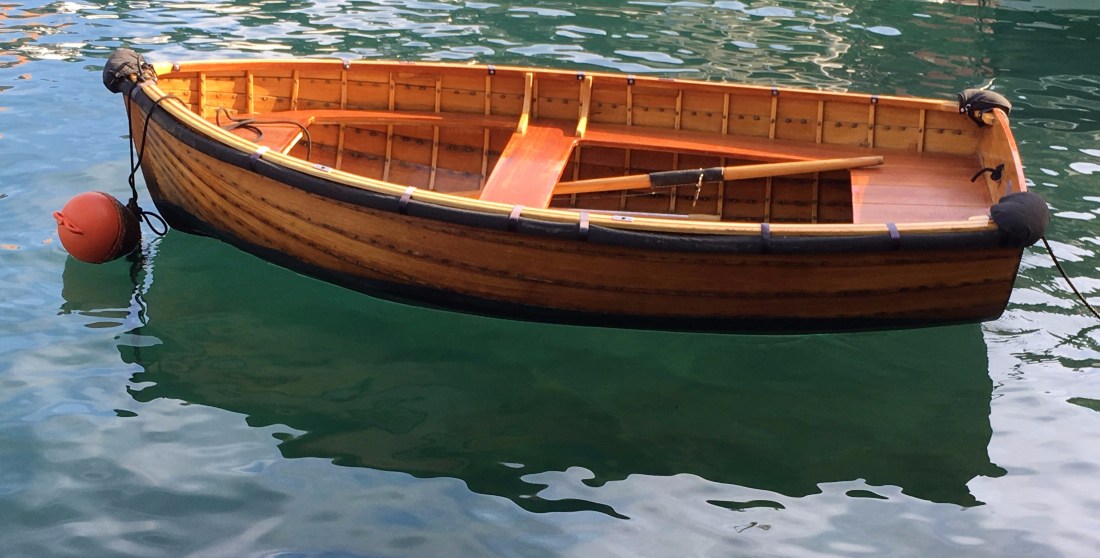
A craft of classic character in Portofino’s harbor of yachts and mega-yachts.
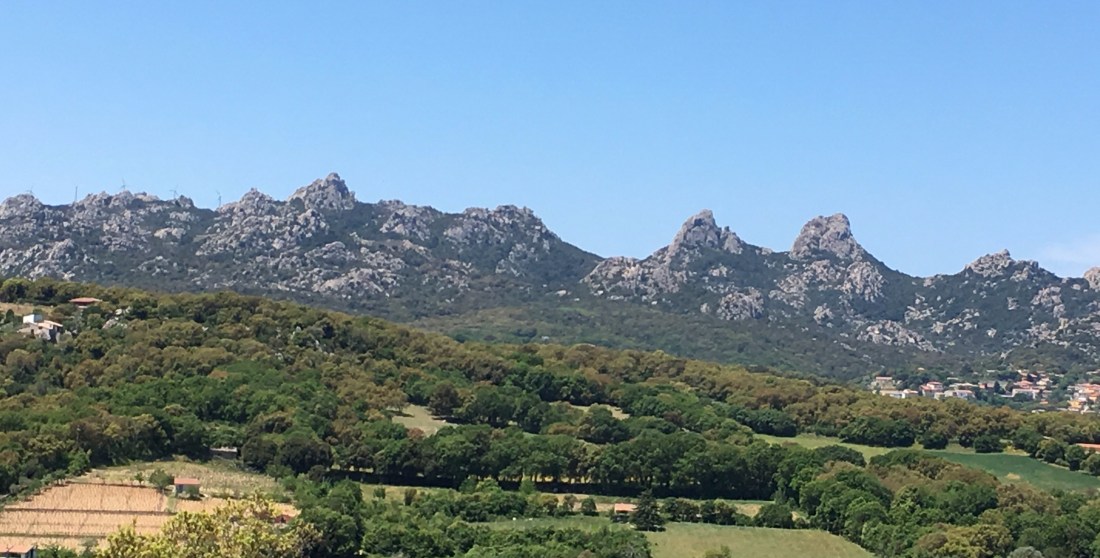
Jagged peaks distinguish the coastal hills of northern Sardinia.
Sicily is the roughly rugby ball-shaped island off the tip of Italy’s boot. Approximately the size of Massachusetts in the USA, Sicily is the largest island in the Mediterranean Sea, but most of what I’ve known of it has come by way of “The Godfather” films.
It is apparent that agriculture is almost everybody’s business in modern-day Sicily. In the east, fruit trees (especially lemons and oranges) are most common; in the central region it’s olives; and in the west it’s vineyards which dominate the rocky reddish-brown fields; but citrus, olives and grapes are grown from east coast to west and feed much of the Mediterranean world. Sicily’s highway system features thousands of bridges which span the valleys and leave the groves and vineyards undisturbed.
Between the sea and the steppe along the central portion of Sicily’s southern coastal valley – a hundred miles long and two-to-four miles wide — there’s an agricultural valley with what must be a half-million white hoop houses where fruits and vegetables of many varieties get both an early start to the growing season and shelter from Sicily’s searing summer sun.
To the north and west of Sicily is the Mediterranean’s second largest island, Sardinia, about which I’ve known even less. It was first settled by people from what is now the mainland of Italy, but it took until the country’s unification of 1948 for Sardinia to become Italian in a legal sense. Still, Sardinia may differ from Sicily and the mainland of Italy in as many ways as it’s similar.
Because of threats from the sea by one invading force after another over the centuries, the island’s heritage is mountain-based more than seacoast. Despite a once-thriving tuna fishing industry near the northwest tip of the island and an annual tuna festival that occurs on the small southwest island of San Pietro, and even though the fish named “sardine” is attributed to this island, seafood is less a staple of diets than one would anticipate for an island people; and it’s difficult to find many seafood choices at grocery markets in Sardinia.
While Italy is known for its stunning coastal routes — for example, the Amalfi Coast and Cinque Terre – the roads on the island of Sardinia tend to avoid the coastal cliffs, preferring what in ancient times would have been the safer passage along the inland side of the coastal hills. Some of Sardinia’s most beautiful roads follow rivers through valleys which are more dense with lush, green growth than anywhere else in Italy.
There is much less agriculture in Sardinia than we saw elsewhere in Italy…..in Sardinia, small wheat fields mostly…..and those fields often host rocks and huge boulders. There is so much stone on Sardinia that some places hold up barbed-wire fences with stone posts, not wood; and in many places the fences are entirely of rocks. The limestone buttresses of Sardinia — many miles of high hills topped with sharp peaks — are spectacular.
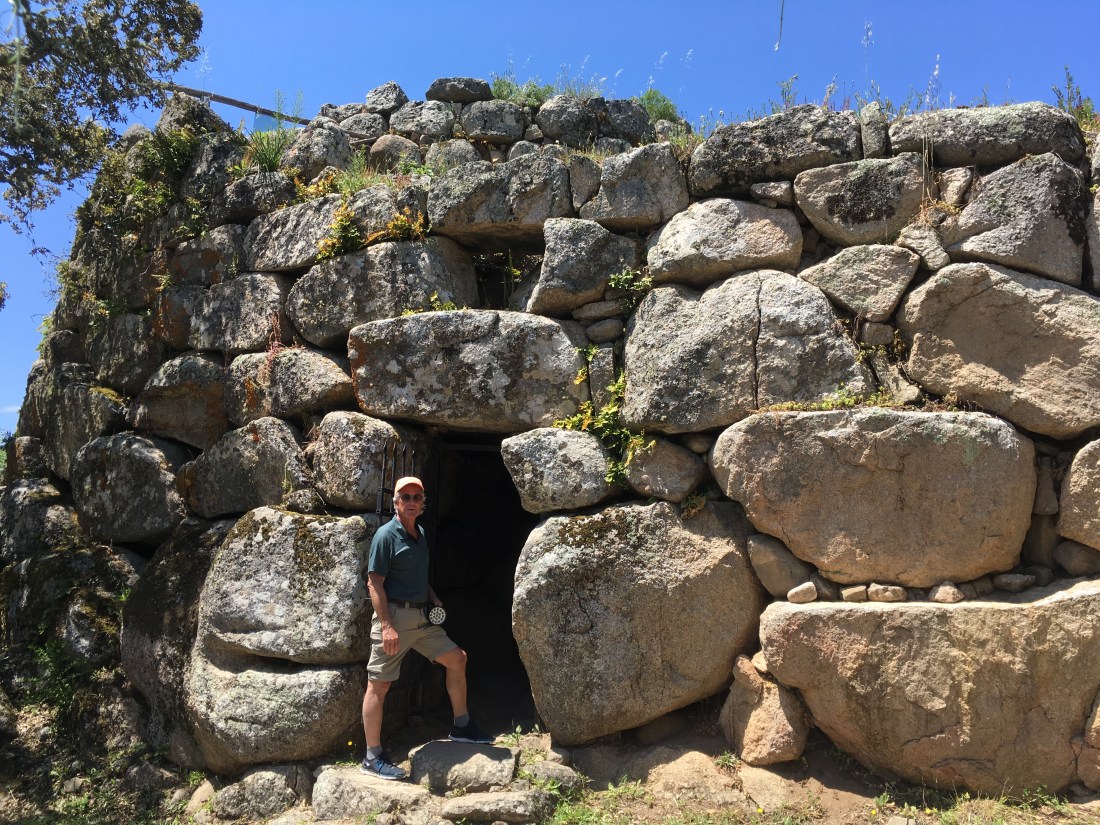
There is far less Greek influence on Sardinia than on Sicily and the mainland of Italy. Ruins are from the Spanish, Romans, Carthaginians, Phoenicians and even earlier civilizations. There are on Sardinia remains of at least 7,000 squat conical towers called “nuraghi,” dating to as early as 1800 BC. Their builders left no written language but more than 1500 of their bronze figures have been found in caves across Sardinia.
JER
One of many well-preserved Greek temples on Sicily — here at the Valley of the Temples near Agrigento above the island’s southern shore.
Even unrecommended routes provide extraordinary scenery on an Italian road trip.
None of the travel books, mobile apps or internet websites included “Strada Statale 18” among the recommended routes from Tropea to Scilla, near the toe of Italy. But we ignored the advice, and our GPS.
It’s possible to tour Italy without really seeing Italy. So much is so beautiful that travel itineraries are hard-pressed to include even a small portion of the spectacular scenery and historical highlights, much less the mundane or unsightly. And we saw more proof of Italy’s deserved, almost divine reputation along this unheralded route.
But — between wide fields of wild flowers which are especially beautiful in May, and around corners of SS 18 that were often situated on steep slopes above the spectacular “Mar Tirreno” shoreline, and passing through gorgeous groves of mature olive trees shading blankets of pugnacious purple thistle, and in spite of bright red poppies blooming here and there and everywhere — we couldn’t overlook some ragged towns and many miles of refuse-strewn roadways. This too is Italy.
From the modern Palermo–Syracuse A19/E932 expressway which slices east-west through Sicily’s center, we diverted to many minor roads — sometimes by choice and sometimes by mistake — and made our way toward Sicily’s southern sea shore. We traveled tight, twisting roads, sometimes rough, but often trimmed with multi-colored wildflowers thriving during this particularly cool, wet May. Along this random route we scanned valleys of awesome beauty and hillsides kept tidy by the precise and pleasing placement of vineyards, orchards and olive groves, with leaves of olive trees shimmering silver in the afternoon breeze and bright sun.
However, the further our twisting travels advanced us south, the browner and more barren the hills became — still awesome to be sure, but in a different way…..in fact, a sad legacy of the Roman Empire’s insatiable desire to expand. Trees were clear-cut for agriculture and building construction, without any apparent thought to reforestation. As a result — and we saw evidence in the fine mud drying on the pavement of many low spots on these back roads — Sicily is gradually eroding into the sea.
In the modern era it is possible to travel to ancient sites without making a wrong turn. But during our recent Italian road trip, we traveled more days without GPS than with this marvelous convenience because, frankly, we were looking for a little inconvenience.
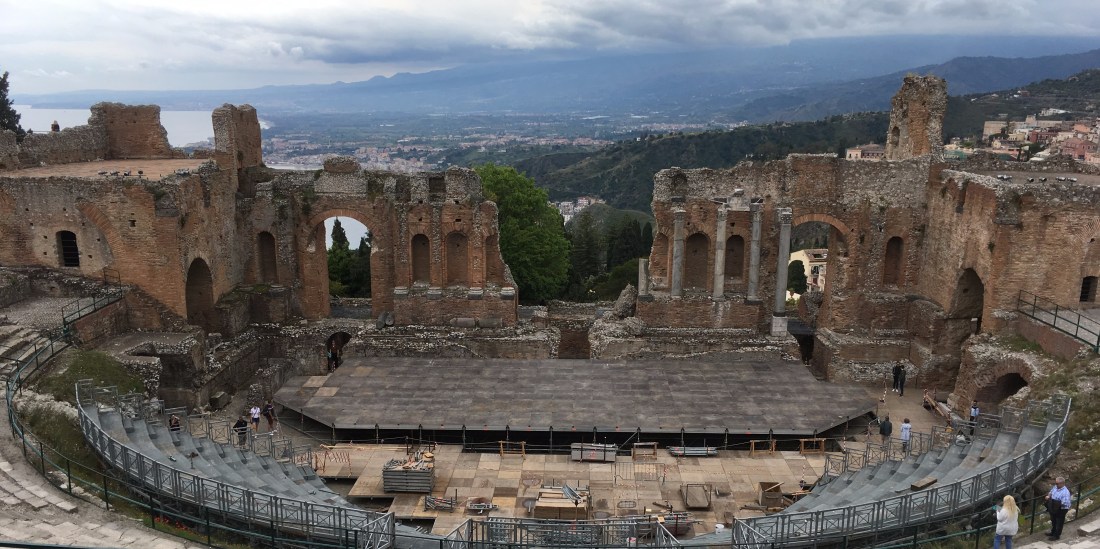
In Taormina, considered to be the first resort town of ancient times on what is now the island of Sicily, we searched at length for “Teatro Antico di Taormina” — the Greek theater built in the 3rd Century BC and remodeled by the Romans in the 1st Century AD. It is one of the largest ancient venues of its kind in Europe, and it’s still used for productions today. Yet — for two hours — we couldn’t find it!
We circled and criss-crossed the vibrant town of Taormina for nearly two hours, drove up and down its hillside roads, and stopped to ask a variety of locals for directions; but we never saw a sign for this big attraction until we finally approached the theater, on foot, just 50 yards from its entrance. The blessing of our bungling was that we saw far more of this famous and prospering town than most people do….and certainly more of it than we had planned.
In contrast and on the opposite side of Sicily — the southwest corner — we had no trouble finding a working farm we had booked for a night’s stay. Hand-painted signs on fence-posts pointed the turn-off from the busy paved highway, and continued to mark the way down three miles of rocky two-track paths through weedless vineyards to a farm which has been in the same family for three generations and once made wine from the grapes it still grows.
Modern technology has moved the winemaking to another location, and the facility is now a bed-and-breakfast style inn. We dined next to eight-foot diameter casks and antique wine-making tools in a stone room with several high arching alcoves. Our bedroom, a twenty-by-twenty-by-twenty-foot cube, with a view over the orchards and vineyards to the sea, was the room occupied by our host when he was a youth.
And then there’s Sardinia, a smaller island located a 13-hour overnight ferry ride northwest of Sicily. There are supposed to be 7,000 ancient nuraghi on Sardinia, erected between 1800 to 1500 BC for purposes that experts still debate. There are signs along the roadways to many of these generally cone-shaped stone structures, but rarely is the driver given the distance to the site, and frequently there is no passable road to the nuraghi. We pursued several dead ends.
And it seems like rural Sardinians like to fool with travelers by piling up rocks in their fields in the shape of cones which imitate the antiquities. We chased after some of these imposters as well.
JER
Ancient “Nuraghe Maiori” in northeast Sardinia, where the journey was as engaging as the destination.
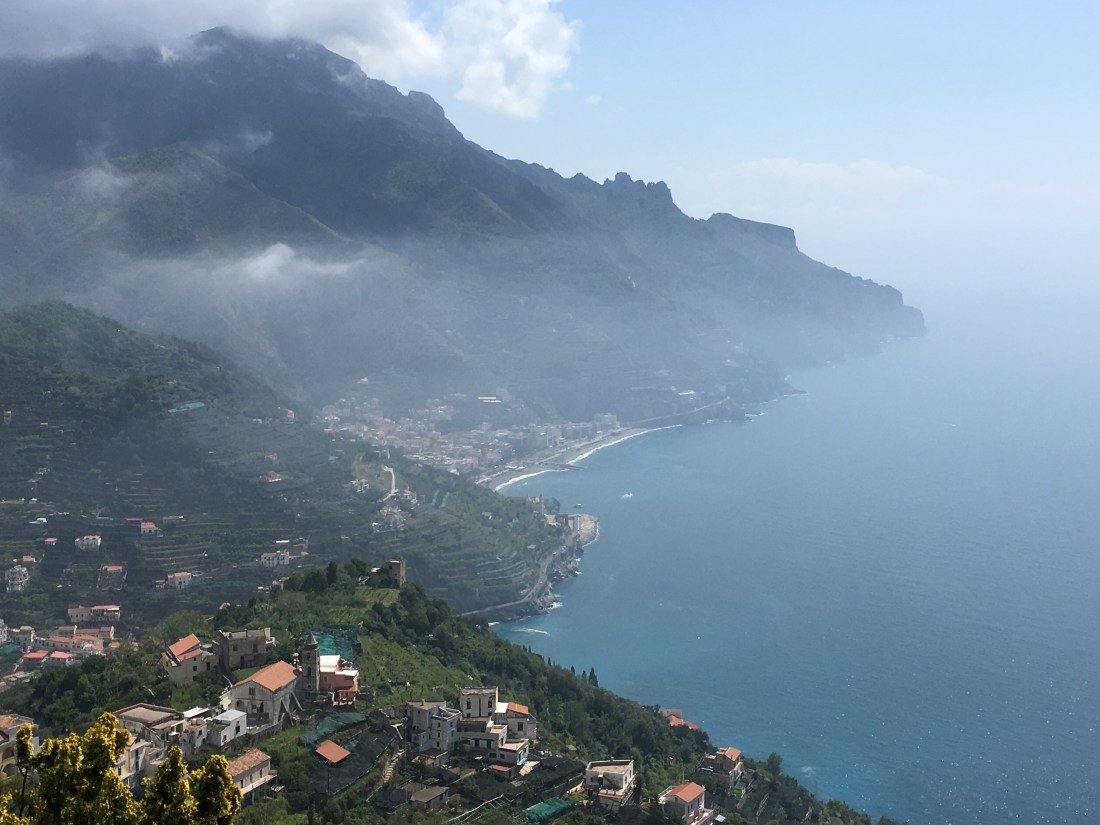
In the clouds over Ravello, high above the Amalfi Coast…..a lesson about sky-high Italian taxes.
It is a popular notion that French is the world’s most lovely language; and, indeed, it is beautiful when spoken by just about anybody but me.
But, in my life’s travels so far, I find that, from the mouth of an Italian, the native language might be the most melodious of all tongues. Phrases delivered with a descending and then rising pitch…..and if with a patient pace…..are music to the ears.
Even as we struggled to recite an item on a restaurant menu, the Italian language somehow sounded pleasant. And out of the mouth of an experienced waiter, the menu recitation was pure poetry.
When loved ones greet each other in Italian after a period of separation – and it doesn’t have to be a long time apart — they talk over each other’s endearments with a passionate commotion that has harmonic dissonance befitting a modern musical masterpiece at its climax. It’s not Italian opera which is so world-renowned, of course, but the hugs and kisses of Italian greetings certainly combine drama and symphony.
For Italians themselves, however, it’s cash that’s music to the ears. In a country where everyday people pay a 70% tax rate, the unrecorded cash transaction is lovely.
On two occasions during our recent travels the hosts of our accommodations surprised us with cash requests — to pay the bill for two nights at an ancient sea-abutting apartment in Scilla, and to pay for an enchanting evening meal during a farm-stay located down three miles of rocky, rutted two-track road through vineyards to the southwest tip of Sicily near Marsala.
The Italian artist from whom we purchased two dinner plates in Ravello, and who offered a deep discount if we would pay by cash rather than credit card, complained that taxes in Italy are too high and the public services too few in his dysfunctional country.
One of the obviously lacking government services is law enforcement. Laws prohibiting parking here and passing there are ignored almost everywhere, as are speed limits. Stop signs and traffic signals appear to be open to individual interpretation by Italian drivers. And the rude and repeated blaring of their horns, well, that was not music to my ears.
In Sri Lanka, drivers tooted their horns lightly to inform me of their location and intentions. In Italy, drivers laid on their horns because they thought I was a horse’s ass…..“stupido” in the lovely local language.
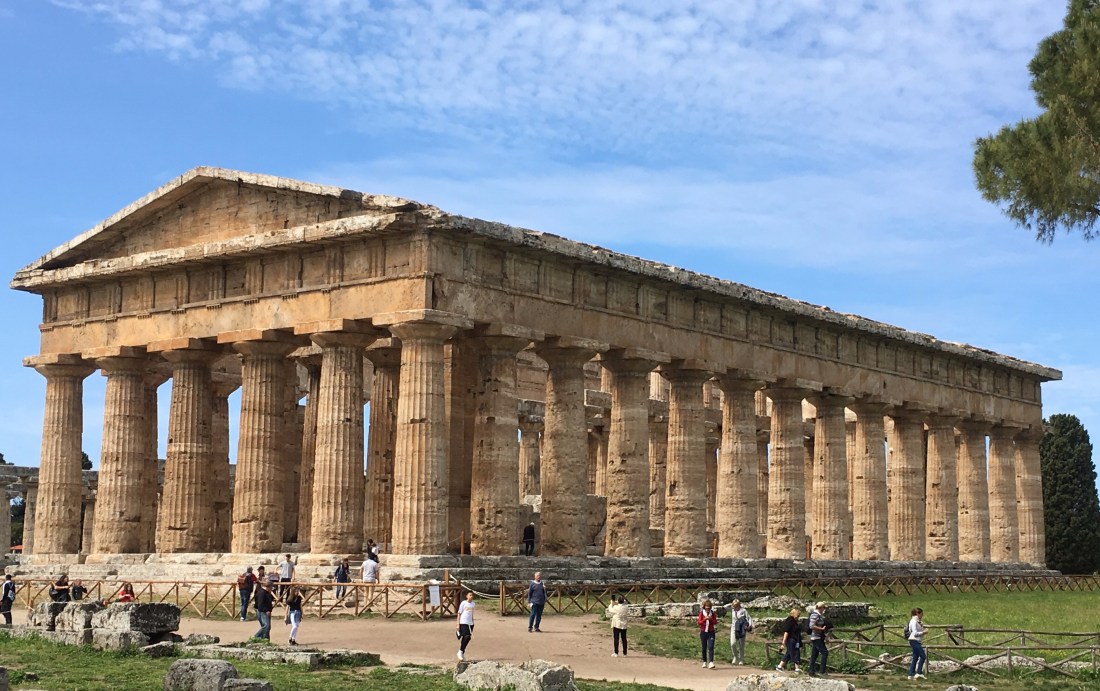
The Temple of Neptune dates from the time of Greek occupation of what is now southern Italy….about 450 BC. It was unearthed in the late 1950’s.
Italy’s elderly dress and act as if they have just attended a funeral. Dour expressions and dark clothing, day-time and evening, at work or…..I hesitate to use the word….at “play.”
Perhaps they have been humbled by history, which for Italy has been long and catastrophic, and well documented by cultures which have valued the written record.
Entire cities — some of the peninsula’s greatest — have been lost to natural disasters and human frailities.
Amalfi, located on the now famous coastline that bears its name, was a city of 70,000 citizens when it slid into the sea in 1343, victim of an earthquake. Previously it had been a center of commercial trading, a superpower among cities in the Mediterranean region. Rebuilt, and now a town of 5,000 year-round residents, Amalfi has become a center of tourism, swelling to more than 10,000 overnighters during the high summer season…..but still just a fraction of its former glory.
Less than a hundred miles away but 14 centuries earlier, Pompeii was entirely consumed over two days in August of 79 AD when nearby Mount Vesuvius erupted and buried the city. Pompeii had been a bustling metropolis noted for cultural events and sporting spectacles which filled its large civic arena. It is now a tourist attraction and archeological treasure.
Between these calamities, of course, the fall of the Roman Empire which, from the perspective of preserved record, was the most polished and powerful civilization on Earth — at least it controlled all of the Mediterranean world for four centuries — but whose influence was trimmed and eventually toppled by the arrogant over-reach of its leaders and the self-indulgence of its citizens.
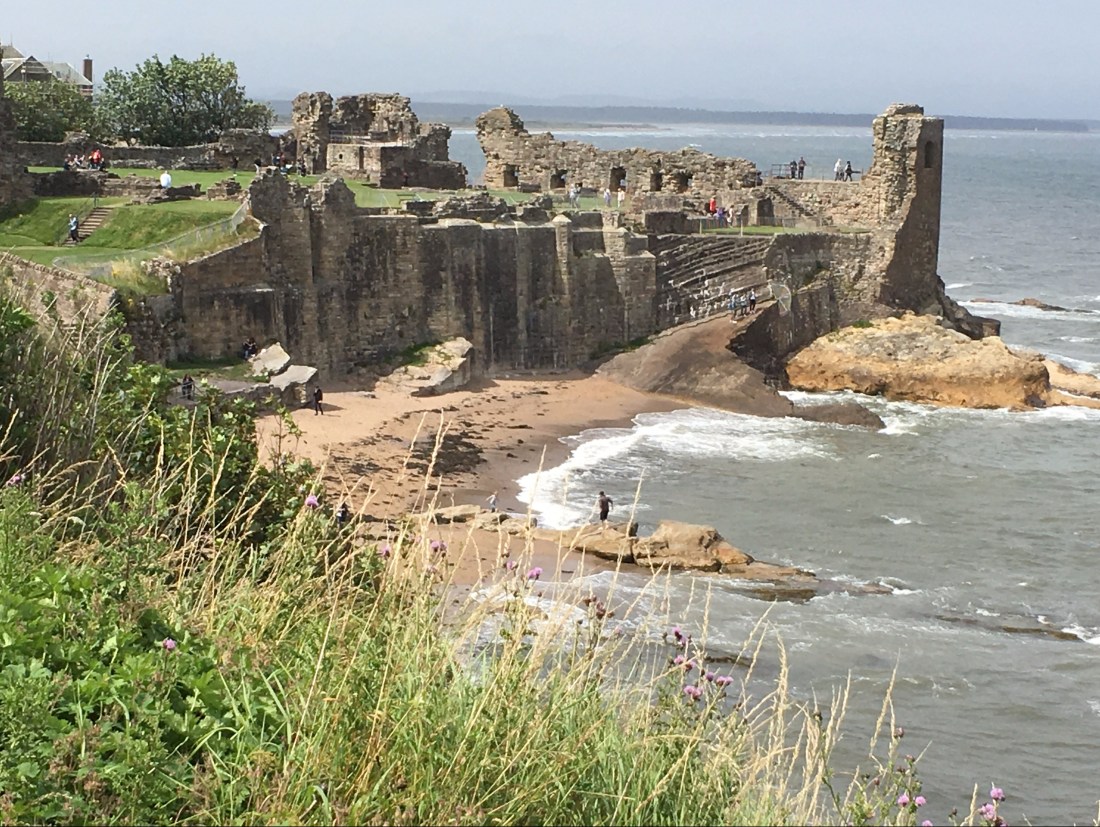
Further south along the Tyrrhenian coast near the ankle of Italy’s boot, what remains of the Castle of Amantea looms large over today’s town of Amantea. The castle was once important to the Byzantines (early Turks), Arabs, Normans (early French), Swabians (early Germans), Angevins (early French), Aragonese (early Spanish) and Bourbons (also early French). The castle was severely damaged in earthquakes of 1638 and 1783 and finally left to disintegrate after the failed seige by Napolean’s troops ended in 1807.
And then there’s Sicily…..not one of its several prominent and powerful civilizations has survived, and reminders are everywhere. There are many places where deeply burried ruins of the Roman Empire rest atop ruins of earlier Greek colonies, and sometimes there’s evidence of an intermediate occuption by the Carthaginians. Earthquakes have buried many parts of Sicily, including 90% of the eastern port city of Messina where 70,000 people perished in 1908. Mt Etna, still an active volcano, has experienced major explosions at least a dozen times during the past two dozen centuries, sometimes lasting months, and at least once covering or crushing everything between it and the Ionian Sea 70 miles away.
Song-writer Paul Simon, accomplished as any of the greatest poets of Ancient Rome or more recent Italian history, wrote……
“God only knows, God makes his plan/ The information’s unavailable to the mortal man/ We’re working our jobs, collect our pay/ Believe we’re gliding down the highway/ When in fact we’re slip slidin’ away.”
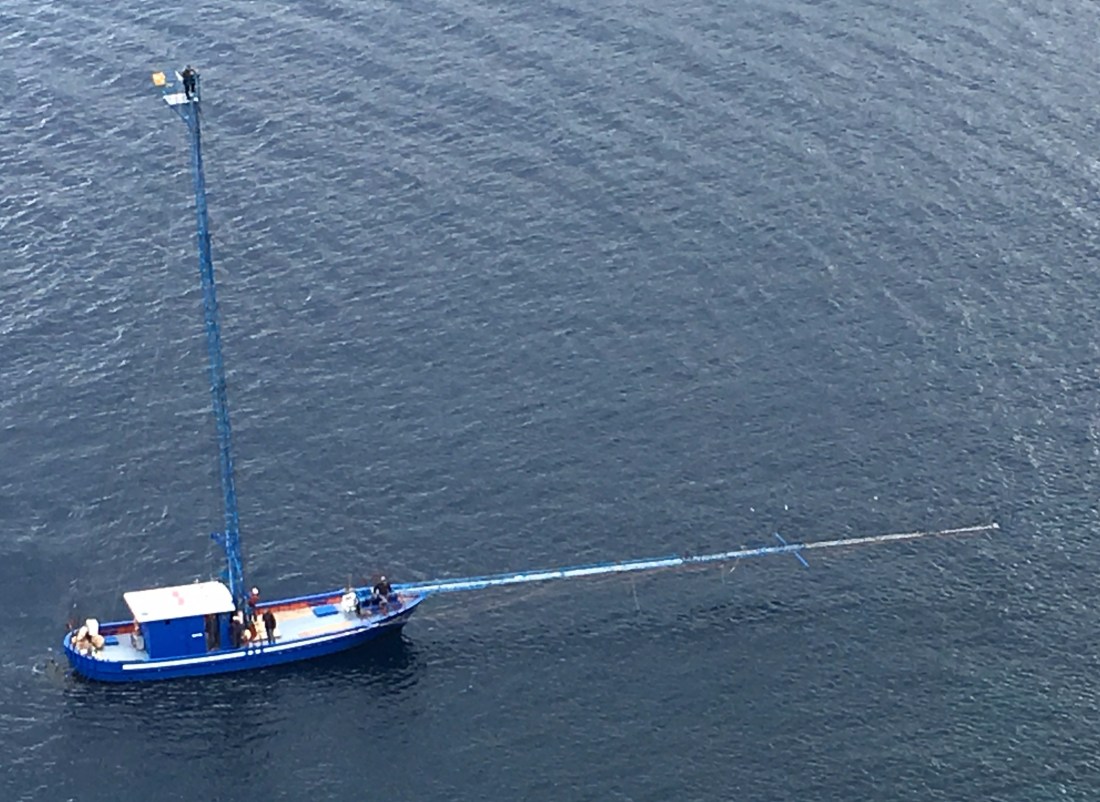
Searching for Swordfish near the tip of Italy’s toe.
My wife comments that I have a tendancy to book accommodations at the end of the road…..and, generally, that it rewards us.
In Sri Lanka, during travel that immediately preceded the latest terrorism in this tiny nation, our favorite stops were hard to find and wonderful to experience…..at the end of the pavement along the country’s southern coast near Tangalle, and up narrow twisting 45-degree inclines to inns over Ella and Kandy.
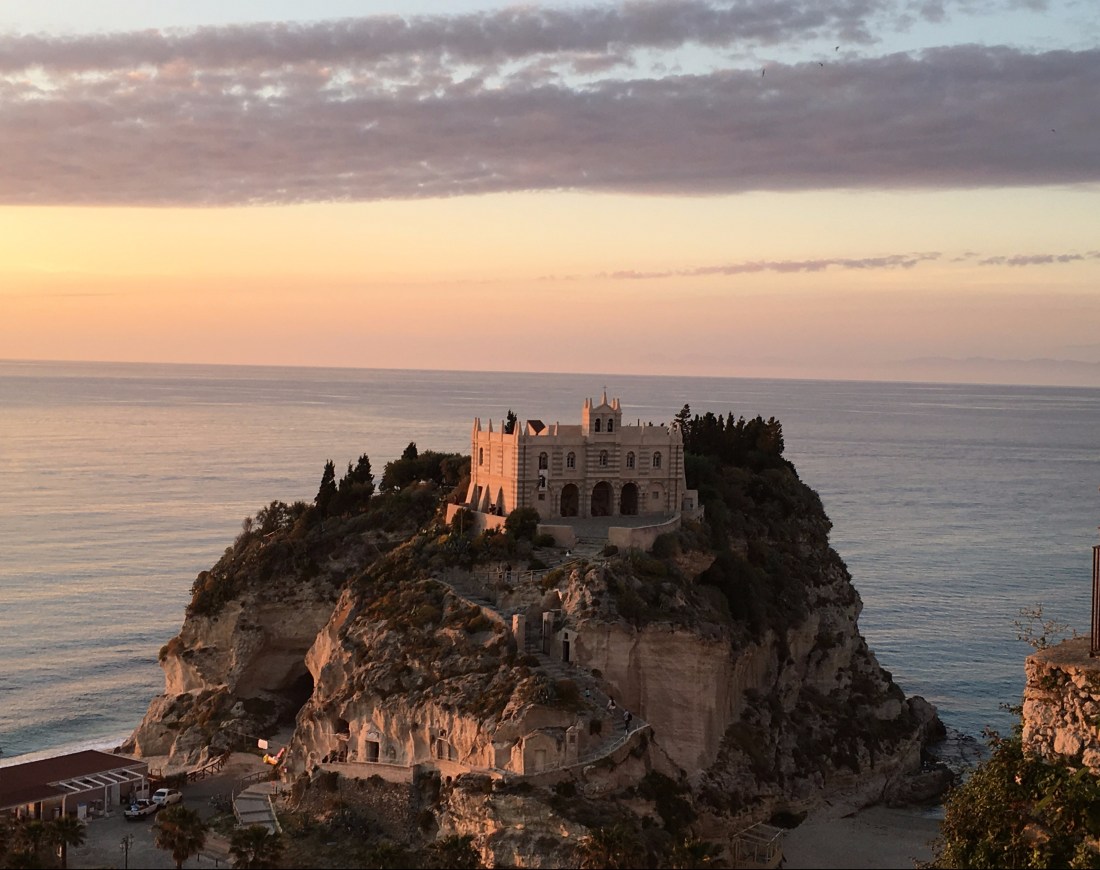
More recently we drove route 522 to its terminus near the tip of Italy’s toe, to Tropea, a town with dozens of small plazas and narrow intersecting cobblestone alleys atop a cliff which provides killer views of the sun setting beside the volcanic island of Stromboli; and at every meal we enjoyed the sweetest red onions we’ve ever tasted.
Even closer to the tip of the toe, in Scilla, we found an apartment in the lower level of an ancient building against which the Tyrrhenian Sea pounded all night, as it has for centuries. Above our bed was a four-foot square portal through which we crawled to a deck with two chairs situated above the ocean…..the Castle of Scilla above us to the left, small boats in front with high masts and long gang planks in search of swordfish, the coastal cliffs of Italy as far as we could see to our right and, across the alley, the finest food and wine during our first week of exploring southern Italy.
There’s probably a message here……perhaps that in travel, as in life, a little extra effort makes a big difference.
JER
Tropea’s famous sunset makes its most popular attraction glow….Santa Maria dell’Isola.
Travel provides a reminder that much of the world is not as beautiful or tranquil as life at home.
It’s Sunday here in southern Italy; and I’m thinking of what novelist, intrepid traveler and prolific travel writer Paul Theroux has written: “It’s true that travel is the saddest of pleasures, the long-distance overland blues.” He has witnessed, many times, what I have only glimpsed…..namely, that if one’s eyes are really open, the traveler will very often see a mean and ugly world.
From a lifetime of intentional, investigative travel, Theroux concludes (In Ghost Train to the Eastern Star): “Most people on earth are poor. Most places are blighted and nothing will stop them from getting worse…..there are too many people and an enormous number of them spend their hungry days thinking about America as the Mother Ship…..Most of the world is worsening, shrinking to a ball of bungled desolation. Only the old can really see how gracelessly the world is aging and all that we have lost. Politicians are always inferior to their citizens. No one on earth is well governed.”
Which suggests to me that God should have rested one day earlier….. after five days, not six…..before He created humans and gave them dominion over every other living thing on earth.
I’m among those Theroux would consider old enough to see that there are few if any nations on earth — including the USA — where the powerful have not preyed on the powerless. Where there has not been violence in the name of religion. Where war has not been waged on that nation’s own residents, its neighbors or beyond…..often accompanied by unspeakable atrocities. Where poverty and pollution are not worsening. Where hunger and homelessness are not increasing. Where the most basic human rights of some group of people are not being trampled by another group.
Travel — as opposed to vacations or tourism — exposes this. And it’s important that it does.
Most people need a vacation….a time away from the daily grind and routine people, places and projects. This can be near-by or far-away, in isolation or with others, active or sedentary, rustic or all-inclusive.
Most people benefit from tourism…..visiting important and iconic sites, sometimes in remote and idyllic locations, but more often found at venues over-crowded with other tourists and groups of tourists following guides hoisting flags aloft and who stop to explain the highlights of each attraction.
I have enjoyed and still do appreciate getting away and seeing the sites, but that is not all I seek from travel in retirement. I now plan longer trips, at a slower pace, to more distant places. I wander more intentionally at some times, and with no purpose whatsover at other times. I like to grocery shop, cook and eat in. I like to have morning coffee at the same local place several days in a row, and I try to discern the patterns and exceptions. I like to walk neighborhoods and ride local public transportation. I like to struggle with the local currency and a few words of the local langage.
I read more about our destinations — before, during and after each journey; and without the need to rush back into the rat race, I reflect more.
I enjoy fine accommodations and dining when I travel, but I realize luxury is the enemy of true travel, for it tends to interfere with observation and serendipity. I tend to avoid group tours, large-ship cruises and all-inclusive resorts because they impose obstacles to the opportunity to experience problems and the kindness of strangers, which we have found in every country, from young and old, male and female, English-speakers and those with whom we communicated through hand signals and pantomime.
I think, for example, of the young German couple who stopped to help replace a blown tire after a lorry drove our rental car off a narrow twisting country road in Scotland, and of the conversation about Scottish and US politics in which we engaged with employees of the service station where our damaged tire was repaired….turns out we were in the county where Donald Trump’s ancestors lived.
I think also of the recently retired Swedish couple who helped us find an alternative when our train from Copenhagen to Hamburg broke down; and the several hours of conversation which revealed shared beliefs about immigrant and refugee policy debates in our respective nations.
I admire those who incorporate learning and/or serving within their travel. Some immerse themselves in language learning; others in building schools, churches or health facilities; still others use their precious days-off from their jobs to rush in and help after devasting natural disasters strike around our nation and world. None of these experiences is my favorite form of journey, but each is truly “travel” in the sense that it removes a person not just in terms of place, but also in terms of perspective and pressing personal agenda.
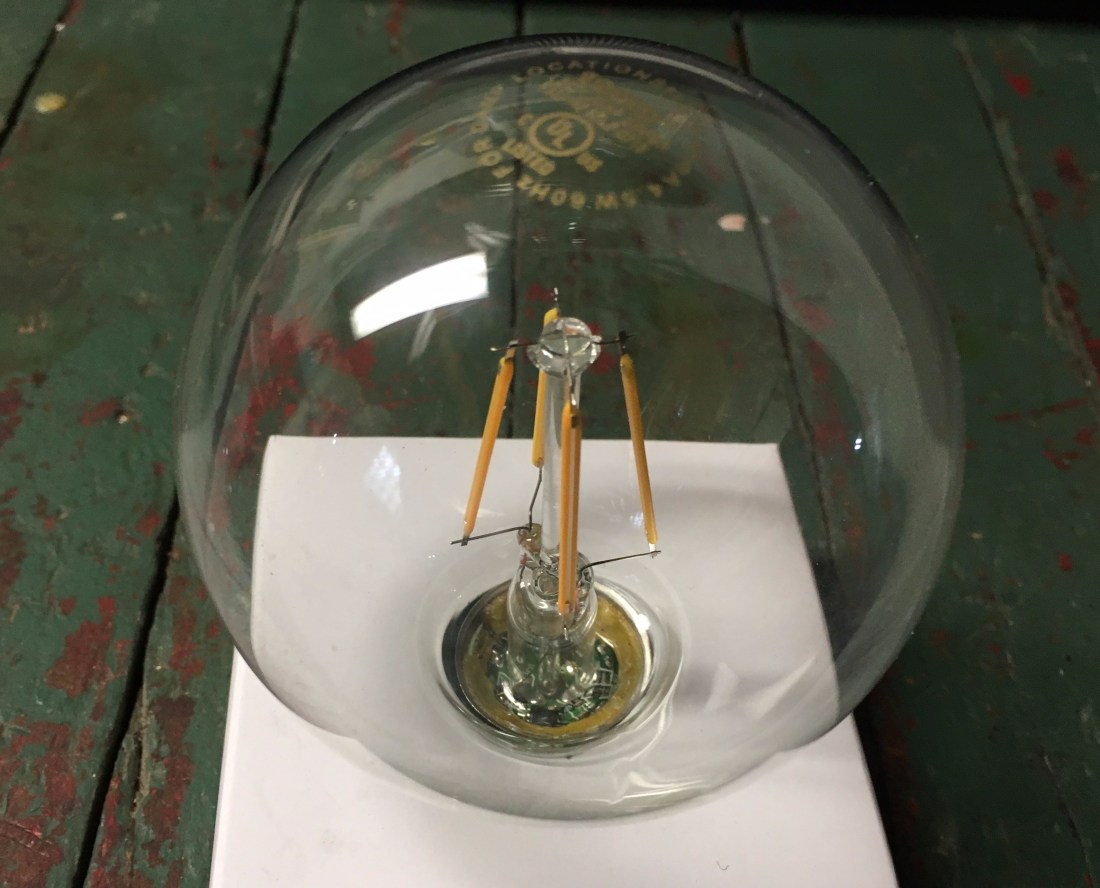
This $7 lightbulb will outlast $700 appliances, as well as the author.
As I was completing the purchase of a light bulb the other day, the 20-something saleswoman informed me that, at three hours of use each day, the bulb I was buying would last 22.8 years. To which I deadpanned, “Well, then, I guess it will outlive me.” She just stared at me, her mouth open but speechless…..at less than one-third my age, without creases or age spots, her porcelain face so innocent of the high-class problems that perplex a middle-class old man.
I expect certain products to come with extended warranties — for example, big capital investments like metal roofing and replacement windows carry guarantees of 30, 40 and even 50 years. But when a person reaches the point of puchasing a routine consumer product which is projected to outlive the buyer, it tends to make that person pause…..and, in my case, to get impatient with modern home appliances.
It annoys me that so many appliances we are made to purchase today are so grossly inferior to the items they replace and which may have served us for decades, and our parents before us. Dealers today offer expensive service agreements and warranties to repair or replace appliances they know cannot hold up to normal use. Compounding the problem, today’s appliances come loaded with far too many features that far too frequently malfunction. These features add to the total price and distract from the true purpose of the product.
Furthermore, the new appliances rarely do their jobs as well as the old. Promoted to be energy-efficient and water-saving, “modern” dishwashers and clothes washers take four times as long to do their jobs, which they do poorly, necessitating repeat operations.
So, while it’s nice to know this inexpensive light bulb will still be shining in early 2042, it’s distressing to anticipate that, before this bulb dims, most of my high priced appliances will need to be replaced several times over.
By the way, if you find yourself lost in the southwest corner of Missouri, just north of Diamond (population 909) on State Highway 59, you might discover that a shrine there for small appliances is an interesting stop. It’s called “World’s Largest Small Electrical Appliance Museum.”
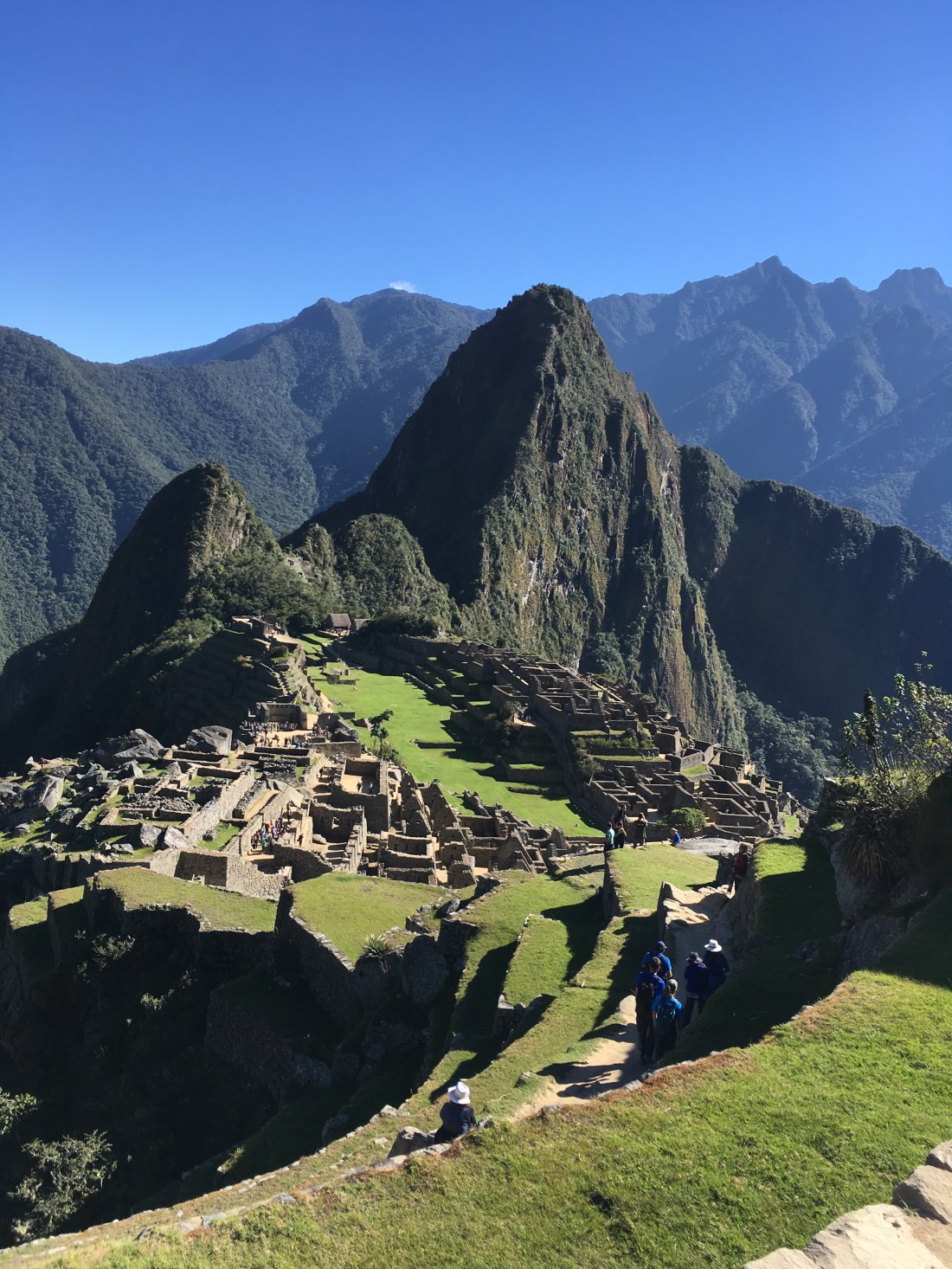
After four days on the Inca trail, approaching Machu Picchu.
Genuinely responsible world travel is itself a journey; it’s not a destination at which one ever really arrives.
After a transoceanic flight, a traveler has added to environmental damage beyond what even the most eco-friendly lodging, living and learning can mitigate. But, nevertheless, in choosing places to eat, sleep and tour, one might give higher priority to “eco-friendly” than all the other filters which travel planning websites provide. Consider how local foods and labor as well as low impact lodging might add to the authenticity of the experience.
In selecting accommodations for travel of several weeks, I will chose a variety of price points and styles…..no two alike, and not one like home. Some of my better-planned lodging choices will be actively engaged in sophisticated carbon offsetting; while on the other hand, some of our spontaneous choices for meals with local color and flavor, I’m sad to say, will still be serving with plastic utensils, cups and straws or using styrofoam and plastic bags for leftovers and take-away.
Having landed in a foreign country, considerations for local transportation might begin with the traveler’s own two legs. Nothing beats the pace of walking for really seeing a new place; and along with biking and hiking, nothing is better for one’s own health as well as the fitness of our environment. While I prefer to be my own driver in small towns and country-sides, I am a fan of inexpensive and efficient mass transportation systems in large cities.
Thoughtful travelers will think twice about the use of animal power, such as horse drawn carriages and camel or elephant rides. Often the conditions for these animals are terrible. On the other hand, such features of foreign travel may be providing desperately needed jobs and incomes locally. This is one of the difficult dilemmas that can make responsible travel decisions messy.
Often there will be both international and local entities competing for the traveler’s business — for example, for rafting, kayaking, hiking, historic walks or museum tours. I think the responsible traveler gives preference to the more locally owned and operated options. I say this in spite of having a less than satisfactory experience after selecting a local Cusco company to lead my cousin and me on a hike of Peru’s Inca Trail last year.
I usually have a sense of guilt competing with my euphoria after a long international journey full of exciting times and exquisite scenes. I’ve often seen poverty and even abject squalor. I’ve walked past deceitful panhandlers and desperate beggers alike. I’m never sure that I made the correct decisions about what to see and how to see it. And my uncertainty actually increases with each journey.
I’m thinking that’s a good sign. For if travel ever makes me unreflective — or worse, callous — then I think I will have missed altogether the reason for travel.
JER
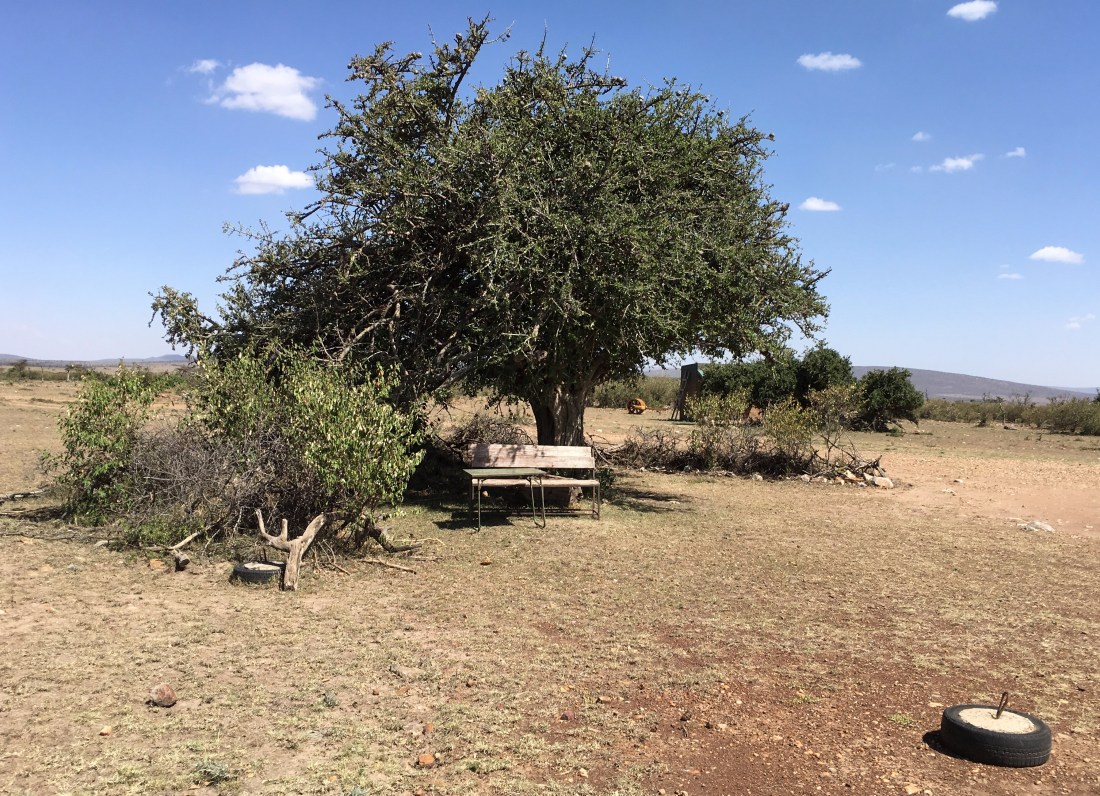
The “departure gate” for a dirt landing strip near Mara Naboisho Conservancy in Kenya wastes no energy on amenities.
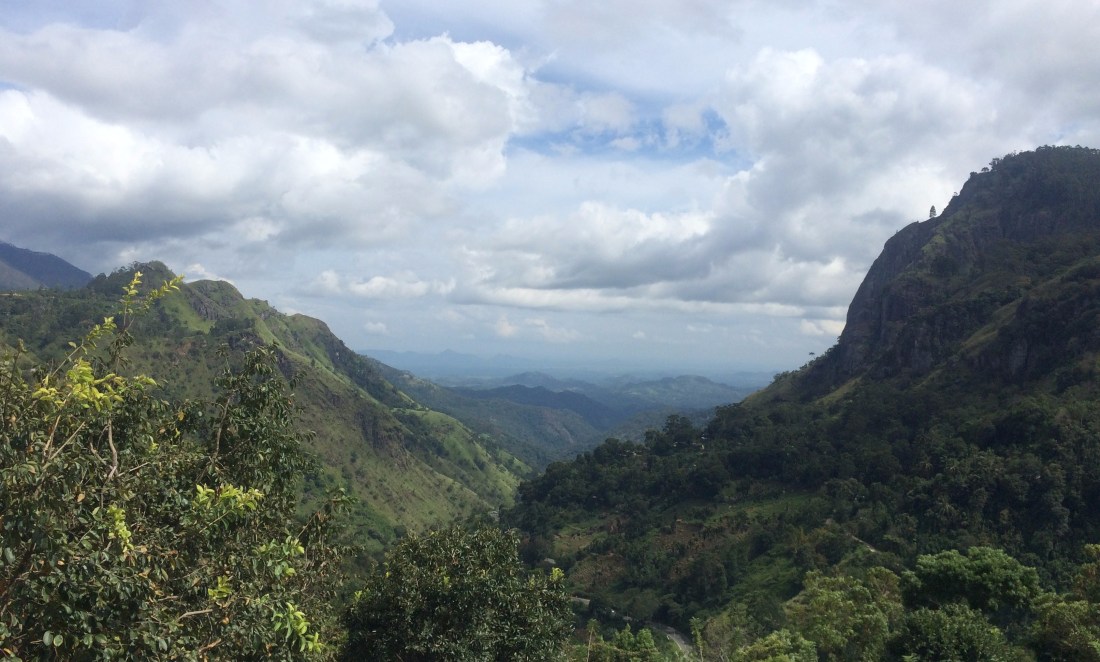
The hills surrounding Ella, Sri Lanka contrast to the horrific violence elsewhere in the country on Easter Sunday.
We woke on Easter morning to find emails from family on the other side of the world and brief items on our mobile phone feeds from CNN and the Washington Post about horrific, wide-spread and orchestrated violence in Sri Lanka which, while we had been sleeping, had killed more than 200 people and injured more than twice that number. Having visited that nation just five weeks earlier, we were stunned, and immediately turned on the television for more information.
Our first stop was MSNBC, which led with the Sri Lanka tragedy, but turned to a correspondent in Ireland — 5,000 miles away — for the story. The reporter devoted most of his time to talking about Christianity’s recent troubles (the Irish love that word), including the destruction of Notre Dame cathedral in Paris six days earlier and the on-going sex abuse scandal in the Catholic church worldwide.
So we turned to our favorite “CBS Sunday Morning,” which made the violence in Sri Lanka the lead subject of its brief news section at the top of the show. But, the CBS reporter was not on-site either — but in India. That evening for “Sixty Minutes,” CBS still did not have a reporter on the ground in Sri Lanka.
Sri Lanka is not on the radar of western media, and that’s a psychological wound the country has carried for many decades, and adds to its frequent suffering.
When the tsunami of 2004 killed more people in Sri Lanka than any other country except Indonesia — and five times as many people as in Thailand — Sri Lankans bristled — and they still do — that Thailand received the media’s attention while Sri Lanka’s far more extensive death and destruction received little notice.
When 100,000 people died during a quarter century of civil strife in Sri Lanka, which “ended” in 2009, the tragedy was not a story in the western world. At first, the war in Southeast Asia, which the USA got in the middle of, pushed other wars out of western news. But even later, Sri Lanka’s civil war was not news in America.
Easter’s violence could be different. With Christian worship services and Easter Sunday brunches the apparent targets of suicide bombings, the West may finally pay attention to this pear-shaped nation the size of Indiana rubbing up against the southeast coast of India. Futhermore, because of the scope and coordination of the bombings, it is suspected that forces outside Sri Lanka assisted a local extremist group.
The potential for violence had been brought to the attention of some top government authorities and security forces several weeks earlier, allowing Sri Lankan police to locate and arrest two dozen suspects before the dead had even been fully tallied, but raising serious questions as to why authorities did not act more promptly and prevent the carnage.
I’m grateful that we were so recently able to explore the southwest quadrant of Sri Lanka. From its gorgeous coastline to its graceful hill country, we found the nation to be warm and welcoming. The only danger we felt was when an oncoming bus was in our lane of traffic and bearing down on our tiny rental car.
We saw ethnic and religious diversity, of course, but no sign of the politicized factions and friction that this tiny country cannot seem to escape and about which we heard so little in western media……until now, tragically.
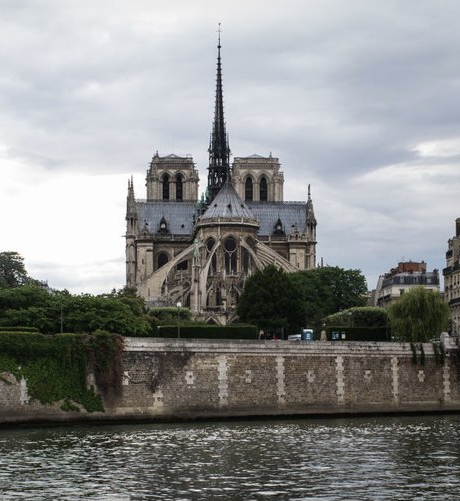
Notre Dame Cathedral in Paris, before the fire of April 15, 2019. (Photo by Andrea Ronchini/NurPhoto via Getty Images)
My one and only visit to Notre Dame Cathedral in Paris was on my honeymoon, when everything was new…..even old things.
The inferno at the cathedral is a terrible loss for the world, not just for France and Catholicism; and it is unsurprising that before the blaze was extinguished there were promises all around, including from the President of France to the Pope in Rome, to rebuild. More than a half billion dollars in pledges were made for this purpose in the first 24 hours, and that amount doubled over the next two days.
Is it heresy to suggest that the cathedral not be rebuilt?
Might this be a time to remind believers that the Christian faith is not found in visible huge structures, but in the invisible Holy Spirit.
Might it be a better witness to what we’re told Christ stood for to take the time and money of rebuilding a monument and apply those resources to ministry that rebuilds damaged people, or repairs our deteriorating environment which every day suffers irreplaceable loss?
It has been widely reported that the roof of the cathedral cannot be rebuilt as it was — with huge redwood timbers — because trees that were used 800 years ago are not available today. Isn’t that heartbreaking, and shouldn’t that tell us something about what is really important and where the world’s genuinely critical priorities might be?
I know that the Notre Dame has been more than a monument to many people over the centuries, including a place of worship or celebration or solace for some, a work of art for others, a source of pride for others, and a historical marker for still others.
But what a story might be told if it was determined to respond here more as Jesus might have, and less as humans will.
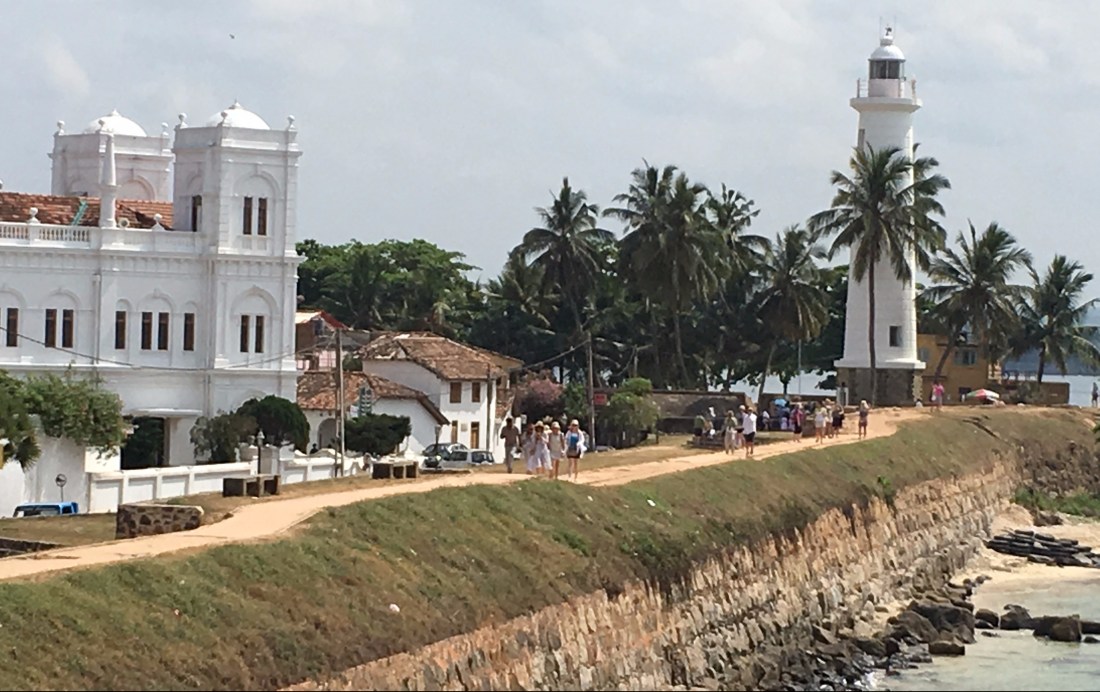
A portion of Galle Fort in Sri Lanka…..built by the Portugese and fortified by the Dutch before becoming part of the British Empire, when the lighthouse was built adjacent to 300-year old Meeran Mosque.
For generations of students, the history books they read in US schools to teach events of the 15th to 17th Centuries focused on the seafaring nations of Europe and their conquests of the “America’s.” They portrayed these brave people as discoverers of a new world — as explorers, not exploiters. The texts and teachers ignored the rich cultures that already were entrenched in what is now South, Central and North America. They ignored the Norse and the seafaring cultures of Asia and of the southern hemisphere who had been wandering the world under sail hundreds of years earlier.
A more complete and fair reading of this slice of world history is that people from European coastal countries were merely among the first to terrorize and colonize distant indigenous populations, and among the first to steal the resources of foreign lands while spreading the religions and diseases of their far-away homelands.
A traveler today sees this story repeated all over the world……the British, Dutch, Portuguese and Spanish, especially, overwhelming indigenous populations and then fighting with each over the control of these lands. One can see these themes today in architecture, language, laws, museums and customs across the globe….including in Singapore and Sri Lanka from which we have recently returned, as well as the many Central and South American countries we’ve visited previously.
A more complete and fair reading of a later slice of world history — the 19th and 20th Centuries — would expose these same European nations, aided and abetted by others (including the USA) — as the exploiters of natural resources on the African continent. It would reveal their audacity to draw borders for African countries based on their needs, not those of the African people. These nations settled their disputes with others by dividing up lands for which they had no authority or affinity. These themes are apparent in the tensions and bigotry that still simmer across Africa, and sometimes boil over.
These history lessons — which travel has taught me more than school texts — horrify and humble me. I’m humiliated by the role the USA has played. But I also realize how difficult it is to chart the course for US diplomacy in the world.
I don’t want America to create colonies…..or to act with imperialist impression, even if not intent. On the other hand, the USA cannot withdraw from the world stage and leave weak nations to be colonized by their mounting monetary debt to China or to be conquered by the unchecked military might of Russia.
I don’t want America’s role to be that of the world’s police force or rescue squad; but I do not want our country to be known as a nation which turns a blind eye to inhuman cruelties or often-times human-assisted natural disasters which cause millions of people around the world to suffer every day.
I want the text books for future generations of school children to be honest. And I want them to describe America as a country which learned from its mistakes and then struggled to find, promote and defend the high moral ground in all diplomatic, scientific, economic and military pursuits. I want that to be our story, and the accurate portrayal of America in history books of the future.
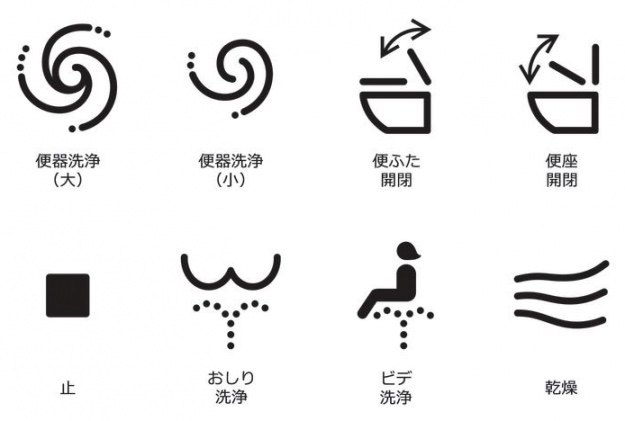
Among the operating instructions for a toilet in Japan.
I wonder if it’s correct that you can tell a lot about a country’s culture by analyzing its commodes.
If that is true, then Japan is the world’s most sophisticated nation. For it is in Japan where we encountered toilets featuring control panels with as many buttons and dials as a supersonic jet.
Before being seated, each person may choose his or her preference for the hue and strength of the bathroom lighting and the temperature of the toilet seat. Once seated, one may make a choice of the music that will accompany the activities.…both volume and genre may be selected. There are controls for the temperature, direction and force of the cleansing water. One can select an appropriate flushing force. And should anything mal-function, there is usually a telephone nearby for requesting assistance.
Many other countries will have bidets alongside commodes, and manual on-and-off faucets; but in Japan, it’s all-in-one, with push-button controls.
Such feature-laden loos are not everywhere in Japan, of course; but they are not rare for hotels and restaurants as well as in modern offices and upscale apartments.
Of the nations with the largest national gross domestic product (in order, the USA, China, Japan, Germany and the United Kingdom), far and away, it’s Japan with the most lavish lavatories.
And China has the worst……where a simple hole in the ground in an unheated phonebooth-size enclosure is common, and toilet paper is not.
Those who fear the Chinese juggernaut miss the message of the men’s room in most of China. They miss the meaning of eastern China’s polluted skies and poisoned waterways, and of western China’s impoverished villages and one-room school houses. They miss China’s invisible disabled population, and a gap between rich and poor which dwarfs that of the USA. They miss Chinese parents of means who choose to educate their children in high schools which provide a western education, and who send their children to colleges and universities in western countries.
China is a predatory lender to poor nations, and it is financing buildings, bridges, roads, ports and even vineyards in other nations around the world to prepare for impending disaster within its own borders. Its educational system is a failure, its environment is toxic, equal rights are non-existent, and economic class warfare is inevitable. It is not because the country is so great that China is an external threat to world order; the threat is that there is so much out-of-order within China.



 ALL OVER THE MAP