
Sicily is the roughly rugby ball-shaped island off the tip of Italy’s boot. Approximately the size of Massachusetts in the USA, Sicily is the largest island in the Mediterranean Sea, but most of what I’ve known of it has come by way of “The Godfather” films.
It is apparent that agriculture is almost everybody’s business in modern-day Sicily. In the east, fruit trees (especially lemons and oranges) are most common; in the central region it’s olives; and in the west it’s vineyards which dominate the rocky reddish-brown fields; but citrus, olives and grapes are grown from east coast to west and feed much of the Mediterranean world. Sicily’s highway system features thousands of bridges which span the valleys and leave the groves and vineyards undisturbed.
Between the sea and the steppe along the central portion of Sicily’s southern coastal valley – a hundred miles long and two-to-four miles wide — there’s an agricultural valley with what must be a half-million white hoop houses where fruits and vegetables of many varieties get both an early start to the growing season and shelter from Sicily’s searing summer sun.
To the north and west of Sicily is the Mediterranean’s second largest island, Sardinia, about which I’ve known even less. It was first settled by people from what is now the mainland of Italy, but it took until the country’s unification of 1948 for Sardinia to become Italian in a legal sense. Still, Sardinia may differ from Sicily and the mainland of Italy in as many ways as it’s similar.
Because of threats from the sea by one invading force after another over the centuries, the island’s heritage is mountain-based more than seacoast. Despite a once-thriving tuna fishing industry near the northwest tip of the island and an annual tuna festival that occurs on the small southwest island of San Pietro, and even though the fish named “sardine” is attributed to this island, seafood is less a staple of diets than one would anticipate for an island people; and it’s difficult to find many seafood choices at grocery markets in Sardinia.
While Italy is known for its stunning coastal routes — for example, the Amalfi Coast and Cinque Terre – the roads on the island of Sardinia tend to avoid the coastal cliffs, preferring what in ancient times would have been the safer passage along the inland side of the coastal hills. Some of Sardinia’s most beautiful roads follow rivers through valleys which are more dense with lush, green growth than anywhere else in Italy.
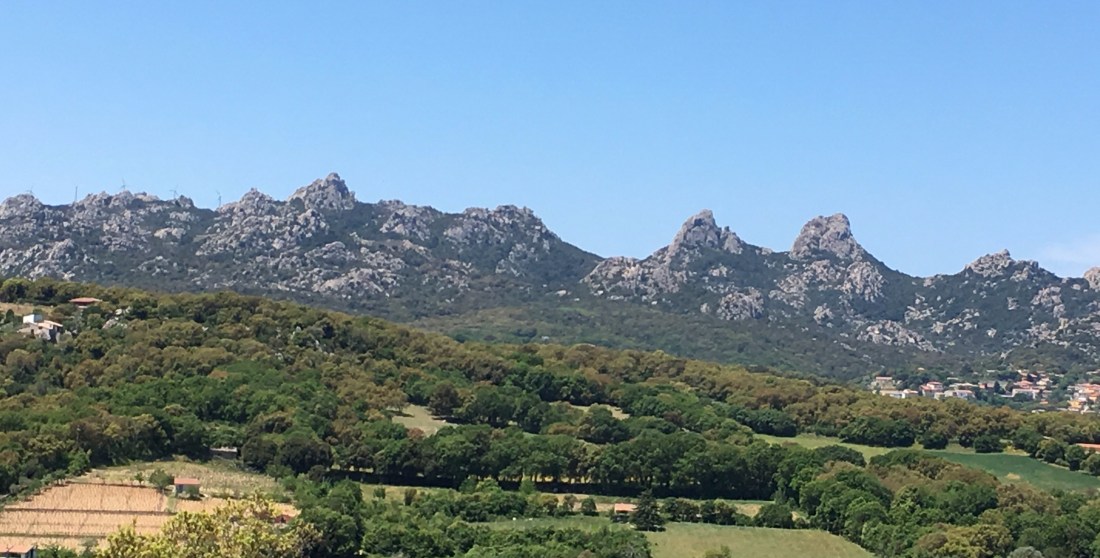
There is much less agriculture in Sardinia than we saw elsewhere in Italy…..in Sardinia, small wheat fields mostly…..and those fields often host rocks and huge boulders. There is so much stone on Sardinia that some places hold up barbed-wire fences with stone posts, not wood; and in many places the fences are entirely of rocks. The limestone buttresses of Sardinia — many miles of high hills topped with sharp peaks — are spectacular.
There is far less Greek influence on Sardinia than on Sicily and the mainland of Italy. Ruins are from the Spanish, Romans, Carthaginians, Phoenicians and even earlier civilizations. There are on Sardinia remains of at least 7,000 squat conical towers called “nuraghi,” dating to as early as 1800 BC. Their builders left no written language but more than 1500 of their bronze figures have been found in caves across Sardinia.
JER


