
Europeans “discovered” what is now South Africa about the same time they came to and began colonizing and exploiting the Americas. There is not much that has occurred in South Africa since that is different than what has occurred in US history, except in detail and especially in degree, which is probably why people refer to South America as a nation of extremes.
What we now know to be absurd laws are a stain on both nation’s histories. In the 18th Century the framers of the US Constitution compromised to count some black Americans as three-fifths of whole persons, but there was a time as late as the 20th Century when South African lawmakers did not grant black persons any countenance at all. At almost the same time that the United States’ majority white government was finally overturning various states’ discriminatory “Jim Crow” laws, South Africa’s minority white government was imposing apartheid as the law of the land nationwide.
Class distinctions are found in both countries, of course; but in South Africa, the gap appears to be not only wider but also closer to home: even in Cape Town suburbs, the garage or storage shed of one property owner may be finer than a next door neighbor’s entire family residence.
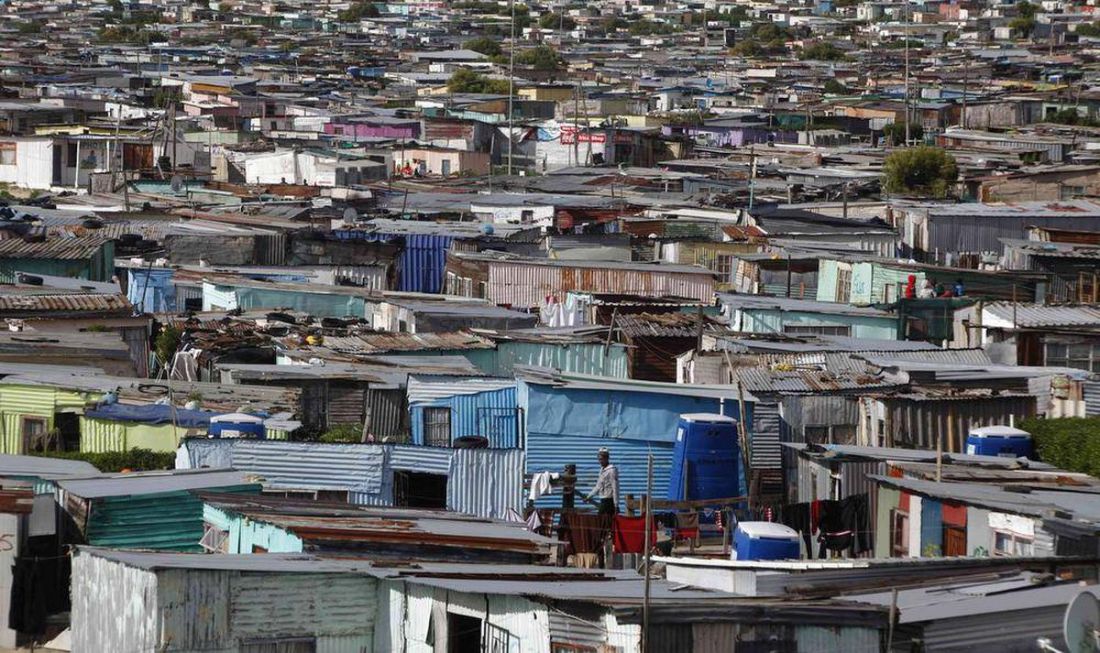
Yet, never in all my years of travel throughout the US have I seen anything that compares with South Africa’s “townships.” These are the places — usually on the periphery of towns — where non-whites (Indians, Africans and “Coloureds”) were sent to live during late 19th Century until the end of apartheid, and from which many of those people or their descendants have been unable to escape. The worst of the terrible townships are several square miles of squalid and densely situated mud or metal-sided shacks topped with make-shift metal roofs, often secured by large rocks. Across some of these roofs, wires are strung like Christmas decorations to steal electricity if there is a nearby power pole. The local sanitation department is often a string of stinking port-a-potties.
To be fair, in other places — although often on unwanted rocky, treeless hillsides — the government is slowly replacing township shacks with less densely spaced modest houses equipped with electricity and indoor plumbing. The design of hundreds of the new houses will be identical, but occasionally the dwellings vary in color. Still, this upgraded sprawl cannot remove from my mind the picture of township conditions we viewed in too many other places of South Africa.
I have read of the vibrant life in some areas of some townships, and also accounts about people who — given the choice — have chosen not to leave their township roots. I know that Soweto Township boasts of having the African continent’s largest hospital, and that it’s a teaching hospital to boot; but I’m not sure that size is really an indicator of quality of care or quality of life. Rather, size may be an indicator of need. . .of rampant nearby illness and injury.
JER
 ALL OVER THE MAP
Hi Jack, I couldn’t agree more.
LikeLike
I agree. Thanks for such a thoughtful post.
LikeLike