Politeness

Swedes are quite possibly the most polite people on the planet.  The waiters, waitresses, hotel receptionists and others we met in the hospitality industry really were, well, hospitable. Without exception….as was the case with clerks, tellers, event workers and all others with whom we interacted.

Not only do Swedish drivers stop for pedestrians who are entering crosswalks; the drivers stop for pedestrians who are merely approaching crosswalks and might just be thinking about the possibility of crossing the street.  After a few days of this in Sweden’s larger cities, I would see a car slow down for me and I would think, “Oh, I guess I should cross the road now.”

The GPS which came with my new Swedish-made car not only has a sweet accented voice, the voice actually precedes many directions with the word “Please.”  Like, “Please stay left.” And, “Please take the second exit at the round-about in 200 meters onto the one-six-four.”

After two weeks of this in Sweden, I began to wonder if my own behavior, which is pleasant if not always perfectly patient, might appear almost boorish in this supernaturally courteous country.

JER
 

Off Season

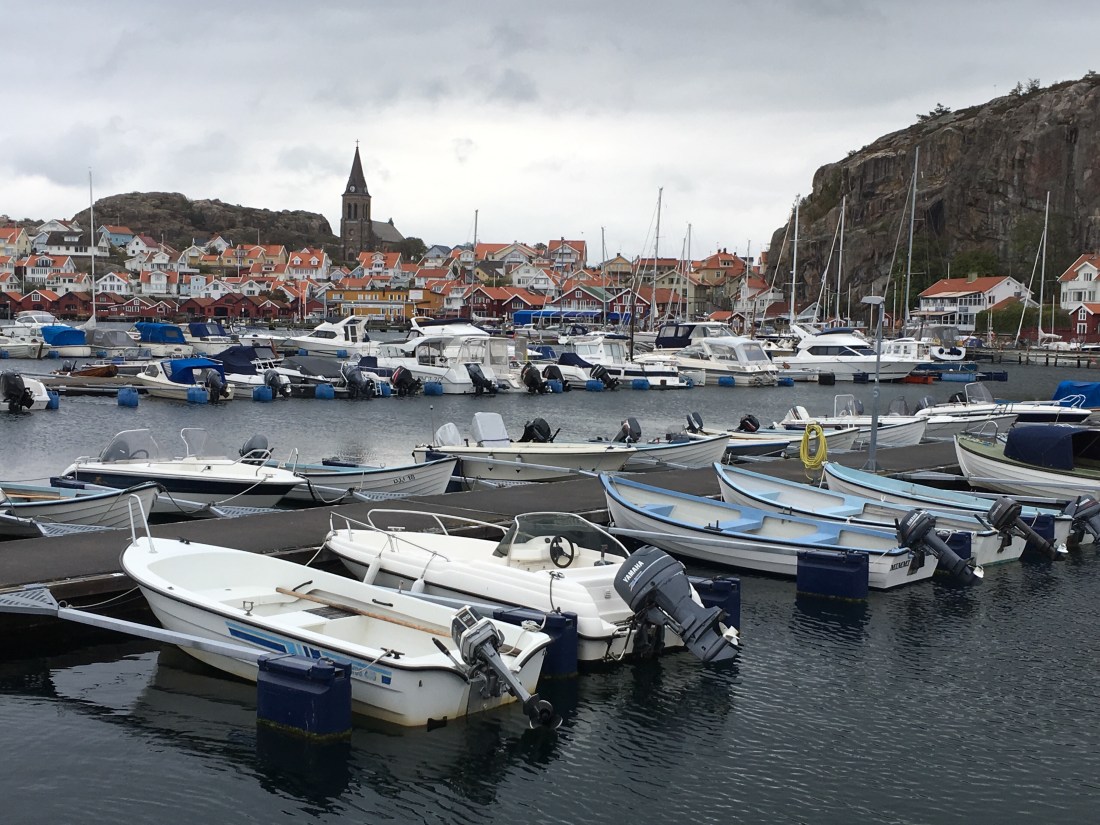
I enjoy traveling during the uncrowded off-season, but that was not my intention in Sweden this summer.  Turns out that the season with the longest days is a very short one in Sweden, where the Artic Circle slashes across the nation’s northern quarter.

By mid-August, when light still dominates the Swedish sky both early and late each day, employees have already returned to city jobs from their summer holidays, and staff and services are scaled back at Swedish vacation destinations. Students are back in session a week later.

Dinner reservations are no longer needed. Exorbitant Swedish prices for merchandise are discounted 40 to 70 percent in shops opposite the harbors of small villages, where few boats are on the move.

My first thought was, if this were Michigan in the USA, the tourism lobby would go nuts.  But after a week of weather that felt more like November in Michigan, I could see why, by late August, most of Sweden’s resort towns are already sealed up and sleepy.

JER


Motorway Metaphor

The new automobile I just purchased comes with a feature that provides two warnings when the car begins to drift.  There’s a wobble in the ride and the steering works against the driver when the vehicle wanders over the center or shoulder striping. The feature is disarmed if the driver uses the turn signal first.
There is a something here to suggest for leaders: that it will be a smoother ride, and fewer opposing forces will be at work, if leaders signal their intentions before allowing their organization to veer off course or taking it in a new direction.
JER

Cash or Credit

In the USA we encounter establishments which don’t accept credit cards.  In Sweden it is more common to be in a place that does not take cash.

In Gothenburg, for example, at a huge hotel that is part of world-wide chain, and at a casual corner Peruvian bistro where we stopped for drinks, bites and memories of our Inca Trail trek last spring, it was no cash but credit cards only.

In Stockholm one cannot use  cash to ride public transportation. Or to purchase food or drink at the Culture Festival. Or to enter most museums or theaters.

And  between these two largest of Sweden’s cities, along the country’s motorways, the only way to purchase fuel is with a credit card.

In the USA one can get along without a credit card more easily than without cash. In Sweden it may be possible to travel the country without cash, but a traveler without a credit card will not get very far.

JER


FA6FC1FB-71A1-4F1D-99F2-337DB8F2AE14
Especially tasty after the Inca Trail trek.

Missed Connections

From the expansive porch addition fronting the massive former post office which is now a hotel and dominates Drottningtorget, the central square in Gothenburg, Sweden, one can observe what place-making — the buzz-word of urbanization in the USA — really requires. Here there are three anchor hotels and two other hotels in sight. Here the city tram lines, local and inter-city bus lines, and both inter-city and out-of-country train lines come together. Packs of people depart one mode of transportation and traverse the plaza to connect with another.

By contrast, in my USA community, the bus station of one city has been rebuilt just four miles from a bus and train depot just rebuilt in the adjacent town, which also has a separate airport commuter bus stop two miles away. The inter-city and state train line here miss-connects with one in another town by thirty miles. Each independent effort discourages use of itself and the other transportation systems.

In my community, as in others in the USA (the Detroit metropolitan area, for example), people reject regionalization, seeing only what they must give up. If they would lose their self-interest they would gain much more, both for themselves and others.

JER

Packing

The biggest difference in packing for our European summer this year compared to our first trip as honeymooners decades ago is the pills.  Each of us prepared sandwich bags of vitamins, supplements and anti-inflammatories, as well as several small bottles of prescription medicine.  Only birth control pills were needed the first time around.

JER