
It has been said — millions of times, I suppose — “All roads lead to Rome.”
This proverb dates to at least the Middle Ages. Something close to it was put in writing by a French theologian in the 12th Century AD. I suppose it had some factual validity during the height of the Roman Empire a thousand years earlier.
The meaning – and it’s as true for elementary school children as university post-graduate students, and in the work place for blue and white color workers alike, and for both local or world travelers – is that there are many different ways to get to the same answer, solution or destination.
All of this is fine and good, but we spent most of a recent three-week road trip headed away from Rome. Our intent was to focus on what we had not visited before…..the less-traveled countryside and small towns nearer the toe of Italy and on the islands of Sicily and Sardinia. Until the final day of our travels, if we saw a sign that pointed toward Rome, we headed the other way.
Sea-side Seating
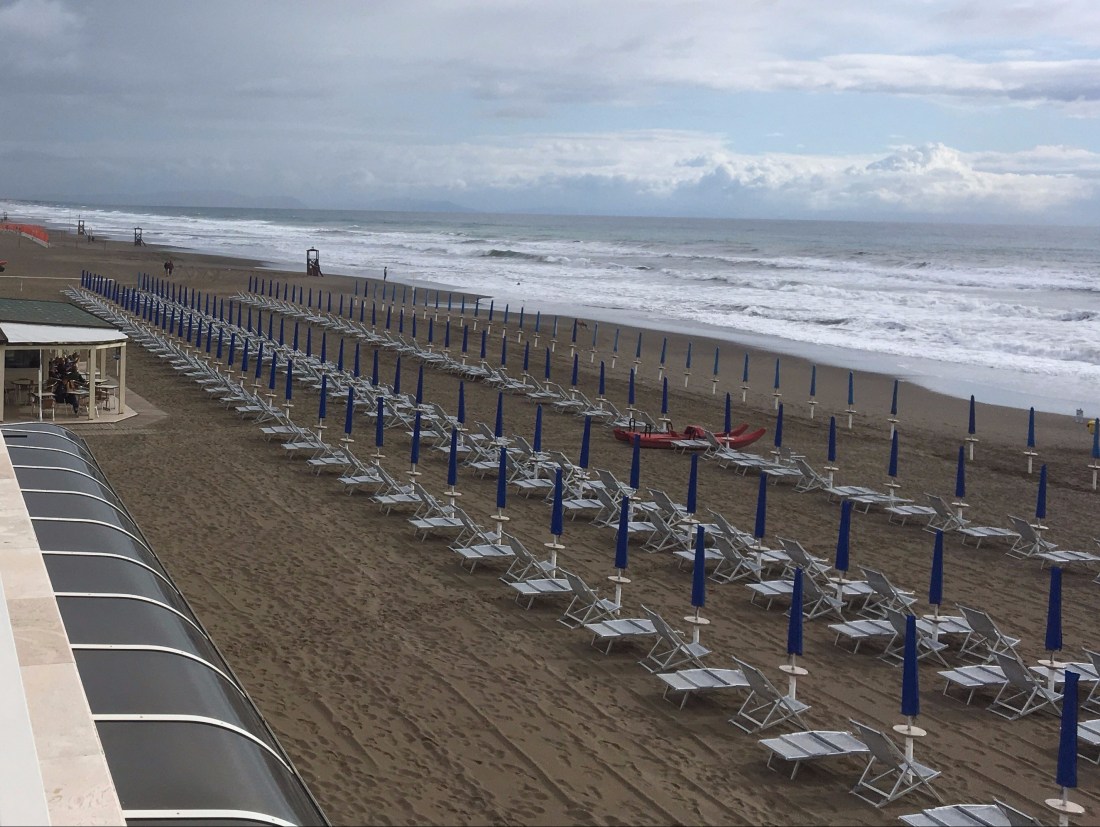
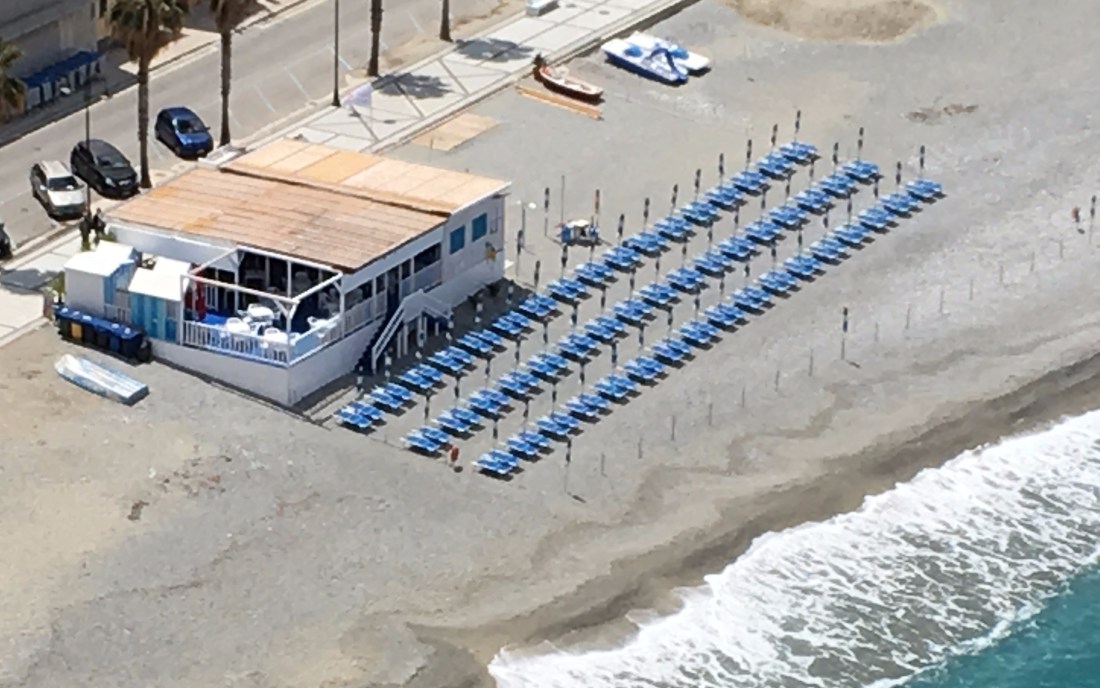
Every day in May, rain or shine and no matter how chilly, all along the Italian Mediterranean shoreline, those who control Italian beach properties set out in perfectly aligned rows, every lounge chair and umbrella in their arsenal. Some places it’s three or four dozen chairs; other places it’s more than two hundred.
But most days in May, at every one of the beaches, every one of the chairs goes unused, all day.
I understand that, during Europe-wide holidays in August, a capacity crowd might be expected. But why set up all the chairs at the start of every day, and remove them every evening, day after day, in May? What’s the purpose?
Is this make-work job security that we’ve seen so much of in countries outside the USA?
Does the local chamber of commerce or tourism bureau require this to demonstrate capacity?
Or, might this be just a male thing, like a marking of one’s territory?
The Cork Screw
Because my favorite wines are sauvignon blanc from the Marlborough region of New Zealand, where screw-off tops rather than cork stoppers are considered the state of art, I have not been thinking much about the corkscrew. But while recently in rural and small town Italy — where New Zealand wines are impossible to find, cork trees provide a cash crop and cork is still king when it comes to sealing wine bottles — I purchased a bottle of white wine at a market…..and later struggled mightily, and unsuccessfully, to open the bottle.
Try to remove the cork from a wine bottle without one and you come to appreciate what a marvelous invention the cork screw is. Seems like a simple enough device, and marketers have added bells and whistles. But the essential ingredient of the device – the screw – has never been bettered.
Whoever it was who invented the corkscrew is unknown. It is believed that what became useful to open wine bottles was a modification of a device widely used to dislodge bullets stuck in rifles. The earliest known patent for a corkscrew as a bottle opener was attained by an Englishman in the 1700’s. He should have become a rich man.
JER
 ALL OVER THE MAP