
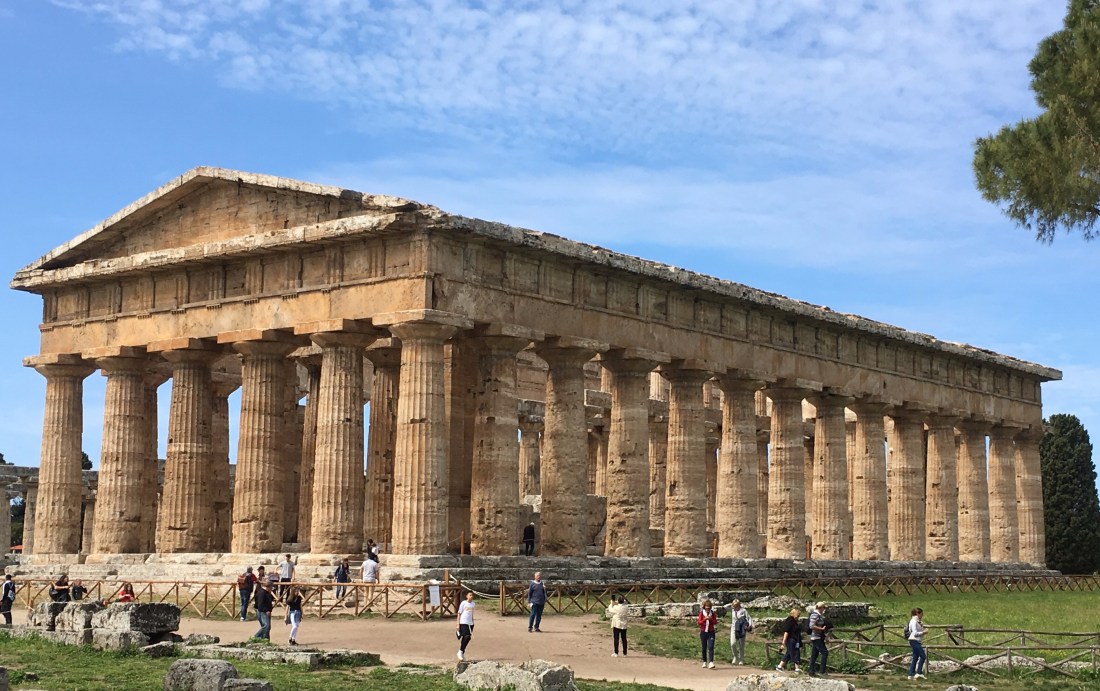
Italy’s elderly dress and act as if they have just attended a funeral. Dour expressions and dark clothing, day-time and evening, at work or…..I hesitate to use the word….at “play.”
Perhaps they have been humbled by history, which for Italy has been long and catastrophic, and well documented by cultures which have valued the written record.
Entire cities — some of the peninsula’s greatest — have been lost to natural disasters and human frailities.
Amalfi, located on the now famous coastline that bears its name, was a city of 70,000 citizens when it slid into the sea in 1343, victim of an earthquake. Previously it had been a center of commercial trading, a superpower among cities in the Mediterranean region. Rebuilt, and now a town of 5,000 year-round residents, Amalfi has become a center of tourism, swelling to more than 10,000 overnighters during the high summer season…..but still just a fraction of its former glory.
Less than a hundred miles away but 14 centuries earlier, Pompeii was entirely consumed over two days in August of 79 AD when nearby Mount Vesuvius erupted and buried the city. Pompeii had been a bustling metropolis noted for cultural events and sporting spectacles which filled its large civic arena. It is now a tourist attraction and archeological treasure.
Between these calamities, of course, the fall of the Roman Empire which, from the perspective of preserved record, was the most polished and powerful civilization on Earth — at least it controlled all of the Mediterranean world for four centuries — but whose influence was trimmed and eventually toppled by the arrogant over-reach of its leaders and the self-indulgence of its citizens.
Further south along the Tyrrhenian coast near the ankle of Italy’s boot, what remains of the Castle of Amantea looms large over today’s town of Amantea. The castle was once important to the Byzantines (early Turks), Arabs, Normans (early French), Swabians (early Germans), Angevins (early French), Aragonese (early Spanish) and Bourbons (also early French). The castle was severely damaged in earthquakes of 1638 and 1783 and finally left to disintegrate after the failed seige by Napolean’s troops ended in 1807.
And then there’s Sicily…..not one of its several prominent and powerful civilizations has survived, and reminders are everywhere. There are many places where deeply burried ruins of the Roman Empire rest atop ruins of earlier Greek colonies, and sometimes there’s evidence of an intermediate occuption by the Carthaginians. Earthquakes have buried many parts of Sicily, including 90% of the eastern port city of Messina where 70,000 people perished in 1908. Mt Etna, still an active volcano, has experienced major explosions at least a dozen times during the past two dozen centuries, sometimes lasting months, and at least once covering or crushing everything between it and the Ionian Sea 70 miles away.
Song-writer Paul Simon, accomplished as any of the greatest poets of Ancient Rome or more recent Italian history, wrote……
“God only knows, God makes his plan/ The information’s unavailable to the mortal man/ We’re working our jobs, collect our pay/ Believe we’re gliding down the highway/ When in fact we’re slip slidin’ away.”
JER
 ALL OVER THE MAP