
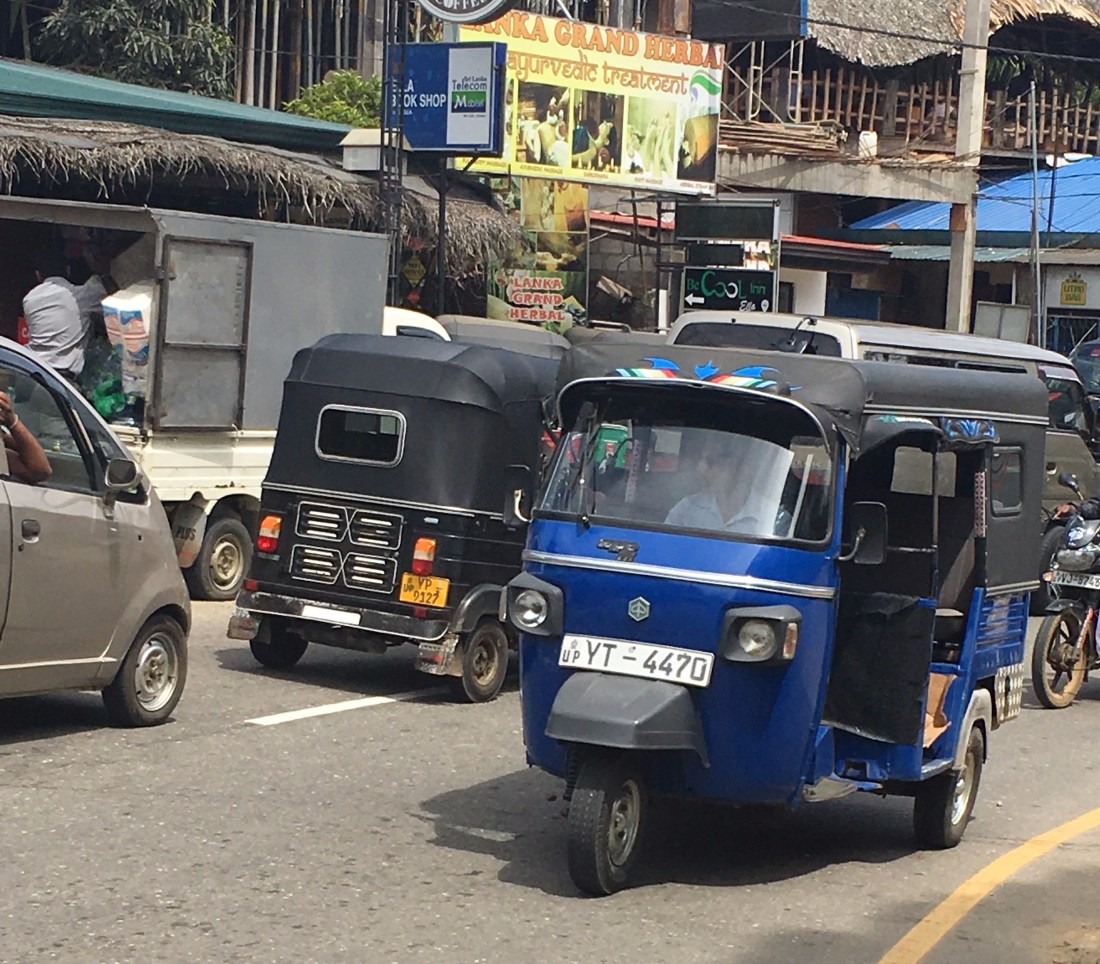
Calmed by two Dramamine and a large bottle of local Lion lager, I took to the left lane of Highway A2 to commence the circle tour of the southwest quadrant of the small, pear-shaped nation of Sri Lanka, just off the southeast coast of India.
Our plans to do this without a guide and driver had caused raised brows and widened eyes among everyone in the capital city of Colombo who had inquired about our itinerary, and it didn’t take long to understand why. But it’s not a decision we regretted for even one moment.
It is true that traffic lanes are merely suggestions — that two lanes of highway often translates into four or five vehicles across the road…..bicycles, motor cycles, three-wheel tuk-tuks, cars, trucks and – most menacing of all – buses – all swerving around nonchalant pedestrians (many women elaborately draped), oblivious live stock and ubiquitous dogs (often lame), all claiming the right-of-way with a honking cacophony of drivers’ thoughts and threats.
Road-side stands selling everything from robust fruits and vegetables to local crafts, used tires, household necessities and tacky inflatable toys, crowd to the edges of busy streets; and shoppers think nothing of parking on the pavement, further restricting passage. People conduct conversations on the roadway pavement without regard to traffic, as if they care more about personal relationships than vehicular progress. Imagine that.
Small traffic information signs compete with myriad commercial signs and huge billboards for drivers’ attention. English is absent from at least half the signs. As it should be.
The roads themselves are smooth as can be, missing the minefields of cracks and potholes we are accustomed to in the USA. Our air-conditioned Suzuki brand car gave us relief from Sri Lanka’s sweltering February and March mid-day heat when outdoor excursions are otherwise out of the question. And we found places that were well out of the way for most US tourists.
At the southern tip of Sri Lanka, just beyond Tangalle, where the beach road turns from pavement to dirt, just after the spot where the washed-out road is being replaced with a new bridge, we found our accommodations at a five-year old concrete and brick hacienda that stands on property where the 2004 tsunami had washed away a private residence of less sturdy construction. We were just the second guests from the USA to visit here in the five years of this establishment’s operation.
Above the country’s ancient capital of Kandy, at the end of a twisting road set at a 60-degree incline that nearly fought our car to a draw, we found a villa constructed by a gracious German who converted his residence and office to a tourist inn when the brutal civil disturbances of Sri Lanka began to subside a dozen years ago. I have the feeling our host has a story, and I fantasize about recording it.
JER
 ALL OVER THE MAP