
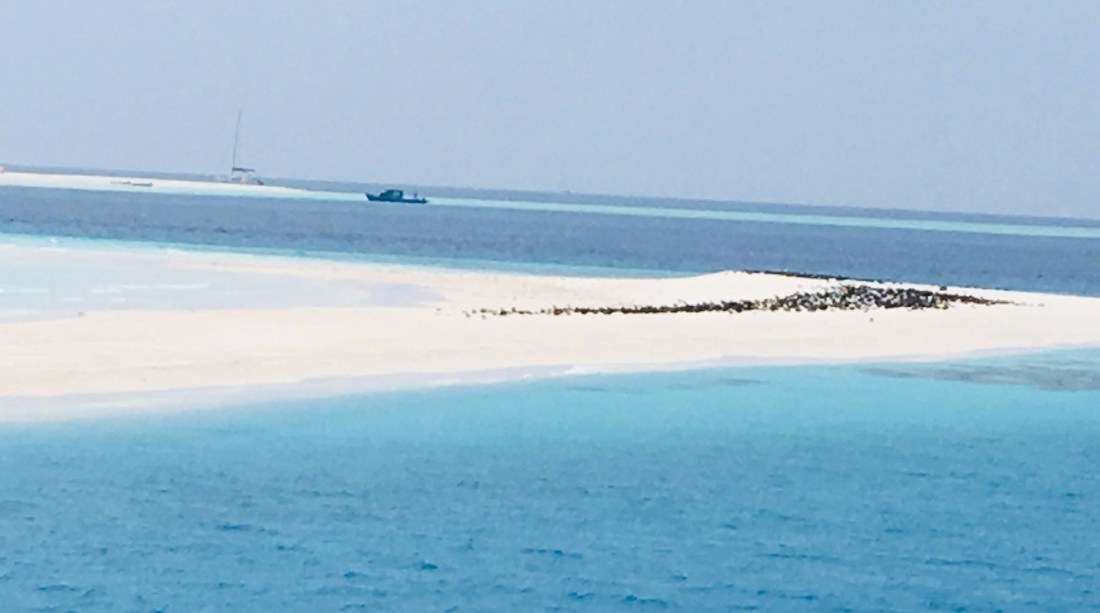
I will always cherish Maldives for providing my first open-water scuba diving experience. The master diver who acompanied me on three hour-long dives made me feel comfortable and free as we explored more than 65 feet beneath the ocean surface.
But Maldives brought home to me (again) how terribly our planet is being harmed and changed.
Maldives is an independent island nation in the Indian Ocean whose maximum elevation is just eight feet above sea level. It’s comprised of 26 atolls, consisting of more than 1,000 islands and countless coral-rimmed shallow turquoise pools which appear to be lighted from beneath. Here is where the snorkeling and diving is best, and here is where the picture is most disheartening.
The coral here is damaged, or already dead and distintegrating. It’s not 10 or 20 percent dead or dying, but well over 90 percent light-brown skeletons of deceased coral, covered with white powder. What seems to be an endless array of gloriously decorated fish stands out starkly against a background on which tan and dirty white dominate the palette, with dusty olive accents.
The cause is warming sea water. The Indian Ocean is the most rapidly warming ocean on the planet. I’m not smart enough to explain why this is so, but it is. Weather patterns affected by global warming have changed world-wide ocean currents that have resulted in the Indian Ocean actually “stealing” heat from the Pacific Ocean and some of the earth’s land masses. While this has slowed the rise of temperatures on land and sea elsewhere around the world, it is raising havoc in the Indian Ocean.
JER
 ALL OVER THE MAP